Category Archives: Mediterranean Diet

Right Diet Preserves Brain Function and Size

mp9004223691.jpg  Neurology last year reported that the proper diet seems to help prevent age-related brain shrinkage and cognitive decline.

From the press release:

People with diets high in several vitamins or in omega 3 fatty acids are less likely to have the brain shrinkage associated with Alzheimer’s disease than people whose diets are not high in those nutrients, according to a new study published in the December 28, 2011, online issue of Neurology, the medical journal of the American Academy of Neurology.

Those with diets high in omega 3 fatty acids and in vitamins C, D, E and the B vitamins also had higher scores on mental thinking tests than people with diets low in those nutrients. These omega 3 fatty acids and vitamin D are primarily found in fish. The B vitamins and antioxidants C and E are primarily found in fruits and vegetables.

So the dietary pattern linked to preservation of brain size and function in this study is: high omega-3 fatty acids and vitamins B, C, D, and E. I don’t know if study participants were getting these nutrients from supplements or from food or a combination. (I haven’t read the full article.)

Note that the time-honored Mediterranean diet is also associated with lower rates of dementia and slower rate of age-related mental decline.

I previously reported that a supplement cocktail of three B vitamins slowed the rate of brain shrinkage

Steve Parker, M.D.

Reference: Bowman, G.L., et al. Nutrient biomarker patterns, cognitive function, and MRI measures of brain aging. Neurology. doi: 10.1212/WNL.0b013e3182436598

h/t to Randall Parker at FuturePundit

3 Comments

Filed under Dementia, Health Benefits, Mediterranean Diet

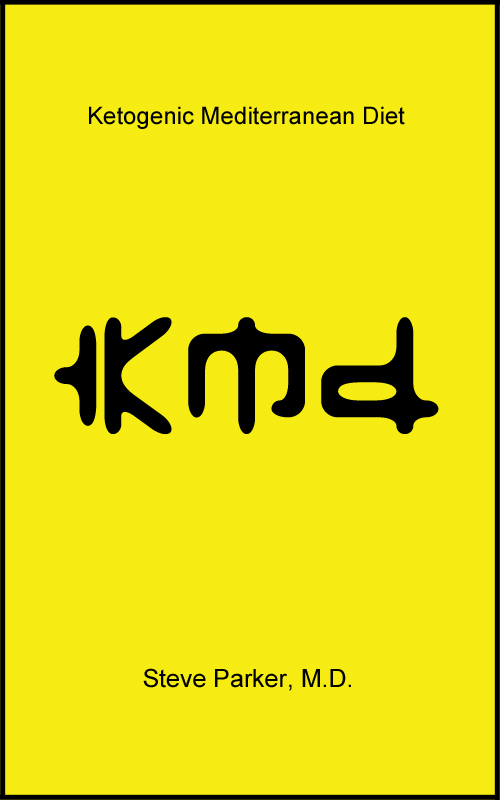
Ketogenic Mediterranean Diet Now in Book Form

A number of my patients and blog readers have asked for a more comprehensive presentation of the Ketogenic Mediterranean Diet. The KMD, as you may be aware, is the basis for the Low-Carb Mediterranean Diet.  Both of them are in Conquer Diabetes and Prediabetes: The Low-Carb Mediterranean Diet.

Odd cover, huh?

The new book is geared for folks who don’t have diabetes, but want to lose weight with a very-low-carb diet.  It’s called KMD: Ketogenic Mediterranean Diet.  Readers of Conquer Diabetes and Prediabetes will get nothing out of the new book: they’ve seen it all before.  Here’s the book description from Amazon.com:

Dr. Steve Parker presents the world’s first low-carbohydrate Mediterranean diet. Nutrition experts for years have recommended the healthy Mediterranean diet. It’s linked to longer life span and reduced rates of heart attack, stroke, cancer, diabetes, and dementia. Dr. Parker (M.D.) has modified the Mediterranean diet to help you lose excess weight while retaining most of the healthy foods in the traditional Mediterranean diet. What’s the secret? Cut back on the fattening carbohydrates such as concentrated sugars and refined starches.

You’ll discover how to manage your weight without exercise, without hunger, without restricting calories, while eating fish, meat, chicken, vegetables, fruits, wine, olive oil, nuts, and cheese.

The book includes advice on how to avoid weight regain, instruction on exercise, a week of meal plans, special recipes, a general index, a recipe index, and scientific references. All measurements are given in both U.S. customary and metric units. This low-carbohydrate Mediterranean diet is included also in Dr. Parker’s Advanced Mediterranean Diet (2nd edition) and Conquer Diabetes and Prediabetes. Are you finally ready to lose weight while eating abundantly and without counting calories?

♦   ♦   ♦


KMD: Ketogenic Mediterranean Diet is available for purchase at Amazon.com (Kindle edition here, also) or Barnes and Noble (Nook version here).  The ebook version is available in multiple formats at Smashwords

Steve Parker, M.D.

2 Comments

Filed under ketogenic diet, Mediterranean Diet, My KMD Experience, Shameless Self-Promotion, Weight Loss

Does Olive Oil Protect Against Stroke?

Older adults with high olive oil consumption have a lower risk of stroke, according to French investigators.

The Mediterranean diet, rich in olive oil, has long been linked to lower rates of stroke and other health benefits.  The French researchers wondered stroke prevention might be attibutable to higher olive oil consumption.  Triglyceride esters of oleic acid comprise the majority of olive oil, and oleic acid blood levels reflect olive oil consumption. 

Have you heard of monounsaturated fatty acids?  Oleic acid is one.

Methodology

Over 7,000 older adults without history of stroke were surveyed with regards to olive oil consumption.  Oleic acid plasma levels were measured in over a thousand of the study participants.  Over the course of five years, 175 strokes occurred.

Compared with those who never used olive oil, those with the highest consumption had a 41% lower risk of stroke.  The researchers made adjustments for other dietary variables, age, physical activity, and body mass index.

In looking at the plasma oleic acid levels, those in the highest third of levels had 73% lower risk of stroke compared to those in the lowest third.

Comments

Results suggest that the olive oil in the Mediterranean diet  may help explain the diet’s protection against stroke.  They also support my inclusion of olive oil in the Low-Carb Mediterranean Diet and Advanced Mediterranean Diet.

Steve Parker, M.D.

Reference:  Samieri, C. et al.  Olive oil consumption, plasma oleic acid, and stroke incidence: the Three-City StudyNeurology, Published online before print June 15, 2011, doi: 10.1212/WNL.0b013e318220abeb

3 Comments

Filed under Health Benefits, Mediterranean Diet, olive oil, Stroke

How Are Green and Black Olives Different?

Laura Dolson over at About.com explains the differences and briefly discusses olive processing in a recent post.

Olives, of course, are time-honored components of the Mediterranean diet.  I’ve had a few good crops in my backyard here in Arizona.

Steve Parker, M.D.

2 Comments

Filed under Mediterranean Diet, olive oil

Mediterranean Diet Linked to Brain Preservation

 The Mediterranean diet slowed age-related mental decline in elderly Chicago residents, according to researchers at Rush University Medical Center.  The investigators noted that a Manhattan population following the Mediterranean diet also showed slower mental decline and lower rates of Alzheimers dementia.

Over 3,000 study participants (2,280 blacks, 1,510 whites) were studied for an average of eight years.  Food consumption was determined by questionnaires, and mental function was tested every three years.  Adherence to the Mediterranean diet was judged according to a Mediterranean diet score developed by Panagiotakis, et al.

The greater the adherence to the Greek-style Mediterranean diet, the lower the rate of mental decline over the course of the study.

Mental decline to some extent is a normal part of aging.  If we can avoid it or lessen it’s impact, why not?  A couple ways to do that are regular exercise and the Mediterranean diet.

Would a low-carb Mediterranean diet work just as well or better?  Nobody knows yet.

Steve Parker, M.D.

Reference:  Tangney, Christine, et al. Adherence to a Mediterranean-type dietary pattern and cognitive decline in a community population.  American Journal of Clinical Nutrition, 2010.  doi 10.3945/ajcn.110.007369


3 Comments

Filed under Health Benefits, Mediterranean Diet

Mediterranean Diet Linked to Less Sudden Cardiac Death in Women

"Trust me. You don't want sudden cardiac death until you're very old!"

A Mediterranean-style diet is one of four factors helping to greatly reduce the risk of sudden cardiac death in women, as reported by Reuters on June 5, 2011. The other factors reducing risk were maintainence of a healthy weight, regular exercise, and not smoking.

The study involved women only, so we don’t know if the research, reported in the Journal of the American Medical Association, applies to men.  I bet it does.

This study confirms many earlier ones linking the Mediterranean diet with longevity and reduced rates of heart disease.

Steve Parker, M.D.

Comments Off on Mediterranean Diet Linked to Less Sudden Cardiac Death in Women

Filed under coronary heart disease, Health Benefits, Mediterranean Diet

Mediterranean Diet Ranks No.2 Overall

US News and World Report a couple months ago ranked 20 popular diets for weight loss, overall healthfulness,  and diabetes and heart disease management.  Overall best diet was awarded to the DASH diet. Mediterranean came in No.2. 

The Mayo Clinic has free info on the DASH diet.  Here’s my definition of the Mediterranean diet.

Steve Parker, M.D.

6 Comments

Filed under Mediterranean Diet

Everything You Ever Wanted to Know About Olives But Were Afraid to Ask…

Olives and olive oil are iconic components of the the Mediterranean diet.  Nutrition Diva Monica Reinagel has a wonderful post about olives and olive oil.  What are the best olives to eat?  How are olives processed?  Are olives more heathful than olive oil?  Click through for the answers.

-Steve Parker, M.D.

3 Comments

Filed under Mediterranean Diet

Spanish Ketogenic Mediterranean Diet Cures Metabolic Syndrome

The very-low-carb Spanish Ketogenic Mediterranean Diet cures metabolic syndrome, according to investigators at the University of Córdoba in Spain. 

The metabolic syndrome is a collection of clinical factors that are linked to high risk of developing type 2 diabetes and heart disease.  Individual components of the syndrome include elevated blood sugar, high trigylcerides, low HDL cholesterol, high blood pressure,  and abdominal fat accumulation.

Spanish researchers put 26 people with metabolic syndrome on the Spanish Ketogenic Mediterranean Diet for twelve weeks and monitored what happened.  At baseline, average age was 41 and average body mass index was 36.6.  Investigators didn’t say how many diabetics or prediabetics were included.  No participant was taking medication.

What’s the Spanish Ketogenic Mediterranean Diet?

Calories are unlimited, but dieters are encouraged to keep carbohydrate  consumption under 30 grams day.  They eat fish, lean meat, eggs, chicken, cheese, green vegetables and salad, at least 30 ml (2 tbsp) daily of virgin olive oil,  and 200-400 ml of red wine daily ( a cup or 8 fluid ounces  equals 240 ml).  On at least four days of the week, the primary protein food is fish.  On those four days, you don’t eat meat, chicken, eggs, or cheese.  On up to three days a week, you could eat non-fish protein foods but no fish on those days. 

How’s this different from my Ketogenic Mediterranean Diet?  The major differences are that mine includes one ounce (28 g) of nuts daily, less fish overall, and you can mix fish and non-fish protein foods every day.

Regular exercisers were excluded from participation, and my sense is that exercise during the diet trial was discouraged. 

What Were the Results?

Metabolic syndrome resolved in all participants.

Three of the original 26 participants were dropped from analysis because they weren’t compliant with the diet.  Another one was lost to follow-up.  Final analysis was based on the 22 who completed the study.

Eight of the 22 participants had adverse effects.  These were considered slight and mostly appeared and  disappeared during the first week.  Effects included weakness, headache, constipation, “sickness”, diarrhea, and insomnia. 

Average weight dropped from 106 kg (233 lb) to 92 kg (202 lb).

Body mass index fell from 36.6 to 32.

Average fasting blood sugar fell from 119 mg/dl (6.6 mmol/l) to 92 mg/dl (5.1 mmol/l).

Triglycerides fell from 225 mg/dl to 110 mg/dl.

Average systolic blood pressure fell from 142 mmHg to 124.

Average diastolic blood pressure fell from 89 to 76.

So What?

A majority of people labeled with metabolic sydrome continue in metabolic sydrome for years.  That’s because they don’t do anything effective to counteract it.  These researchers show that it can be cured in 12 weeks, at least temporarily, with the Spanish Ketogenic Mediterranean Diet.

ResearchBlogging.orgVery-low-carb diets are especially good at lowering trigylcerides, lowering blood sugar, and raising HDL cholesterol.  Overweight dieters tend to lose more weight, and more quickly, than on other diets.  Very-low-carb diets, therefore, should be particularly effective as an approach to metabolic syndrome.  It’s quite possible that other very-low-carb diets, such as Atkins Induction Phase, would have performed just as well as the Spanish Ketogenic Mediterranean Diet.  In fact, most effective reduced-calorie weight-loss diets would tend to improve metabolic syndrome, even curing some cases, regardless of carb content

Most physicians recommend that people with metabolic syndrome either start or intensify an exercise program.  The program at hand worked without exercise.  I recommend regular exercise for postponing death and other reasons.

Will the dieters of this study still be cured of metabolic syndrome a year later?  Unlikely.  Most will go back to their old ways of eating, regaining the weight, and moving their blood sugars, triglycerides, and HDL cholesterols in the wrong direction.

Steve Parker, M.D.

Reference: Pérez-Guisado J, & Muñoz-Serrano A (2011). A Pilot Study of the Spanish Ketogenic Mediterranean Diet: An Effective Therapy for the Metabolic Syndrome. Journal of medicinal food PMID: 21612461

Comments Off on Spanish Ketogenic Mediterranean Diet Cures Metabolic Syndrome

Filed under ketogenic diet, Mediterranean Diet, Overweight and Obesity

Mediterranean Diet for Diabetes

In 2009, Current Diabetes Reports published “The usefulness of a Mediterranean-based diet in individuals with type 2 diabetes,” by Catherine M. Champagne, Ph.D., R.D., L.D.N.  Unfortunately, the full article isn’t available to you at no cost.  But I read it.  Her article is a review of available scientific evidence related to the Mediterranean diet as applied to a diabetic population.  Here’s a quote:

This diet is a viable treatment option; advisors should stress not only adherence to a fairly traditional Mediterranean eating plan but also a lifestyle that includes sufficient physical activity.

I’ve been publishing my series on exercise here in dribs and drabs for the last several months.

Dr. Champagne was very favorably impressed with the DIRECT trial of Shai et al, which I covered extensively elsewhere.  DIRECT compared three diets over 24 months: Atkins, Mediterranean/calorie-restricted, and low-fat/calorie-restricted.  Mind you, it was a weight loss study, but a fair number of diabetics participated.  Mediterranean-style eating showed the most beneficial effects for diabetics. 

The author also mentions evidence that a modified Mediterranean diet may help counteract the build-up of fat in the liver, seen in up to 70% of type 2 diabetics.  I wrote recently about how a very-low-carb diet beat the low-fat diet so often recommended for this condition (hepatic steatosis or non-alcoholic fatty liver disease).

ResearchBlogging.orgIf you want full online access to Champagne’s 6-page article, you can purchase it for $34 (USD) at SpringerLink.  I cite many of the same scientific sources and provide a whole lot more in my 216-page Conquer Diabetes and Prediabetes: The Low-Carb Mediterranean Diet, at Amazon.com for $16.95 or $9.99 (the Kindle edition) or in multiple ebook formats from Smashwords.

Steve Parker, M.D.

Reference: Champagne, Catherine (2009). The usefulness of a Mediterranean-based diet in individuals with type 2 diabetes. Current Diabetes Reports DOI: 10.1007/s11892-009-0060-3

1 Comment

Filed under Health Benefits, Mediterranean Diet, Shameless Self-Promotion