Category Archives: Causes of Diabetes

What Causes Type 2 Diabetes?

“Beats me. I teach math!”

I have no simple answer for you, unfortunately.

You can lower your risk of type 2 diabetes significantly by avoiding overweight and obesity, by exercising regularly, and by choosing the right parents.  These provide clues as to the causes of diabetes.  The Mediterranean diet also prevents diabetes.

UpToDate.com offers a deceptively simple answer:

Type 2 diabetes mellitus is caused by a combination of varying degrees of insulin resistance and relative insulin deficiency. [Insulin is the pancreas hormone that lowers blood sugar.] Its occurrence most likely represents a complex interaction among many genes and environmental factors, which are different among different populations and individuals.

So, what causes the insulin resistance and relative insulin deficiency?

Understanding the pathogenesis [cause] of type 2 diabetes is complicated by several factors. Patients present with a combination of varying degrees of insulin resistance and relative insulin deficiency, and it is likely that both contribute to type 2 diabetes. Furthermore, each of the clinical features can arise through genetic or environmental influences, making it difficult to determine the exact cause in an individual patient. Moreover, hyperglycemia itself can impair pancreatic beta cell function and exacerbate insulin resistance, leading to a vicious cycle of hyperglycemia causing a worsening metabolic state.

The UpToDate article then drones on for a several thousand words discussing mouse studies, various genes, free fatty acids, adiponectin, leptin, amylin, insulin secretion, insulin resistance, impaired insulin processing, insulin action, body fat distribution, inflammation, various inflammatory markers, low birth weight, high birth rate, prematurity, etc.  More excerpts:

Increased free fatty acid levels, inflammatory cytokines from fat, and oxidative factors, have all been implicated in the pathogenesis of metabolic syndrome, type 2 diabetes, and their cardiovascular complications.

Insulin resistance may, at least in part, be related to substances secreted by adipocytes [fat cells] (“adipokines” including leptin adiponectin, tumor necrosis factor alpha, and resistin).

Type 2 diabetes most likely represents a complex interaction among many genes and environmental factors.

That’s the simplest answer I can give now.

Steve Parker, M.D.

Reference: “The Pathogensis of Type 2 Diabetes Mellitus”  by David K McCulloch, MD, and R Paul Robertson, MD, at UpToDate.com, updated June 2012, and accessed November 19, 2012.

10 Comments

Filed under Causes of Diabetes

White Rice Linked to Type 2 Diabetes

Did you see this?

http://ca.news.yahoo.com/white-rice-seen-type-2-diabetes-says-study-233837784.html

-Steve

Update March 15, 2012: I read the primary research article and blogged about it at Advanced Mediterranean Life.

2 Comments

Filed under Carbohydrate, Causes of Diabetes

173 Years of US Sugar Consumption

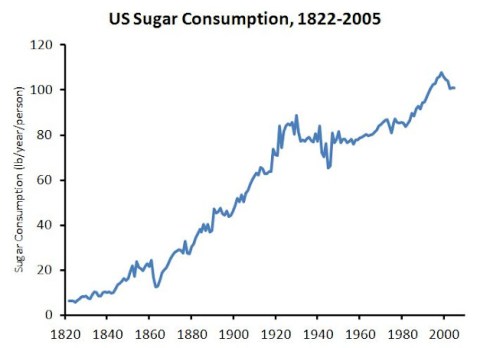
US Sugar Consumption: 1822-2005

 Thanks to Dr. Stephan Guyenet and Jeremy Landen for this sugar consumption graph.  I’d never seen one going this far back in time. 
 
Dr. Guyenet writes:
It’s a remarkably straight line, increasing steadily from 6.3 pounds per person per year in 1822 to a maximum of 107.7 lb/person/year in 1999.  Wrap your brain around this: in 1822, we ate the amount of added sugar in one 12 ounce can of soda every five days, while today we eat that much sugar every seven hours.
The U.S. Department of Agriculture estimates that added sugars provide 17% of the total calories in the average American diet.  A typical carbonated soda contain the equivalent of 10 tsp (50 ml) of sugar.  The average U.S. adult eats 30 tsp  (150 ml) daily of added sweeteners and sugars.
 
Note that added sugars overwhelmingly supply only one nutrient: pure carbohdyrate without vitamins, minerals, protein, fat, antioxidants, etc.
 
Do you think sugar consumption has anything to do with diseases of affluence, also known as diseases of modern civilization?  I do.
 
Was our pancreas designed to handle this much sugar?  Apparently not, judging from skyrocketing rates of diabetes and prediabetes.


4 Comments

Filed under Carbohydrate, Causes of Diabetes, Sugar

Insulin Resistance, Lipotoxicity, Type 2 Diabetes, and Atherosclerosis

This will bore most readers.

I just want to mention a scientific review article from 2009 that reviews insulin activity (down to a molecular level) in the context of type 2 diabetes, atherosclerosis, and insulin resistance.  Towards the end it starts sounding like an informercial for thiazolidinedione drugs

The author makes a great case for the dangers of hyperinsulinemia.

Good reference overall.

R. A. DeFronzo wrote “Insulin resistance, lipotoxicity, type 2 diabetes and atherosclerosis: the missing links. The Claude Bernard Lecture 2009.”   Diabetologia, 2010 (53); 1,270-1,287.  doi: 10.1007/s00125-010-1684-1

Steve Parker, M.D.

1 Comment

Filed under Causes of Diabetes, coronary heart disease

Which Of Three Low-Carb Diets Reduces Future Risk of Diabetes?

Men eating low-carb diets featuring protein and fats from sources other than red and processed meats may reduce risk of developing type 2 diabetes later, compared to other types of low-carb diets.  The same Boston-based researchers previously looked for a similar association in women and found none.

The article in American Journal of Clinical Nutrition seems to me unusually complicated, like the first sentence of this post.  It was frustrating to read, searching for but not finding much useful for clinical practice.  How low-carb were these diets?  Thirty-seven to 43% of energy from carbs in the most dedicated dieters, compared to 50-60% in the standard American diet.

After wading through most of this article, I came away with the impression the authors were just data-mining a huge database, to add one more item to their CVs (curriculum vitae).  This article is a confusing mess, or maybe I’m just stupid. I regret wasting an hour on it.

Steve Parker, M.D.

Reference: De Konig, Lawrence, et al.  Low-carbohydrate diet scores and risk of type 2 diabetes in menAmercan Journal of Clinical Nutrition, 2011. doi: 10.3945/ajcn.110.004333

4 Comments

Filed under Causes of Diabetes, Fat in Diet, Protein

Mediterranean Diet Prevents Diabetes – Again

Spanish researchers report that the Mediterranean diet reduced the risk of developing diabetes by 50% in middle-aged and older Spaniards, compared with a low-fat diet. 

Over 400 people participated in a trial comparing two Mediterranean diets and a low-fat diet.  Over the course of four years, 10 or 11% of the Mediterraneans developed type 2 diabetes, compared to 18% of the low-fatters.  One of the Mediterranean diets favored olive oil, the other promoted nut consumption.

We’ve seen previously that the Mediterranean diet prevents diabetes—not all cases, of course—in folks who have had a heart attack.  It also reduced the risk of diabetes in younger, generally healthy people in Spain.

So What?

The study at hand is not ground-breaking.  It enhances the body of evidence that the Mediterranean diet is one of the healthiest around.  I suppose another way to look at this study would be to say that the low-fat diet caused diabetes.

Learn how to move your diet in a Mediterranean direction at Oldways or the Advanced Mediterranean Diet website. 

Diabetics and prediabetics should consider the Low-Carb Mediterranean Diet; otherwise look into the Advanced Mediterranean Diet if you need to lose weight.

Steve Parker, M.D.

Reference:  Salas-Salvado, Jordi, et al.  Reduction in the incidence of type 2 diabetes with the Mediterranean diet: Results of the PREDIMED-Reus Nutrition Intervention Randomized Trial.  Diabetes Care, epub ahead of print, October 7, 2010.  doi: 10.2337/dc150-1288

2 Comments

Filed under Causes of Diabetes, Health Benefits, Mediterranean Diet, Prevention of T2 Diabetes

Paleo and Low-Carb Diets: Much In Common?

My superficial reading of the paleo diet literature led me to think Dr. Loren Cordain was the modern originator of this trend, so I was surprised to find an article on the Stone Age diet and modern degenerative diseases in a 1988 American Journal of Medicine.  Dr. Cordain started writing about the paleo diet around 2000, I think.

What’s So Great About the Paleolithic Lifestyle?

In case you’re not familiar with paleo diet theory, here it is.  The modern human gene pool has changed little over the last 50,000 years or so, having been developed over the previous one or two million years.  Darwins’ concept of Natural Selection suggests that organisms tend to thrive if they adhere to conditions present during their evolutionary development.  In other words, an organism is adapted over time to thrive in certain environments, but not others.

The paleo diet as a healthy way to eat appeals to me.  It’s a lifestyle, really, including lots of physical activity, avoidance of toxins, adequate sleep, etc. 

The Agricultural Revolution (starting about 10,000 years ago) and the Industrial Revolution (onset a couple centuries ago) have produced an environment vastly different from that of our Paleolithic ancestors, different from what Homo sapiens were thriving in for hundreds of thousands of years.  That discordance leads to obesity, type 2 diabetes, atherosclerosis, high blood pressure, and some cancers.  Or so goes the theory.

What’s the Paleolithic Lifestyle? (according to the article)

  • Average life expectancy about half of what we see these days
  • No one universal subsistence diet
  • Food: wild game (lean meat) and uncultivated vegetables and fruits (no dairy or  grain)
  • Protein provided 34% of calories (compared to about 12 in U.S. in 1988)
  • Carbohydrate provided 46% of calories (only a  tad lower than what we eat today)
  • Fat provided 21% of calories (42% today)
  • Little alcohol, but perhaps some on special occasions (honey and wild fruits can undergo natural fermentation) , compared to 7-10% of calories in U.S. today [I didn’t know it was that high]
  • No tobacco
  • More polyunsaturated than saturated fats (we ate more saturated than polyunsaturated fat, at least in 1988)
  • Minimal simple sugar availability except when honey in season
  • Food generally was less calorically dense compared to modern refined, processed foods
  • 100-150 grams of dietary fiber daily, compared to 15-20 g today
  • Two or three times as much calcium as modern Americans
  • Under a gram of sodium daily, compared to our 3 to 7 grams.
  • Much more dietary potassium than we eat
  • High levels of physical fitness, with good strength and stamina characteristic of both sexes at all ages achieved through physical activity

[These points are all debatable, and we may have better data in 2010.]

The article authors point out that recent unacculturated native populations that move to a modern Western lifestyle (and diet) then see much higher rates of obesity, diabetes, atheroslcerosis, high blood pressure, and some cancers.  “Diseases of modern civilization,” they’re called.  Cleave and Yudkin wrote about this in the 1960s and ’70s, focusing more on the refined carbohydrates in industrial societies rather than the entire lifestyle.  I expect Gary Taubes would blame the processed carbs, too. 

Paleo diet proponents agree that grains are not a Paleolithic food.  The word “grain” isn’t in this article.  The authors don’t outline the sources of Paleolithic carbs: tubers and roots, fruits, nuts, and vegetables, I assume.  Legumes and milk are probably out of the question, too.

Low-carb diet and paleo diet advocates often allign themselves, even though this version of the paleo diet doesn’t appear to be very low-carb.  The two share an affinity for natural, whole foods, and an aversion to grains, milk, and legumes.  Otherwise I don’t see much overlap.

ResearchBlogging.orgA 2010 article by Kuipers et al (reference below) sugggests that the East African Paleolithic diet derived, on average, 25-29% of calories from protein, 30-39% from fat, and 39-40% from carbohydrate.  That qualifies as low-carb.  Modern Western percentages for protein, fat, and carb are 15%, 33%, and 50%, respectively.

You can make a good argument that these paleo concepts are healthy: high physical activity, nonsmoking, consumption of natural whole foods while minimizing simple sugars and refined starches.  The paleo community is convinced that grains and legumes are harmful; many others disagree.  Also debatable are the role of dairy, polyunsaturated to saturated fat ratio, low sodium, and high potassium.  Modern diets tend to be high-sodium and low-potassium, which may predispose to high blood pressure and heart trouble—diseases of modern civilization.

For more on the paleo diet and lifestyle, visit Free the Animal, Mark’s Daily Apple, and PaNu

Steve Parker, M.D.

Update December 18, 2010:  I found a reference suggesting that Paleolithic diets may have derived about a third—22 to 40%—of calories from carbohydrate, based on modern hunter-gatherer societies.  See the Cordain reference I added below.

Reference:

Kuipers, R., Luxwolda, M., Janneke Dijck-Brouwer, D., Eaton, S., Crawford, M., Cordain, L., & Muskiet, F. (2010). Estimated macronutrient and fatty acid intakes from an East African Paleolithic diet British Journal of Nutrition, 1-22 DOI: 10.1017/S0007114510002679.  Note that one of the authors is Loren Cordain.  Good discussion of various Paleolithic diets.

Eaton, S., Konner, M., & Shostak, M. (1988). Stone agers in the fast lane: Chronic degenerative diseases in evolutionary perspective The American Journal of Medicine, 84 (4), 739-749 DOI: 10.1016/0002-9343(88)90113-1

Cordain, L., et al.  Plant-animal subsistance ratios and macronutrient energy estimations in worldwide hunter-gatherer dietsAmerican Journal of Clinical Nutrition, 71 (2000): 682-692.

10 Comments

Filed under Carbohydrate, Causes of Diabetes, coronary heart disease, Overweight and Obesity

High Carbohydrate Eating Increases Risk of Diabetes

ResearchBlogging.orgThe American Journal of Clinical Nutrition reported earlier this month that high consumption of carbohydrates, high-glycemic-index eating, and high-glycemic-load eating increases the risk of developing diabetes.  High fiber consumption, on the other hand, seems to protect against diabetes. 

The article abstract doesn’t mention type 1 versus type 2 diabetes, but it’s probably type 2, the most common kind.

The observational reseach was done in the Netherlands, but I bet the findings apply to other populations as well.  Australian researchers had established years ago that high-glycemic-index and high-glycemic-load eating is associated with onset of diabetes, at least in women

Is high carbohydrate consumption putting too much strain on the pancreas, which produces the insulin needed to process the carbs?

Steve Parker, M.D.

Reference:  Sluijs I, van der Schouw YT, van der A DL, Spijkerman AM, Hu FB, Grobbee DE, & Beulens JW (2010). Carbohydrate quantity and quality and risk of type 2 diabetes in the European Prospective Investigation into Cancer and Nutrition-Netherlands (EPIC-NL) study. The American journal of clinical nutrition PMID: 20685945

1,2,3

3 Comments

Filed under Carbohydrate, Causes of Diabetes

MSDP Protects Against MetSyn (NCEP ATP-III Criteria) in FHSOC

ResearchBlogging.orgTranslation:  A Mediterranean-style dietary pattern protected against onset of metabolic syndrome (as defined by National Cholesterol Education Program Adult Treatment Panel III) in the Framingham Heart Study Offspring Cohort.

Made you look! 

Don’t you just love acronyms?  Lately it seems you gotta have a clever acronym for your scientific study or it won’t get published or remembered. 

Metabolic syndrome is a constellation of clinical traits that are associated with increased risk for developing cardiovascular disease (two-fold increased risk) and type 2 diabetes (six-fold increased risk).  It’squite common—about 47 million in the U.S. have it.  Metabolic syndrome features include insulin resistance, large waist circumference, low HDL cholesterol, elevated fasting blood sugar, high triglycerides, and elevated blood pressure. 

For optimal health, you want to avoid metabolic syndrome.

Boston-based researchers reported in American Journal of Clinical Nutrition last December that followers of the the Mediterranean diet had less risk of developing metabolic syndrome; not by much, but it was statistically significant.  The study population was the Framingham (Massachusetts) Heart Study Offspring Cohort.

Several thousand men and women were studied via food frequency questionnaires, lab work, and physical exams.  Adherence to the Mediterranean diet was measured via a calculated score ranging from zero to 100.  No diabetics were enrolled.  Average age was 54.  Follow-up time averaged seven years.

They found that those adhering closely to the Mediterranean diet had fewer metabolic syndrome traits at baseline: less insulin resistance, lower waist size,  lower fasting blood sugar, lower triglycerides, and higher HDL cholesterol levels.

Not only that, the Mediterranean dieters developed less metabolic syndrome over time.  Over seven years, 38% of the folks with least compliance to the Mediterranean diet developed metabolic syndrome.  Of those with highest adherence, only 30% developed it.

This is the first study to show a prospective association between the Mediterranean diet and improved insulin resistance.  Avoiding insulin resistance is a good thing, and may help explain the Spanish study that found lower incidence of type 2 diabetes in Mediterranean diet followers.

Why didn’t the investigators report on the incidence of diabetes that developed over the course of the study?  Surely some of these folks developed diabetes.  Are they saving that for another report?  “Publish or perish,” you know.

You can start to see why the Mediterranean diet has a reputation as one of the healthiest around. 

It would be interesting to score these study participants with a very low-carb diet score (VLCDS—yeah, baby!).  Such diets are associated with lower blood pressure, lower blood sugars, lower triglycerides, and higher HDL cholesterol.  Like Mediterranean diet followers, I bet low-carbers would demonstrate lower prevalence of metabolic syndrome at baseline and lower incidence over time. 

Reference: Rumawas, M., Meigs, J., Dwyer, J., McKeown, N., & Jacques, P. (2009). Mediterranean-style dietary pattern, reduced risk of metabolic syndrome traits, and incidence in the Framingham Offspring Cohort American Journal of Clinical Nutrition, 90 (6), 1608-1614 DOI: 10.3945/ajcn.2009.27908

Comments Off on MSDP Protects Against MetSyn (NCEP ATP-III Criteria) in FHSOC

Filed under Causes of Diabetes, coronary heart disease, Health Benefits, Mediterranean Diet

Does Lipid Overload Cause Diabetes?

An up-and-coming theory to explain type 2 diabetes suggests that abnormal lipid metabolism, not glucose/sugar metabolism, is the primary metabolic defect.  Roger H. Unger, M.D., wrote about this in the March 12, 2008, issue of the Journal of the American Medical Association.

Early in the writing of this blog entry, I realized it is much too technical for most of my readers.  If you are not interested in physiology, you can quit reading now.  It’s OK  . . . really.  This may be the most boring blog post of mine you have ever read.  I’m writing this to solidify my own understanding of a new theory.

I assure you my prose in The Advanced Mediterranean Diet weight-loss book is not nearly this technical.

Still with me?  [Get out now while you’re still awake!] 

Definitions and Physiology

Diabetes is defined by high blood glucose (sugar) levels. 

ResearchBlogging.orgThe lipid family includes triglycerides (fats and oils), sterols (e.g., cholesterol), and phospholipids (e.g., lecithin, a major cell membrane component).  Fats are almost entirely composed of trigylcerides.  When fats are broken down, fatty acids are produced.  On the other hand, fatty acids can be joined together, along with glycerol, to form triglycerides. 

Glycogen is a storage form of glucose in liver and muscle tissue.  In olden days, some called it “animal starch.” 

Insulin is a protein hormone produced by pancreatic beta cellsInsulin has multiple actions, not just blood sugar lowering:  

  1. lowers blood glucose levels by driving glucose into cells
  2. inhibits breakdown of glycogen into glucose
  3. inhibits formation of new glucose molecules by the body
  4. stimulates glycogen formation
  5. promotes storage of triglycerides in fat cells (i.e., lipogenesis, fat accumulation)
  6. promotes formation of fatty acids (triglyceride building blocks) by the liver
  7. inhibits breakdown of stored triglycerides
  8. supports protein synthesis 

Fatty acids in muscle tissue block the uptake of glucose from the bloodstream by muscle cells.  Fatty acids in liver tissue impair the ability of insulin to suppress breakdown of glycogen into glucose, and impairs the ability of insulin to suppress production of new glucose molecules.  In other words, an “excessive fatty acid” environment in liver and muscle tissue promotes elevated glucose levels.

Got that?  [This is very difficult material.]  Now on to . . . 

The Lipocentric Theory of Type 2 Diabetes

Type 2 diabetes may be caused by:

  1. Eating too many calories [especially carbohydrates?], leading to…
  2. High insulin levels, leading to…
  3. Stimulation of fat production, leading to…
  4. Increased body fat, leading to…
  5. Deposition of lipids in cells where they don’t belong (that is, not in fat cells), leading to…
  6. Resistance to insulin’s effects on glucose metabolism, leading to…
  7. Lipid accumulation in pancreatic beta cells, damaging them, leading to…
  8. Elevated blood glucose levels, i.e., diabetes.

Perhaps the key to understanding this is to know that “insulin resistance” refers to insulin having less ability to suppress glucose production by the liver, or less ability of various tissues to soak up circulating glucose.  Insulin resistance thereby leads to elevated glucose levels.  But insulin’s effect of “producing fats” (lipogenesis) continues unabated.  Excessive fats, actually fatty acids, accumulate not only in fat cells, but also in liver cells, muscle cells, pancreatic beta cells, and others.  This lipid overload can damage those cells.

If This Theory Is Correct, So What?

Steps #1 and 2 of the lipocentric theory involve excessive caloric intake and high circulating insulin levels, leading to problems down the road.  So overweight people should restrict calories and try to lose at least a modest amount of weight.  Particularly if already having type 2 diabetes or prone to it.   

And what about people with type 2 diabetes who have insulin resistance and have poorly controlled glucose levels?  Most of these have high insulin levels already, contributing to a fat-producing state.  Adding more insulin, by injection, wouldn’t seem to make much sense if there are other alternatives.  The extra insulin would bring glucose levels down, but might also cause lipid overload with associated cellular damage. 

Effective clinical strategies according to Dr. Unger would include 1) caloric restriction, which helps reduce weight, high insulin levels, and fat production, and 2) if #1 fails, add anti-diabetic drugs that reduce caloric intake [exenatide?], that reduce lipid overload [which drug?], or that do both.  

Dr. Unger suggests consideration of bariatric surgery, for caloric restriction and cure of diabetes.

Compared with dietary fats and proteins, carbohydrates generally cause higher circulating insulin levels.  And type 2 diabetics taking insulin shots need higher doses for higher intakes of carbohydrate.  So it makes sense to me to consider preferential reduction of carbohydrate consumption if someone’s going to reduce caloric intake.

Dr. Unger and I agree that reduction of excessive food intake and excess body fat is critically important for overweight people with type 2 diabetes.

Steve Parker, M.D.

References: Unger, R. (2008). Reinventing Type 2 Diabetes: Pathogenesis, Treatment, and Prevention JAMA: The Journal of the American Medical Association, 299 (10), 1185-1187 DOI: 10.1001/jama.299.10.1185

7 Comments

Filed under Causes of Diabetes, Overweight and Obesity