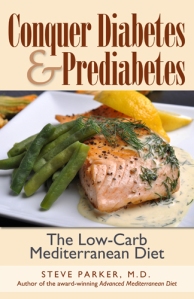
Meal Plans For “Conquer Diabetes and Prediabetes”

For both types 1 and type 2 diabetes, carbohydrate restriction is a great way to help control blood sugars and minimize the toxicity and expense of drug therapy. Here are some low-carb recipes from my book, Conquer Diabetes and Prediabetes. You can also easily incorporate them into a ketogenic diet.

Breakfast:  Chicken Salad Over Greens

1 large egg (50 g)

5-oz can (150 g) of cooked chicken (drain and discard liquid)

½ oz (14 g) onion (2 tbsp or 30 ml), diced

½ stick (40 g) of celery, diced

2 tbsp (30 ml) Miracle Whip Salad Dressing or regular mayonnaise (not low-fat)

salt and pepper

2 oz (60 g) romaine lettuce

2 oz (60 g) raw baby spinach

dash of lemon or lime juice (optional)

1 oz (28 g) walnuts

Hard-boil the large egg, then peel and dice. Place the chicken into a bowl then add the egg, diced onion, diced celery, and the Miracle Whip Salad Dressing. Mix all together, with salt and pepper and/or a dash of lemon or lime juice to taste. Place on bed of romaine lettuce and fresh baby spinach. Enjoy walnuts around mealtime or later as a snack. Digestible carb grams: 11.

Lunch:  Kippered Herring and Cheese

3.5 oz (100 g) canned herring

3 oz (80 g) cheese

Digestible carb grams: 2.

Dinner: Hamburger and Salad

8 oz (225 g) raw hamburger meat

1 oz (28 g) onion, finely chopped

1 tbsp (15 ml) A.1. Steak Sauce or Worcestershire sauce

salt and pepper

3 oz (85 g) lettuce

3 oz (85 g) tomato, cut into chunks

2 oz (60 g) cucumber, peeled and sliced

1.5 tbsp (22 ml) olive oil

½ tbsp (7 ml) vinegar

To the raw hamburger meat, add the chopped onion, A.1. Steak Sauce or Worcestershire sauce, and salt and pepper to taste. Blend thoroughly with your hands. (No particular need for lean hamburger; it’s your choice.) Cook in pan over medium heat. While cooking, prepare your salad.

In a bowl, place the lettuce, tomato chunks, sliced cucumber, and finally, the olive oil and vinegar. Mix salad thoroughly. Salt and pepper to taste.

Enjoy with 6 oz of red wine. Digestible carb grams: 13.

Comments Off on Meal Plans For “Conquer Diabetes and Prediabetes”

Filed under Recipes

Myth: Inadequate Sleep Time Linked to Adult Obesity

Absolutely nothing to do with sleep or obesity

Absolutely nothing to do with sleep or obesity

It’s currently popular to blame inadequate sleep time for overweight and obesity. I found a study supporting that idea in children, but not adults. Here’s the authors’ conclusion:

While shorter sleep duration consistently predicts subsequent weight gain in children, the relationship is not clear in adults. We discuss possible limitations of the current studies: 1.) the diminishing association between short sleep duration on weight gain over time after transition to short sleep, 2.) lack of inclusion of appropriate confounding, mediating, and moderating variables (i.e. sleep complaints and sedentary behavior), and 3.) measurement issues.

I found another analysis from a different team that is skeptical about the association of sleep deprivation and obesity in adults.

Everybody knows adults are getting less sleep now than we did decades ago, right? Well, not really. From Sleep Duration Across the Lifespan: Implications for Health:

Twelve studies, representing data from 15 countries and a time period of approximately 40 years, attempted to document changes in sleep duration over that time period. They found that, overall, there is no consistent evidence that sleep durations worldwide are declining among adults. Sleep duration decreased in six countries, sleep duration increased in seven countries, and mixed results were detected in two (one of which was the USA). In particular, the data from the USA suggest that although mean sleep duration may have actually increased slightly over the past 40 years, the proportion of short sleepers (six hours per night or less) also seems to have increased over the past several decades.

See, it’s complicated. Don’t believe everything you read. Not even this.

Steve Parker, M.D.


2 Comments

Filed under Overweight and Obesity

Yet Another Reason to Exercise as You Get Older

Compared to others, elderly type 2 diabetics are more afflicted with lower leg muscle mass, leg strength, and functional capacity. Click for details.

The right exercise program can counteract these problems and improve quality of life.

Steve Parker, M.D.

h/t Bill Lagakos

Comments Off on Yet Another Reason to Exercise as You Get Older

Filed under Exercise

Wine May Ward Off Depression

…according to an article in The Guardian. This finding is from the PREDIMED study of Spaniards aged 50 to 88. Those who drank between two and seven glasses of wine per week were less prone to develop depression.

She looks happy!

She looks happy!

Wine is allowed on my Advanced Mediterranean Diet, Conquer Diabetes and Prediabetes plan, and the Ketogenic Mediterranean Diet. Of course, some folks should never drink alcohol.

Steve Parker, M.D.

Comments Off on Wine May Ward Off Depression

Filed under Alcohol

Ketogenic Diet Overview

"Waiter, I didn't order sushi!"

“Waiter, I didn’t order sushi!”

Below is my contribution to Low-Carbing Among Friends—Vol. 4, which is an excellent source of low-carb recipes. Get the whole series so you’ll never suffer from diet boredom!

*  *  *

We’re starting to see a resurgence of interest in ketogenic diets for weight loss and management, at least in the United States. Also called “very-low-carb diets,” ketogenic diets have been around for over a hundred years. A few writers in the vanguard recently are Jimmy Moore, Dr. Peter Attia, and Dr. Georgia Ede. Before them, Dr. Robert Atkins was a modern pioneer with his famous Atkins Diet and its Induction Phase.

What is a Ketogenic Diet?

There are many different programs but they tend to share certain characteristics. They restrict digestible carbohydrate consumption to 50 or fewer grams a day, sometimes under 20 grams. This totally eliminates or drastically reduces some foods, such as grains, beans, starchy vegetables (corn, potatoes, peas, etc), milk, and sugar. Nor can you have products made from these, such as bread, cookies, pies, cakes, potato and corn chips, and candy. You eat meat, eggs, fish, chicken, certain cheeses, nuts, low-carb vegetables (e.g., salad greens, broccoli, green beans, cauliflower), and oils. Total calorie consumption is not restricted; you count carb grams rather than calories. This is a radical change in eating for most people.

Raspberries and blackberries are low-carb fruits

Raspberries and blackberries are low-carb fruits

You’re may be wondering what “ketogenic” means. First, understand that your body gets nearly all its energy either from fats, or from carbohydrates like glucose and glycogen. In people eating normally, 60% of their energy at rest comes from fats. In a ketogenic diet, the carbohydrate content of the diet is so low that the body has to break down even more of its fat to supply energy needed by most tissues. Fat breakdown generates ketone bodies in the bloodstream. Hence, “ketogenic diet.” Some of the recent writers are using the phrase “nutritional ketosis” to summarize this metabolic state.

Ketogenic Versus Traditional Calorie-Restricted Dieting

Are there advantages to ketogenic diets for weight loss and management? Numerous recent studies have demonstrated superior weight-loss results with very-low-carb diets as compared to traditional calorie-restricted diets. Weight loss is often faster and more consistently in the range of one or two pounds (0.5 to 0.9 kg) a week. Very-low-carb dieters have less trouble with hunger. If you do get hungry, there’s always something you can eat. From a practical, day-to-day viewpoint, these diets can be easier to follow, with a bit less regimentation than calorie-restricted plans.

Ketogenic diets typically lower blood sugar levels, which is important for anyone with diabetes, prediabetes, and metabolic syndrome. We see higher levels of HDL cholesterol (the good kind), lower triglyceride levels, and a shift in LDL cholesterol to the “large fluffy” kind, all of which may reduce the risk of heart disease. Getting even further into the science weeds, very-low-carb diets reduce insulin levels in people who often have elevated levels (hyperinsulinemia), which may help reduce chronic diseases like type 2 diabetes, high blood pressure, some cancers, and coronary heart disease.  Clearly, ketogenic diets work well for a significant portion of the overweight population, but not for everybody.

Sounds great so far! So why aren’t very-low-carb diets used more often? Many dieters can’t live with the restrictions. Your body may rebel against the switch from a carbohydrate-based energy metabolism to one based on fats. Most of us live in a society or subculture in which carbohydrates are everywhere and they’re cheap; temptation is never-ending.

What Could Go Wrong on a Ketogenic Diet?

Very-low-carb ketogenic diets have been associated with headaches, bad breath, easy bruising, nausea, fatigue, aching, muscle cramps, constipation, and dizziness, among other symptoms.

“Induction flu” may occur around days two through five, consisting of achiness, easy fatigue, and low energy. Atkins dieters came up with the term. It usually clears up after a few days. Some people think of induction flu as a withdrawal syndrome from sugar or refined carbohydrate. My conception is that it’s simply an adjustment period for your body to switch from a carbohydrate-based energy system to one based on fat. Your body cells need time to rev up certain enzymes systems while mothballing other enzymes. To prevent or minimize induction flu, Drs. Stephen Phinney, Jeff Volek, and Eric Westman routinely recommend eating 1/2  tsp (2.5 ml) of table salt daily.

Very-low-carb ketogenic diets may have the potential to cause osteoporosis (thin, brittle bones), kidney stones, low blood pressure, constipation, gout, high uric acid in the blood, excessive loss of sodium and potassium in the urine, worsening of kidney disease, deficiency of calcium and vitamins A, B, C, and D, among other adverse effects. From a practical viewpoint, these are rarely seen, and many experts say they don’t occur in a well-designed ketogenic diet eaten by an essentially healthy person. I favor ketogenic diets designed by physicians or dietitians. In view of these potential adverse effects, however, it’s a good idea to run your ketogenic diet of choice by your personal physician before you get started. This is especially important if you have diabetes, chronic kidney or liver disease, or a history of gout, low blood pressure, or kidney stones.

Athletic individuals who perform vigorous exercise should expect a deterioration in performance levels during the first four weeks or so of any ketogenic very-low-carb diet. Again, the body needs that time to adjust to burning mostly fat for fuel rather than carbohydrate.

Competitive weightlifters or other anaerobic athletes (e.g., sprinters) may be hampered by the low muscle glycogen stores that accompany ketogenic diets. They may need more carbohydrates, perhaps 150 grams a day.

What’s Next After Losing Weight on a Ketogenic Diet?

Caprese salad: mozzarella cheese, tomatoes, basil, extra virgin olive oil

Caprese salad: mozzarella cheese, tomatoes, basil, extra virgin olive oil

A majority of folks eventually increase their carbohydrate consumption above 50 grams a day, which usually takes them out of nutritional ketosis. If they return to the typical 200-300 grams a day that most people eat, they’ll probably gain the lost weight back. Many have found, however, that they can go up to 70-100 grams and maintain at a happy weight. A well-designed program should give careful instructions on the transition out of ketosis and avoidance of regain.

To see a ketogenic diet I designed for my patients, click here.

Steve Parker, M.D.

PS: Another ketogenic diet blogger I’ve been following lately is ItsTheWooo (The Scribble Pad), a nurse who lost major weight on the diet. And don’t overlook Amber and Z. Wilcox-O’Hearn at The Ketogenic Diet for Health.


2 Comments

Filed under ketogenic diet, Overweight and Obesity, Weight Loss

Does Coffee Prevent Type 2 Diabetes?

Fanatic Cook Bix details the surprising answer: Yes.

“Still, study after study, it’s an association that won’t go away … coffee consumption lowers the risk for diabetes. And the more you drink, the lower your diabetes risk. It doesn’t matter whether the coffee is regular or decaf, but regular does consistently show a slight edge over decaf.”

Comments Off on Does Coffee Prevent Type 2 Diabetes?

Filed under Uncategorized

Seasoned Citizens Reduce Fall Risk Via Exercise

… according to an article at MedPageToday. (I thought we already knew that.) Add this to your list of reasons to exercise. Successful aging is a war against gravity.

Tai Chi was the exercise in two of the trials, but the rest consisted of gait, balance, and functional training for activities performed in daily life. Most trials also included strength/resistance training exercises.

***

All the exercises that proved to be effective for fall prevention emphasized balance training, which the researchers said is “ample evidence that this type of program improves balance ability.”

Exercise reduces the risk of fractures by about 40%.

Click for the original research report, a meta-analysis.

Comments Off on Seasoned Citizens Reduce Fall Risk Via Exercise

Filed under Exercise

Do Nuts Help Or Hurt Cholesterol Levels?

Mixed Nuts Improve Diabetes, Too

Mixed Nuts Improve Diabetes

Most of the diets I recommend to my patients include nuts because they are so often linked to improved cardiovascular health in scientific studies. Walnuts are associated with reduced risk of type 2 diabetes in women, and established type 2 diabetics see improved blood sugar control and lower cholesterols when adding nuts to their diets.

Nut consumption lowers total and LDL cholesterol levels, and if triglycerides are elevated, nuts lower them, too. Those changes would tend to reduce heart disease.

Conner Middelmann-Whitney has a good nutty article at Psychology Today.

Steve Parker, M.D.

Reference: Joan Sabaté, MD, DrPH; Keiji Oda, MA, MPH; Emilio Ros, MD, PhD. Nut Consumption and Blood Lipid Levels: A Pooled Analysis of 25 Intervention Trials. Archives of Internal Medicine, 2010, Vol. 170 No. 9, pp 821-827. Abstract:

Background  Epidemiological studies have consistently associated nut consumption with reduced risk for coronary heart disease. Subsequently, many dietary intervention trials investigated the effects of nut consumption on blood lipid levels. The objectives of this study were to estimate the effects of nut consumption on blood lipid levels and to examine whether different factors modify the effects.

Methods:  We pooled individual primary data from 25 nut consumption trials conducted in 7 countries among 583 men and women with normolipidemia and hypercholesterolemia who were not taking lipid-lowering medications. In a pooled analysis, we used mixed linear models to assess the effects of nut consumption and the potential interactions.

Results:  With a mean daily consumption of 67 g of nuts [about 2 ounces or 2 palms-ful], the following estimated mean reductions were achieved: total cholesterol concentration (10.9 mg/dL [5.1% change]), low-density lipoprotein cholesterol concentration (LDL-C) (10.2 mg/dL [7.4% change]), ratio of LDL-C to high-density lipoprotein cholesterol concentration (HDL-C) (0.22 [8.3% change]), and ratio of total cholesterol concentration to HDL-C (0.24 [5.6% change]) (P < .001 for all) (to convert all cholesterol concentrations to millimoles per liter, multiply by 0.0259). Triglyceride levels were reduced by 20.6 mg/dL (10.2%) in subjects with blood triglyceride levels of at least 150 mg/dL (P < .05) but not in those with lower levels (to convert triglyceride level to millimoles per liter, multiply by 0.0113). The effects of nut consumption were dose related, and different types of nuts had similar effects on blood lipid levels. The effects of nut consumption were significantly modified by LDL-C, body mass index, and diet type: the lipid-lowering effects of nut consumption were greatest among subjects with high baseline LDL-C and with low body mass index and among those consuming Western diets.

Conclusion:  Nut consumption improves blood lipid levels in a dose-related manner, particularly among subjects with higher LDL-C or with lower BMI.

Comments Off on Do Nuts Help Or Hurt Cholesterol Levels?

Filed under Heart Disease, nuts

No Benefit to Intensive Type 2 Diabetes Treatment in Mild Disease Without Symptoms

That’s the take-away from an article at MedPageToday. I haven’t had time to dissect the original report yet.

Comments Off on No Benefit to Intensive Type 2 Diabetes Treatment in Mild Disease Without Symptoms

Filed under Uncategorized

Consider Carbohydrate Restriction for Your GERD

Dr. Michael Eades has a post on gastroesophageal reflux disease (GERD) and it’s treatment with carbohydrate-restricted eating versus drugs. GERD is relatively severe and/or frequent heartburn caused by stomach acid backing up in to the esophagus. The lining of your stomach is designed to be resistant to a high-acid environment; your esophagus not so much. A quote from Dr. Eades:

Most people who have GERD, have it for the long term. It’s not something that comes and goes. So these folks go on GERD therapy for the long term, and the most prescribed medications for long-term GERD treatment are PPIs [proton pump inhibitors], which, you now know, keep stomach acid neutralized for the long term, and, as you might imagine, creates a host of problems.

The scientific literature has shown long-term PPI therapy to be related to the following conditions:

  • Anemia
  • Pneumonia
  • Vitamin B12 deficiency
  • Impaired calcium absorption
  • Impaired magnesium absorption
  • Increased rate fractures, especially hip, wrist and spine
  • Osteopenia [thin brittle bones]
  • Rebound effect of extra-heavy gastric acid secretion
  • Heart attacks

Read the rest if you or someone you love has GERD.

Here’s a scientific report supporting Dr. Eades’ clinical experience. Carbs were reduced to 20 grams a day.

Steve Parker, M.D.

PS: Some studies find no association between PPI use and pneumonia. It makes sense that we have stomach acid for good reasons, and that suppressing it may well have adverse effects.

2 Comments

Filed under Uncategorized