Rosiglitazone On the Ropes

A week ago, MedPageToday reported that a British advisory commission recommended the diabetes drug rosiglitazone (Avandia) be withdrawn from the market.

On July 6, I wrote about evidence that rosiglitazone users seem to incur a higher risk of stroke, heart failure, and death.

If I were taking Avandia, I’d be asking my doctor about alternatives. 

Steve Parker, M.D.

2 Comments

Filed under Drugs for Diabetes

Had a Stroke? Statin Drug May Prevent Next One

When taken by properly selected patients, statin drugs prevent strokes.  The American Heart Association’s published stroke treatment guidelines specify which stroke patients benefit from ongoing statin usage.  Find the details at my last Self/NutritionData Heart Health Blog post.

Steve Parker, M.D. 

Comments Off on Had a Stroke? Statin Drug May Prevent Next One

Filed under Uncategorized

Chocolate Fights Heart Failure

My recent post at the Self/NutritionData Heart Health Blog outlines late-breaking evidence that chocolate seems to reduce both deaths and hospitalizations from heart failure among women.

You’ll also find my thoughts on milk versus dark chocolate and the healthy “dose.”

Steve Parker, M.D.

3 Comments

Filed under Diabetes Complications

Mediterranean Diet Lowers Risk of Breast Cancer

A study in the current issue of the American Journal of Clinical Nutrition associates the Mediterranean diet with lower risk of breast cancer in postmenopausal women.

The data derive from the Greek portion of the massive EPIC study: European Prospective Investigation Into Cancer and nutrition.  Investigators followed almost 15,000 women for 10 years.  No protective effect was seen for premenopausal women eating Mediterranean-style.  The study at hand adds to prior evidence that the Mediterranean diet seems to protect against cancer of the breast, prostate, uterus, and colon/rectum.

Steve Parker, M.D.

Reference:  Trichopoulou, Antonia, et al.  Conformity to traditional Mediterranean diet and breast cancer risk in the Greek EPIC (European Prospective Investigation into Cancer and nutrition) cohort.  American Journal of Clinical Nutrition, published July 14, 2010.  doi: 10.3945/ajcn.2010.29619

5 Comments

Filed under cancer, Health Benefits, Mediterranean Diet

Are Refined Carbs Worse for Your Heart Than Saturated Fat?

To reduce coronary heart disease, we need to focus on reducing consumption of refined carbohydrates rather than fat and cholesterol, according to Dr. Frank Hu.

Dr. Hu is not a wild-eyed, bomb-throwing radical. He’s a Harvard professor of nutrition and epidemiology with both M.D. and Ph.D. degrees.  High-glycemic-index carbs in particular are the bad boys, he writes in an editorial published in the American Journal of Clinical Nutrition earlier this year.

Additional details are at my April 26, 2010, post at the Self/NutritionData Heart Health Blog.

Steve Parker, M.D.

2 Comments

Filed under Carbohydrate, coronary heart disease, Fat in Diet, Glycemic Index and Load

Quote of the Day

The White House

[U.S. President Warren G.] Harding inherited an absentee presidency and one of the sharpest recessions in American history.  By July 1921 it was all over and the economy was booming again.  Harding had done nothing except cut government expenditure….

Paul Johnson, in his book, Modern Times, 1983 & 1991

Comments Off on Quote of the Day

Filed under Quote of the Day

High-Protein Diets Harmful to Bones? Nah!

Contrary to accepted wisdom, high  protein intake does not seem to be harmful to mineralization of bone, according to Seattle-based researchers reporting in the American Journal of Clinical Nutriton.  Mineralization of bone is important because higher bone mineral content generally translates to lower risk of fractures.

A consistent criticism of low-carbohydrate diets in the past is that they are detrimental to bone health.  How so?  If you reduce carb consumption, you have to replace at least some of the calories with either fat or protein.  Some low-carb diets lean towards higher protein content, others towards higher fat, still others increase both fat and protein.  The building blocks of proteins are amino acids, and some amino acids are acidic.  Acid-rich biochemical states may promote removal of calcium from bone and, ultimately, loss of that calcium in urine.  The calcium-poor bones are more prone to fracture.

If that theory is correct, women eating greater amounts of protein should demonstrate lower bone mineralization.  [The primary bone minerals are calcium and phosphorus.] 

ResearchBlogging.orgInvestigators tested the theory in 560 women aged 14 to 40 by measuring bone mineral density (via DEXA scans) over two or three years and monitoring food consumption via yearly questionnaires.  This was an observational study, not interventional.

They found that bone mineral density had nothing to do with protein consumption.  Higher protein intake was not associated with lower bone density.

Women in the low-protein group ate 52 g of protein daily, compared to 63 g in the medium group and 77 g in the high-protein tertile.  As best I can tell, the low-protein third of participants ate 12% of total calories as protein, compared to 20% in the high-protein third.  [Study authors could have put this in the appropriate table, but, mysteriously, opted against that.]

Caveats

We can’t tell from this study whether these findings apply to protein intakes outside this range, to men, or to women older than 40.  To their credit, the study authors review much of the pertinent literature and note that research in this area produces results all over the map.  To me, this suggests that the association between dietary protein and bone mineralization in the general population is weak, if not nonexistent.

Bottom Line

Looks like you can stop worrying so much about hurting your bones if you’re on a low-carb, high-protein diet.

Steve Parker, M.D.

Reference: Beasley, J., Ichikawa, L., Ange, B., Spangler, L., LaCroix, A., Ott, S., & Scholes, D. (2010). Is protein intake associated with bone mineral density in young women? American Journal of Clinical Nutrition, 91 (5), 1311-1316 DOI: 10.3945/ajcn.2009.28728

 

2 Comments

Filed under Protein

Do Calcium Supplements Cause Heart Attacks?

They might, if you’re a woman over 50 taking over 500 mg elemental calcium daily without a vitamin D supplement.

Details are at my recent Self/NutritionData Heart Health Blog post.

Steve Parker, M.D.

2 Comments

Filed under coronary heart disease

“Advanced Mediterranean Diet” Has Gone Green

The Advanced Mediterranean DietMy 2007 book, The Advanced Mediterranean Diet: Lose Weight, Feel Better, Live Longer is now available in PDF format for $9.95 USD.  It’s not a low-carb diet book, but a calorie-restricted, balanced diet incorporating the healthy features of the traditional Mediterranean diet.  The physical book is also available from Amazon or CreateSpace. 
My editor and I weren’t thinking globally when we finished the book: measurements are in U.S. customary units.  The average reader can convert to other units with minimal hassle.

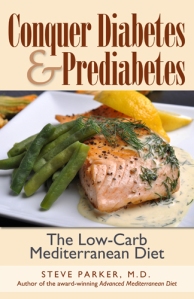
Loss of excess weight can be accomplished by measuring either carb grams or calories.  If you can handle monitoring your calorie consumption—and I make it as easy as possible in the book—then the Advanced Mediterranean Diet is a good way to go.  Due to the relatively high carbohydrate content of the traditional Mediterranean diet, however, people with diabetes or prediabetes should do better with carb-counting, as in the Low-Carb Mediterranean Diet or Ketogenic Mediterranean Diet.

Either way, I got you covered.

Steve Parker, M.D. 

2 Comments

Filed under Mediterranean Diet, Shameless Self-Promotion