
Another article on diabulimia from the BBC. I don’t recall any type 2s doing this.
Some Type 1s Skip Insulin to Lose Weight
Comments Off on Some Type 1s Skip Insulin to Lose Weight
Filed under Uncategorized
Is Low-Carb Killing Swedish Women?
![MPj04384870000[1]](https://diabeticmediterraneandiet.com/wp-content/uploads/2010/03/mpj043848700001.jpg) A recent Swedish study suggests that low-carbohydrate/high protein diets increase the risk of cardiovascular disease in women. I’m not convinced, but will keep an eye on future developments. This is a critical issue since many women eat low-carb/high protein for weight loss and management.
A recent Swedish study suggests that low-carbohydrate/high protein diets increase the risk of cardiovascular disease in women. I’m not convinced, but will keep an eye on future developments. This is a critical issue since many women eat low-carb/high protein for weight loss and management.
Researchers followed 43,000 women, 30-49 years of age at enrollment, over the course of 16 years. In that span, they had 1270 cardiovascular events: ischemic heart disease (heart attacks and blocked heart arteries), strokes, subarachnoid hemorrhages, and peripheral arterial disease. Food consumption was estimated from a questionnaire filled out by study participants at the time of enrollment (and never repeated).
In practical terms, … a 20 gram decrease in daily carbohydrate intake and a 5 gram increase in daily protein intake would correspond to a 5% increase in the overall risk of cardiovascular disease.
So What?
To their credit, the researchers note that a similar analysis of the Women’s Health Study in the U.S. found no such linkage between cardiovascular disease and low-carb/high protein eating.
The results are questionably reliable since diet was only assessed once during the entire 16-year span.
I’m certain the investigators had access to overall death rates. Why didn’t they bother to report those? Your guess is as good as mine. Even if low-carb/high protein eating increases the rate of cardiovascular events, it’s entirely possible that overall deaths could be lower, the same, or higher than average. That’s important information.
I don’t want to get too far into the weeds here, but must point out that the type of carbohydrate consumed is probably important. For instance, easily digested carbs that raise blood sugar higher than other carbs are associated with increased heart disease in women. “Bad carbs” in this respect would be simple sugars and refined grains.
In a 2004 study, higher carbohydrate consumption was linked to progression of blocked heart arteries in postmenopausal women.
It’s complicated.
PS: I figure Swedish diet doctor Andreas Eenfeldt would have some great comments on this study, but can’t find them at his blog.
Reference: Lagiou, Pagona, et al. Low carbohydrate-high protein diet and incidence of cardiovascular diseases in Swedish women: prospective cohort study. British Medical Journal, June 26, 2012. doi: 10.1136/bmj.e4026
Filed under Carbohydrate, coronary heart disease, Heart Disease, Protein
How’s Charlie Martin Doing on Week 10 of His Low-Carb Diet?
Great! Read the details at PJ Media or his FB page. In addition to being low-carb, he also characterized the diet as paleo. He has an ambitious exercise program that may not be necessary at this point. Exercise is more helpful for maintenance of weight loss. I’m sure that doing this in the public’s eye is helping him stick with it.
Comments Off on How’s Charlie Martin Doing on Week 10 of His Low-Carb Diet?
Filed under Uncategorized
Diabetes Linked to Increased Risk of Cancer
The risk is higher for those with diabetes over 15 years, and in type 2 diabetics taking insulin. See Diabetes Care for details.
My Conquer Diabetes and Prediabetes program should help many folks avoid insulin.
Comments Off on Diabetes Linked to Increased Risk of Cancer
Filed under Uncategorized
Meal Plans From “Conquer Diabetes and Prediabetes”
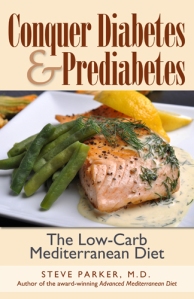
These recipes are from Conquer Diabetes and Prediabetes.
Day 2
Breakfast: Mexican Eggs and Avocado
3 large eggs (50 g each)
1 tbsp (14 g or 15 ml) butter
½ cup (120 ml) Pico de Gallo a la Rosa (see below)
1 California avocado (135 g), peeled, seeded, and sliced
salt and pepper
Sauté eggs in butter. Top with ½ cup Pico de Gallo a la Rosa (see Special Recipes). May substitute for Pico de Gallo: any serving of commercial picante sauce with no more than 3 g of digestible carb (digestible carb grams = total carb grams in serving minus fiber grams in serving). Salt and pepper to taste. Digestible carb grams: 7.
PICO DE GALLO A LA ROSA
This is a great garnish for several other foods, such as steak and hamburger.
6 oz (170 g) tomatoes
2 oz (56 g) onion
1 jalapeno pepper (14 g)
3–4 tbsp (2 g) cilantro
salt
Chop all vegetables very finely. Use the entire jalapeno, including seeds, but not the stem. If you prefer less spicy heat, use less jalapeno and discard the seeds. Combine all ingredients after chopping. Salt to taste. Eat at room temperature, chilled, or heated at medium heat in a saucepan (about 5 minutes, until jalapenos lose their intense green color). Makes 1.25 cups.
Nutrient Analysis:
Recipe makes about three servings of ½ cup (120 ml) each. One serving has 80 calories, 4 g carb, 1 g fiber, 3 g digestible carb, 1 g protein, minimal fat. 83% of calories are from carbohydrate, 10% from protein, 7% from fat.
Lunch: Tuna Salad Over Lettuce, with Walnuts
1 large egg (50 g)
3 oz (85 g) romaine lettuce
5-oz can of white albacore tuna packed in water (drain and discard the fluid)
½ oz (14 g) onion, diced (about 2 tbsp)
8-inch stalk (40 g or 20-cm stalk) of celery, diced
2 tbsp (30 ml) Miracle Whip Dressing or regular mayonnaise
salt and pepper
dash of lemon (optional)
1 oz (28 g) walnuts
Hard-boil a large egg, then peel and dice. Drain liquid off a 5-ounce can of white albacore tuna (net 3.5 oz or 100 g of fish); empty tuna into bowl. To bowl, add diced egg, diced onion, diced celery, and Miracle Whip Dressing or regular mayonnaise. Mix all together, with salt and pepper and/or a dash of lemon to taste. Place on bed of romaine lettuce. Enjoy walnuts around mealtime. Digestible carb grams: 9.
Dinner: Baked Trout with Snow Peas (sugar snap peas)
7 tbsp (100 g) extra virgin olive oil
5 garlic cloves (15 g), diced
1.5 tbsp (6 g) raw parsley, chopped
1 tsp (5 ml) salt
1 tsp (5 ml) black pepper
¾ fl oz (22 g or ml) lemon juice
4 leaves (1.5 g) fresh basil, chopped
16 oz (450 g) fresh trout
6 oz (170 g) snow peas (sugar snap peas)
5 oz (150 ml) white wine
This recipe provides two large servings of fish and two servings of snow peas.
In a glass or plastic bowl, mix 5 tbsp (70 g) of the extra virgin olive oil, 3 of the diced garlic cloves (9 g), the chopped raw parsley, salt, black pepper, the lemon juice, and the chopped basil. This is your marinade.
Place fresh trout filets in a medium sized (8–9″ or 20–23 cm diameter) glass baking dish, then cover with marinade. Let sit in refrigerator for 1–2 hours, turning occasionally. Preheat oven to 375°F (190°C). Pull fish dish out of refrigerator once you start the preheat process. Cover glass dish with aluminum foil, then bake in oven for 20–40 minutes. Cooking time depends on your oven and the thickness of the fish. Thin filets about 1/2″ (1.25 cm) thick may be done in 20–25 minutes. Thicker fish (1″ or 2.5 cm)) may take 30–45 minutes. This is a judgment call. When done, it should flake apart readily with a fork. This works well for trout, salmon, cod, tilapia, and perhaps others. Consider squeezing fresh lemon juice on cooked fish for extra zing.
Now the snow peas. Snap off and discard both tips of the snow pea pods. Sauté 2 diced garlic cloves (6 g) in olive oil over medium heat until soft, perhaps a couple minutes. To the pan add the snow peas. Salt and pepper to taste. Stir snow peas often, if not continuously, while cooking over medium heat, about 3 minutes. Enjoy 5 oz (150 ml) white wine with your meal. Digestible carb grams in wine and half the fish, half the snow peas: 11.
Comments Off on Meal Plans From “Conquer Diabetes and Prediabetes”
Filed under Recipes
Red Wine For Athletic and Bedroom Performance
Quercetin in red wine may boost blood levels of testosterone, according to very preliminary research covered by ScienceDaily. Higher testosterone levels may boost athletic performance and rev up libido.
Filed under Uncategorized
Interested in Fasting?
The Ledger.com has an article on fasting, covering a few specific plans and potential health benefits. It’s written for the general public.
Comments Off on Interested in Fasting?
Filed under Uncategorized
A Response to “Low-Carb Eating and Cardiovascular Risk Factors” in Obesity Reviews
Here’s a response to the article in my last post. W.S. Yancy, a well-known low-carb advocate, is one of the authors. So maybe the original article is critical of low-carb eating.
Comments Off on A Response to “Low-Carb Eating and Cardiovascular Risk Factors” in Obesity Reviews
January 7, 2013 · 6:05 PMLow-Carbohydrate Diets and Cardiovascular Risk Factors
The current issue of Obesity Reviews has an article entitled “Low-carbohydrate diets and cardiovascular risk factors.” I haven’t read it but predict that the authors found lowered triglycerides, higher HDL cholesterol, unchanged or slightly higher LDL cholesterols, and lower blood pressures in those eating sufficiently low-carb. All these changes would tend to reduce risk of heart attack and cardiac death. The article’s not free but you can probably pick it up for $20-40 (USD).

Comments Off on Low-Carbohydrate Diets and Cardiovascular Risk Factors
Filed under Uncategorized


 Diabetic Mediterranean Diet