Contrary to popular belief among the experts, type 2 diabetes is not one of the causes of Alzeimer dementia. They may indeed be associated with each other, but that’s not causation.
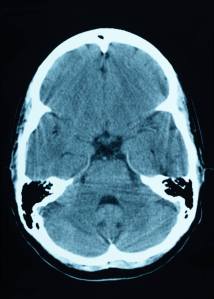
Brain CT scan
An oft-repeated theory from Gary Taubes 2007 masterpiece,
Good Calories, Bad Calories, is that many of the chronic diseases of modern civilization, including Alzheimer disease, are caused by abnormal blood sugar and insulin metabolism. Especially high insulin levels induced by a diet rich in refined carbohydrates. If that’s the case, you’d expect to see a high prevalence of Alzheimer disease in older type 2 diabetics.
Dr. Emily Deans (psychiatrist) has been considering this issue recently at her Evolutionary Psychiatry blog.
The brains of Alzheimer patients, under a microscope, are characterized by many senile plaques (aka neuritic plaques) and neurofibrillary tangles. That’s the gold standard for diagnosis. Nevertheless, brain biopsies are rarely done to diagnose Alzheimer disease in living patients, and even autopsies after death are rare. The diagnosis usually is clinical, based on ruling out other illnesses, etc.
Nearly all the studies associating diabetes with Alzheimers disease (and other dementias) are observational or epidimiologic. [The exception is the Honolulu-Asia Aging Study.] Establishing an association is helpful in generating theories, but establishing causation is the goal. At least five studies confirm an association.
Neurology this year reported findings of Japanese researchers who examined the brains of 135 people who died between 1998 and 2003. They lived in Hisayama, a town with an incredibly high autopsy rate of 74%. These people before death had undergone an oral glucose tolerance test. Their insulin resistance was calculated on the basis of fasting glucose and fasting insulin (HOMA-IR). None of them showed signs of dementia at the time of study enrollment in 1988.
What Did They Find?
Twenty-one of the 135 subjects developed Alzheimer-type dementia. The investigators don’t say if the diagnosis was based on the brain examination, or just a clinical diagnosis without a brain biopsy. How this got beyond the article reviewers is beyond me. [If I’m missing something, let me know in the comments section below.] It must be a clinical diagnosis because if you don’t act demented, it doesn’t matter how many senile plaques and neurofibrillary tangles you have in your brain.
 Senile plaques, but not neurofibrillary tangles, were more common in those with higher levels of blood sugar (as measured two hours after the 75 g oral glucose dose), higher fasting insulin, and higher insulin resistance. People with the APOE epsilon-4 gene were at even higher risk for developing senile plaques.
The researchers did not report whether the subjects in this study had been previously during life with diabetes or not. One can only hope those data will be published in another paper. Why make us wait?
Average fasting glucose of all subjects was 106 mg/dl (5.9 mmol/l); average two-hour glucose after the oral glucose load was 149 mg/dl (8.3 mmol/l). By American Association of Clinical Endocrinologists criteria, these are prediabetic levels. Mysteriously, the authors fail to mention or discuss this. [I don’t know if AACE criteria apply to Japanese.] Some of these Japanese subjects probably had diabetes, some had prediabetes, others had normal glucose and insulin metabolism.
As with all good research papers, the authors compare their findings with similar published studies. They found one autopsy study that tended to agree with their findings (Honolulu) and three others that don’t (see references below). In fact, one of the three indicated that diabetes seems to protect against the abnormal brain tissue characteristic of Alzheimer disease.
Botton Line
Type 2 diabetes doesn’t seem to be a cause of Alzheimer disease, if autopsy findings and clinical features are the diagnostic criteria for the disease.
If we assume that type 2 diabetics have higher than normal blood sugar levels and higher insulin levels for several years, then hyperglycemia and hyperinsulinemia don’t cause or contribute to Alzheimer dementia. Myth busted. [I hope that’s not copyrighted by the “Myth Busters” TV show.]
Type 2 diabetes is, however, linked with impaired cognitive performance, at least according to many of the scientific articles I read in preparation for this post. So type 2 diabetics aren’t in the clear yet. It’s entirely possible that high blood sugar and /or insulin levels cause or contribute to that. [Any volunteers to do the literature review? Best search term may be “mild cognitive impairment.”]
Type 2 diabetes is associated with Alzheimer disease, but we have no proof that diabetes is a cause of Alzheimers. Nor do we have evidence that high blood sugar and insulin levels cause Alzheimer disease.
Alzheimer disease is a major scourge on our society. I’d love to think that carbohydrate-restricted eating would help keep blood sugar and insulin levels lower and thereby lessen the devastation of the disease. Maybe it does, but I’d like to see more convincing evidence. It’ll be years before we have a definitive answer.
Steve Parker, M.D.
References:
Matsuzaki T, Sasaki K, Tanizaki Y, Hata J, Fujimi K, Matsui Y, Sekita A, Suzuki SO, Kanba S, Kiyohara Y, & Iwaki T (2010). Insulin resistance is associated with the pathology of Alzheimer disease: the Hisayama study. Neurology, 75 (9), 764-70 PMID: 20739649
Heitner, J., et al. “Diabetics do not have increased Alzheimer-type pathology compared with age-matched control subjects: a retrospective postmortem immunocytochemical and histofluorescent study.” Neurology, 49 (1997): 1306-1311. Autopsy study, No. of subjects not in abstract. They looked for senile plaques and neurofibrillary tangles, etc. The title says it all.
Beeri, M.S., et al. “Type 2 diabetes is NEGATIVELY [emphasis added] associated with Alzheimer’s disease neuropathology.” J. Gerontol A. Biol Sci. Med. Sci. 60 (2005): 471-475. 385 autopsies. The title again says it all.
Arvanitakis, Z., et al. “Diabetes is related to cerebral infarction but NOT [emphasis added] to Alzheimers disease pathology in older persons.” Neurology, 67 (2006): 1960-1965. Autopsy study of 233 Catholic clergy, about 50:50 women:men.











 Diabetic Mediterranean Diet