Category Archives: Uncategorized

Noteworthy People With Diabetes

dLife maintains a list of famous, prominent, or noteworthy folks who have or had diabetes.  I mention it here in case you have diabetes and sometimes feel like it’s got you by the throat and is ruining your life.  Be inspired.

Steve Parker, M.D.

B.B. King is No.3 on Rolling Stone's list of 100 Best Guitarists of All Time

PS: Who has a list of infamous diabetics?

1 Comment

Filed under Uncategorized

FDA Approves Exenatide for Once Weekly Use

Once-weekly injection of exenatide, sold in the U.S. as Bydureon, has been approved for use by the U.S. Food and Drug Administration.  It’s main competitors are Byetta (exenatide  injected twice daily) and Victoza  (liraglutide).  Byetta  and Bydureon are made by the same company, Amylin Pharmaceuticals.  Bydureon apparently is a slow-release formulation of exenatide.

Victoza is the one that celebrity chef Paula Deen endorsed about a month ago, around the same time she revealed she’s had type 2 diabetes for three years.  Victoza’s injected once daily.

The New York Times has a January 27, 2012, article on Bydureon, focusing on business and investing.  The new drug is expected to retail for $4,200 (USD) a year. 

Click for complete prescribing information.

Click for a press release approved by Amylin.

David Mendosa is excited about Bydureon.

These drugs are in a class called GLP-1 receptor agonists, which mimic the effect of glucagonlike peptide- 1, a hormone that increases insulin secretion by the pancreas when blood sugar levels are high.  They are prescribed as adjuncts to diet and exercise in adults with type 2 diabetes.

Steve Parker, M.D.

Comments Off on FDA Approves Exenatide for Once Weekly Use

Filed under Uncategorized

Brenna Reviews Sugar Substitutes

Too late now!

Dietitian Brenna at Eating Simple has a recent post on sugar substitutes, which I sometimes refer to as non-caloric sweeteners (not entirely accurate).  She reviewed sucralose, saccharine, aspartame, and acesulfame potassium.  Not sure why she didn’t cover sugar alcohols like xylitol, erythritol, and sorbitol.  Brenna links to a Mayo Clinic article on artificial sweeteners, including sugar alcohols.

I never got excited enough to cover this topic in detail myself.  Thanks, Brenna.

Steve Parker, M.D.

8 Comments

Filed under Uncategorized

Can Diabetes Be Prevented?

Not Paula Deen

Paula Deen’s recent announcement of her type 2 diabetes got me to thinking about diabetes prevention again.  If you’re at high risk of developing diabetes you can reduce your risk of full-blown type 2 diabetes by 58% with intensive lifestyle modification.  Here’s how it was done in a 2002 study:

The goals for the participants assigned to the intensive lifestyle intervention were to achieve and maintain a weight reduction of at least 7 percent of initial body weight through a healthy low-calorie, low-fat diet and to engage in physical activity of moderate intensity, such as brisk walking, for at least 150 minutes per week. A 16-lesson curriculum covering diet, exercise, and behavior modification was designed to help the participants achieve these goals. The curriculum, taught by case managers on a one-to-one basis during the first 24 weeks after enrollment, was flexible, culturally sensitive, and individualized. Subsequent individual sessions (usually monthly) and group sessions with the case managers were designed to reinforce the behavioral changes.

Although the Diabetes Prevention Program encouraged a low-fat diet, another study from 2008 showed that a low-fat diet did nothing to prevent diabetes in postmenopausal women

I don’t know Paula Deen.  I’ve never watched one of her cooking shows.  She looks overweight and I’d be surprised if she’s had a good exercise routine over the last decade.  I’m sorry she’s part of the diabetes epidemic we have in the U.S.  I wish her well.  Amy Tenderich posted the transcript of her brief interview with Paula, who calculates her sweet tea habit gave her one-and-a-half cups of sugar daily).

  • Nearly 27% of American adults age 65 or older have diabetes (overwhelmingly type 2)
  • Half of Americans 65 and older have prediabetes
  • 11% of U.S. adults (nearly 26 million) have diabetes (overwhelmingly type 2)
  • 35% of adults (79 million) have prediabetes, and most of those affected don’t know it

I think excessive consumption of concentrated sugars and refined carbohydrates contribute to the diabetes epidemic.  Probably more important are overweight, obesity, and physical inactivity.

The Mediterranean diet has also been linked to lower rates of diabetes (and here).  Preliminary studies suggest the Paleo diet may also be preventative (and here).

Greatly reduce your risk of type 2 diabetes by eating right, keeping your weight reasonable, and exercising.

Steve Parker, M.D.

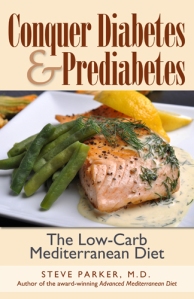
PS: Paula, if you’d like a copy of Conquer Diabetes and Prediabetes: The Low-Carb Mediterranean Diet, have your people contact my people.

Reference:  Diabetes Prevention Program Research Group.  Reduction in the Incidence of Type 2 Diabetes with Lifestyle Intervention or MetforminNew England Journal of Medicine, 346 (2002): 393-403.

9 Comments

Filed under Uncategorized

Book Review: The Smarter Science of Slim

I  recently read The Smarter Science of Slim, by Jonathan Bailor and published in 2012.   Per Amazon.com’s rating system, I give it four stars (“I like it”).

♦   ♦   ♦

Mr. Bailor’s weight-management diet avoids grains, most dairy, oils, refined starches, added sugars, starchy veggies, corn, white potatoes.  You eat meat, chicken, eggs, some fruit, nuts, seeds, and copious low-starch vegetables.  No limit on food if you eat the right items.   

It’s high-fiber, high-protein, moderate-fat, moderate-carb (1/3 of calories from carbohydrate,  1/3 from protein, 1/3 from fat).  He considers it Paleo (Stone Age) eating even though he allows moderate legumes and dairy (fat-free or low-fat cottage cheese and plain Greek yogurt).

Will it lead to weight lose? Quite probably in a majority of followers, especially those eating the standard, low-quality American diet.  When it works, it’s because you’ve cut out the fattening carbohydrates so ubiquitous in Western societies.  The protein and fiber will help with satiety.  Is it a safe eating plan?  Yes.

For those with diabetes needing to lose weight, I prefer a lower carbohydrate content in the diet, something like Conquer Diabetes and Prediabetes: The Low-Carb Mediterranean Diet.

I don’t recall any recipes or specific meal plans.  You put your own meals together following his guidelines.

Our major points of agreement:
 – Exercise isn’t terribly helpful as a weight-loss technique for most folks.
 – We’re overweight because we eat too many starches and sweets.
 – Natural, minimally processed foods are healthier than man-made highly refined items.
 – No need to emphasize “organic” /grass-fed beef/free-range chicken.
 – We don’t do enough high-quality exercise.

I have a few problems with the book:
 – It says we’re eating less.  U.S. caloric consumption over the last several decades has increased by about 150 cals (630 kJ) a day for men and 300 cals (1260 kJ) for women.  The author seems to contradict himself at one point by favorably quoting Hilda Bruch’s writing that “…overeating is observed with great regularity” in the obese. 
 – Scary graphs showing increasing instances of heart disease and diabetes over time aren’t helpful because they ignore population growth.  The population-adjusted diabetes rate is indeed increasing whereas heart disease rates are decreasing.
 – It says the Calories In/Calories Out theory of overweight has been proven wrong.  This is by no means true.  It just hasn’t helped us much to reverse the overweight epidemic.  Sure, it’s often said that if you just cut a daily tablespoon of butter out of your diet, you’d lose 11 lb (5 kg) in a year, all other things being equal.  Problem is, all other things are never equal.  In reality, we replace the butter with something else, or we’re slightly less active.  So weight doesn’t change or we gain a little.
 – It says the “eat less, exercise more” mantra has been proven wrong as a weight loss method.  Not really.  See above.  And watch an episode of TV’s The Biggest Loser.  Exercise can burn off fat tissue.  The problem is that we tend to overeat within the next 12 hours, replacing the fat we just burned. I agree with the author that “eat less, exercise more” is extremely hard to do, which is the reason it so often fails over the long run.  As Mr. Bailor writes elsewhere: “Hard to do” plus “do not want to do” generally equals “it’s not happening.”  Mr. Bailor would say the reason it ultimately fails is because of a metabolic clog or dysregulation. 
 – He says there’s no relationship between energy (calorie) consumption and overweight.  Not true.  Need references?  Google these: PMID 15516193, PMID 17878287, PMID 14762332.  The author puts too much faith in self-reports of food intake, which are notoriously inaccurate.  And obese folks under-report consumption more than others (this is not to say they’re lying). 
 – Mr. Bailor’s assessments too often rely on rat and mice studies.
 – By page 59, I had found five text sentences that didn’t match up well with the numeric bibiographic references (e.g., pages 48, 50, 59).
 – S. Boyd Eaton is thrice referred to as S. Boyd.
 – How did he miss the research on high intensity interval training by Tabata and colleagues in 1996.  Gibala is mentioned often but he wasn’t the pioneer.
 – Several diagrams throughout the book didn’t print well (not the author’s fault, of course).
 – In several spots, the author implies that HIS specific eating and exercise program has been tested in research settings.  It hasn’t.

Mr. Bailor’s exercise prescription is the most exciting part of the book for me.  His review of the literature indicates you can gain the weight-management and health benefits of exercise with just 10 or 20 minutes a week.  NOT the hour a day recommended by so many public heath authorities.  And he tells you how to do the exercises without a gym membership or expensive equipment.  That 20 minutes is exhausting and not fun.  You have fun in all the hours you saved.  If this pans out, we’re on the cusp of a fitness revolution.  Gym owners won’t be happy.  Sounds too good to be true, doesn’t it?

One component of the exercise program is high intensity interval training (HIIT), which I’m convinced is better than hours per week of low-intensity “cardio” like jogging. Better in terms of both fitness and weight management.

The resistance training part of the program focuses on low repetitions with high resistance, especially eccentric slow muscle contraction.  This is probably similar to programs recommended by Doug McGuff. John Little, and Skyler Tanner.  I’m no authority on this but I’m trying to learn.  By this point in the book, I was tired of looking up his cited references (76 pages!).  I just don’t know if this resistance training style is the way to go or not.  I’ll probably have to just try it on myself.  What do you think?

I admire Mr. Bailor’s effort to digest and condense decades of nutrition and exercise research.  He succeeds to a large degree.

Steve Parker, M.D.

 

14 Comments

Filed under Uncategorized

Paleo Diet Improves Glucose Tolerance and Blood Cholesterol

  A Paleolithic diet improved metabolic status with respect to cardiovascular and carbohydrate physiology, according to a 2009 study at the University of California San Francisco.

Here are the specifics, all statistically significant unless otherwise noted:

  • total cholesterol decreased by 16%
  • LDL cholesterol (“bad cholesterol”) decreased by 22% (no change in HDL)
  • triglycerides decreased by 35%
  • strong trend toward reduced fasting insulin (P=0.07)
  • average diastolic blood pressure down by 3 mmHg (no change in systolic pressure)
  • improved insulin sensitivity and reduced insulin resistance; i.e., improved glucose tolerance

Methodology

This was a small, preliminary study: only 11 participants (six male, three female, all healthy (non-diabetic), average age 38, average BMI 28, sedentary, mixed Black/Caucasian/Asian).

Baseline diet characteristics were determined by dietitians, then all participants were placed on a paleo diet, starting with a 7-day ramp-up (increasing fiber and potassium gradually), then a 10-day paleo diet.

The paleo diet: meat, fish, poultry, eggs, fruits, vegetables, tree nuts, canola oil [?], mayonnaise [?], and honey.  No dairy legumes, cereals, grains, potatoes.  Caloric intake was adjusted to avoid weight change during the study, and participants were told to remain sedentary.  They ate one meal daily at the research center and were sent home with the other meals and snacks pre-packed.

Compared with baseline diets, the paleo diet reduced salt consumption by half while doubling potassium and magnesium intake.  Baseline diet macronutrient calories were 17% from protein, 44% carbohydrate, 38% fat.  Paleo diet macronutrients were 30% protein, 38% carb, 32% fat.  Fiber content wasn’t reported. 

I’m guessing there were no adverse effects.

Comments

This study sounds like fun, easy, basic science: “Hey, let’s do this and see what happens!”

I don’t know a lot about canola oil, but it’s considered one of the healthy oils by folks like Walter Willett.  It sounds nicer than rapeseed oil.

I agree with the investigators that this tiny preliminary study is promising; the paleo diet (aka Stone Age or caveman diet) has potential benefits for prevention and treatment for metabolic syndrome, diabetes, and cardiovascular disease such as heart attack and stroke.

The researchers mentioned their plans to study the paleo diet in patients with type 2 diabetes.  No published results yet.

Are you working with a physician on a medical issue that may improve or resolve with the paleo diet?  Most doctors don’t know much about the paleo diet yet.  You may convince yours to be open-minded by trying the diet on your own volition—not always a safe way to go—and showing her your improved clinical results.  Or show her studies such as this.

I’m considering the paleo diet as a treatment for diabetes.  If interested, follow my progress at my PaleoDiabetic blog.

Steve Parker, M.D.

Reference:  Frassetto, L.A., et al.  Metabolic and physiologic improvements from consuming a paleolithic, hunter-gatherer type dietEuropean Journal of Clinical Nutrition, advance online publication, February 11, 2009.   doi: 10.1038/ejcn.2009.4

9 Comments

Filed under Uncategorized

Is Exercise Supposed To Be Fun?

Exercise is not supposed to be fun.  If it is, then you should suspect that something is wrong.

That quote is from an essay by Ken Hutchins posted at the Efficient Exercise website.

When I was a young man in my 30s, I was jogging 20 miles a week and ran a couple marathons (26.2 miles).  I enjoyed it and didn’t do much else for exercise or overall fitness. I thought I was in pretty good shape.  You can get away with that when you’re 35, but not when you’re 50.  At 57 now, I can’t think of any single recreational activity that can help me maintain the overall strength, functionality, and injury resistance I want and need as I age. 

I’ve come to view exercise as a chore, like flossing/brushing teeth, changing the oil in my car, and sleeping when I’d rather not.  I’ve got my current exercise chore whittled down to an hour three times a week.  OK, sometimes just twice a week.

Skyler Tanner takes a thoughtful and in-depth look at the exercise versus recreation dichotomy at his blog.  If you have comments, more people will see them at his site than here.

Steve Parker, M.D.


6 Comments

Filed under Uncategorized

LADA Awareness Week

"Who can tell us about LADA?"

This is the first ever LADA Awareness Week, organized by Diabetes Hands Foundation and dLife.  LADA stands for Latent Autoimmune Diabetes in Adults.  I think of it as type 1 diabetes that starts in adulthood, although there are some differences from typical juvenile-onset type 1 diabetes.

Seven-and-a-half to 10% of apparent type 2 adult diabetics have LADA.  It’s caused by the body attacking its own pancreas beta cells and thereby impairing insulin production; in other words, it’s an autoimmune thing.

Here are some generalities (with exceptions, of course) about LADA, compared to typical type 2 diabetes:

  • lower body mass index, often under 25
  • age at onset under 50
  • poorer response to dietary management
  • poorer response to oral diabetic medications
  • acute symptoms at time of diagnosis (e.g., weight loss, thirst, frequent urination, ketoacidosis, malaise, etc.)
  • higher risk of developing diabetic ketoacidosis
  • much more likely to need insulin

How Is LADA Diagnosed?

First of all, the doctor has to consider the possibility, based on the clinical factors above.  The autoimmune nature of the disease is reflected in islet-cell antiobodies (ICA) and antibodies to glutamic acid decarboxylase (anti-GAD).  These are testable in the blood.  One of the two may be enough.  If the disease is far enough along, blood levels of C-peptide will be low.  C-peptide reflects the body’s production of insulin.

For more information on LADA, talk to your doctor or visit this page at dLife.

Steve Parker, M.D.

Comments Off on LADA Awareness Week

Filed under Uncategorized

Introducing Paleo Diabetic, a New Blog

A few of my patients have asked me if the paleo diet and lifestyle would be good for their diabetes.  I’m not sure.  A few pilot studies suggest it would be.  I expect much more published scientific research over the coming decade, in addition to self-experimentation reports by patients.  I’ll be looking into the matter at Paleo Diabetic.

The paleo diet in modern times began gathering steam in 2008.  It’s still not widely known or followed, but the trend is definitely upwards. 

The idea behind the paleo diet—also referred to as the Stone Age or caveman diet—is that optimal health depends on adherence to dietary and lifestyle factors to which we’re genetically adapted.  Our current mix of genes overwhelmingly reflects the Paleolithic era of human cultural development, starting anywhere from 750,000 to 2.5 million years ago, and ending around 10,000 years ago.  It’s also called the Stone Age.

The paleo diet pattern isn’t set in stone.  In general, it includes nuts, vegetables, fruits, fish, meat, and poultry.  It excludes or limits grains, dairy, legumes, sugars other than fruit or honey, industrial seed oils (e.g., from soybean and corn), and modern processed, highly refined foods.  Fresh, natural, and “organic” are preferred.

I’ve already got a few posts up and plan on new ones once or twice weekly.  If you’re interested, please join me at Paleo Diabetic.

Steve Parker, M.D.

4 Comments

Filed under Uncategorized

Is Grape Seed Extract as Healthful as Wine?

Patients ask me periodically if grape seed extract provides the same health benefit as judicious red wine.  Nobody knows with certainty.  The health benefits of red wine may be due to resveratrol.  Grape seed extract contains potentially healthy antioxidants called proanthocyanidins,

Many people don’t enjoy wine or other alcohol-containing drinks, and others just shouldn’t drink any alcohol.  Should they take a grape seed extract supplement or drink grape juice as a subsitute?  Again, it’s still unclear.  In 2009 I wrote a about a review article looking at the effect of various non-wine grape products and effects on heart disease risk.

A recent meta-analysis out of the University of Connecticut found improvement in two heart disease risk factors in those who take a grape seed extract supplement:

  • systolic blood pressure lower by 1.54 mmHg
  • heart rate lower by 1.42 beats per minute

No effect was seen on lipids (cholesterol and triglycerides), diastolic blood pressure, and C-reactive protein (a test of systemic inflammation).

Granted, these are tiny effects.  It’s unknown whether they, or other unknown effects of grape seed extract, would translate into clinical benefits such as fewer heart attacks and strokes, and longer lifespans.

Bottom Line

Grape seed extract and other non-wine grape products may be as beneficial as red wine in prolonging lifespan and preventing heart disease.  But we have much stronger evidence in favor of red wine and other alcohol-containing drinks.

Steve Parker, M.D.

 Reference:  Feringa, H.H.H, et al. The Effect of Grape Seed Extract on Cardiovascular Risk Markers: A Meta-Analysis of Randomized Controlled TrialsJournal of the American Dietetic Association, 111 (2011): 1,173-1,181.

3 Comments

Filed under Uncategorized