New Insulin Delivery Recommendations 

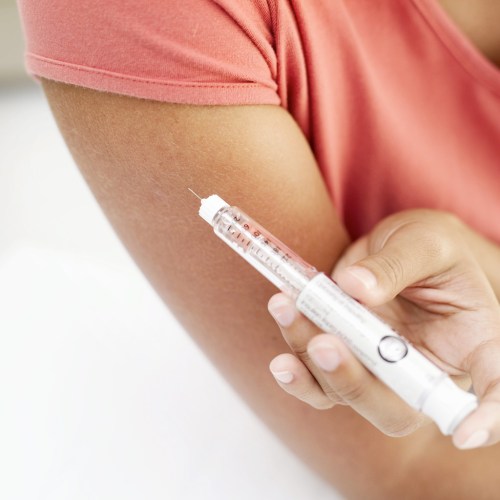
Going in at a 45 degree angle with a 6 mm needle

Going in at a 45 degree angle with a 6 mm needle

“Many primary care professionals manage injection or infusion therapies in patients with diabetes. Few published guidelines have been available to help such professionals and their patients manage these therapies. Herein, we present new, practical, and comprehensive recommendations for diabetes injections and infusions. These recommendations were informed by a large international survey of current practice and were written and vetted by 183 diabetes experts from 54 countries at the Forum for Injection Technique and Therapy: Expert Recommendations (FITTER) workshop held in Rome, Italy, in 2015.”

Source: New Insulin Delivery Recommendations – Mayo Clinic Proceedings

Here are some bullet points that most insulin users need to know:

  • Average skin thickness is 2 to 2.5 mm, with 90% of people under 3.25 mm.
  • Use the shortest needles: 6 mm for syringes, 4 mm for pen injectors. The short needles help you avoid injections into muscle. Injection into muscle increases risk of hypoglycemia and wide blood glucose excursions.
  • Acceptable injection sites: abdomen, thighs, buttocks, upper arms (usually on the back of the arm).
  • If an arm site is chosen with a 6 mm needle, inject into a lifted skin fold (otherwise you might hit muscle).
  • When using the 6 mm needle, inject into a lifted skinfold if you are a child or normal-weight adult. Alternatively, insert the needle at a 45 degree angle.
  • The preferred site for regular insulin (soluble human insulin) is the abdomen, for faster absorption.
  • Use needles only once. (Admittedly, many get away with multiple uses without much trouble.)
  • Don’t inject into lipohypertrophy areas. Lipohypertrophy eventually is an issue in half of insulin users. It is a localized area of swelling or lumpiness at the site of prior injections. It’s often easier to feel than to see. Injection into these areas causes erratic absorption of insulin, with potential widely fluctuating and unpredictable blood sugar levels.
  • Rotate injection sites to avoid lipohypertrophy.
  • If using cloudy insulins (e.g., NPH and some pre-mixed insulins), gently roll and tip the vial or pen until the solution is milk white.

Click here to read about…

  • How to roll and tip a vial to make cloudy insulin milk white.
  • Proper needle disposal.
  • Insulin infusion sets for continuous subcutaneous insulin injection via pumps.

Steve Parker, M.D.

Comments Off on New Insulin Delivery Recommendations 

Filed under Drugs for Diabetes, Uncategorized

Can Diet and Exercise Prevent Cancer?

You need to worry about cancer because you have a roughly four in 10 chance of coming down with invasive cancer. (Skin cancers like squamous cell and basal cell are quite common, but rarely invasive.)

Dr. David Gorski is a breast cancer surgeon. He’s looked at the scientific literature on the linkage between diet and exercises, and the risk of developing cancer.

Here’s his conclusion from a review at Science-Based Medicine:

“You can reduce your risk of cancer by staying active and exercising, eating a healthy diet with a lot of plant-based foods and minimizing intake of processed meats, limiting alcohol consumption (although I think the WCRF/AICR guidelines go a bit too far in saying that you shouldn’t drink at all if possible), and maintaining a healthy weight. (Of course, if you stay active and eat a healthy diet, maintaining a healthy weight will probably not be a problem.) Conceptually, it’s easy to do. In practice, as I’m discovering, it’s anything but easy.”

Source: Diet and exercise versus cancer: A science-based view « Science-Based Medicine

The Mediterranean diet seems to protect against cancer.

Steve Parker, M.D.

PS: One of the reasons I write diet books is that I want to keep you from getting cancer.

3 Comments

Filed under cancer

Whole Health Source Blog: Do Blood Sugar Levels Affect Hunger and Satiety?

From Dr. Guyenet:

“You’ve heard the story before: when you eat carbohydrate-rich foods that digest quickly, it sends your blood sugar and insulin levels soaring, then your blood sugar level comes crashing back down and you feel hungry and cranky.  You reach for more carbohydrate, perpetuating the cycle of crashes, overeating, and fat gain.

It sounds pretty reasonable– in fact, so reasonable that it’s commonly stated as fact in popular media and in casual conversation.  This idea is so deeply ingrained in the popular psyche that people often say “I have low blood sugar” instead of “I’m hungry” or “I’m tired”.  But this hypothesis has a big problem: despite extensive research, it hasn’t been clearly supported.  I’ve written about this issue before.

A new study offers a straightforward test of the hypothesis, and once again finds it lacking.”

Source: Whole Health Source: Do Blood Glucose Levels Affect Hunger and Satiety?

The study at hand involved 15 healthy young men. Results may not apply to overweight post-menopausal women with T2 diabetes, but I bet they do.

Steve Parker, M.D.

3 Comments

Filed under Uncategorized

Mediterranean diet tied to lower risk of gallbladder surgery

“About 700,000 cholecystectomies are performed every year in the United States, according to the American College of Surgeons. Most are the result of blockage due to gallstones. “Gallstones are very common, but most of them are asymptomatic, meaning people have no symptoms. If you don’t have any symptoms from your gallstones, there’s no reason to have your gallbladder removed,” said Dr. James Lewis, a gastroenterologist at the University of Pennsylvania in Philadelphia who was not part of the study.

The vast majority of people with gallstones never have problems from them, Lewis said in a phone interview.”When they do cause problems, then having your gallbladder removed is completely appropriate,” he said.

64,000 women surveyedThe new study, led by Dr. Amelie Barre at the University of Paris Sud in Orsay, used information on nearly 64,000 women who were born between 1925 and 1950 and covered by a national insurance plan. Every two years, they answered questions about their health status, medical history, and lifestyle.

Over the course of 18 years, 2,778 of the women had their gallbladder removed.Women who ate the most legumes, fruits, vegetable oil, and whole grain bread were anywhere from 13 to 27 per cent less likely to have gallbladder surgery than were women who ate the least of those foods.”

Source: Mediterranean diet tied to lower risk of gallbladder surgery: study – Health – CBC News

Comments Off on Mediterranean diet tied to lower risk of gallbladder surgery

Filed under Uncategorized

The Telegraph Asks: What’s so healthy about a Mediterranean diet?

Click the link at bottom for details about the healthy Mediterranean diet. You’ll see a reference to a low-carb Mediterranean diet that helps newly diagnosed type 2 diabetics avoid drug therapy. Click here my free low-carb Mediterranean diet.

Some quotes:

“A diet with a name that conjures up memories of suppers in the sunshine, the Mediterranean diet plan celebrates the fresh, colourful produce of a region that boasts an enviable life expectancy. Hence why it has been heralded as one of the world’s best diets – but what makes Med cuisine so healthy?

What is a Mediterranean diet? The diet plan consists mostly of fruit, vegetables, whole grains, pasta, rice and olive oil, with a moderate amount of cheese, wine, yogurt, nuts, fish, eggs, poultry and pulses, and meat thrown in.

Unlike our diet in the UK, which tends to be very high in saturated fats (pies, pastries, meats, pizza and take away foods like kebabs and burgers), the Mediterranean diet includes more monounsaturated fats, such as plant oils, nuts, seeds and oily fish.”

Source: What’s so healthy about a Mediterranean diet?

Comments Off on The Telegraph Asks: What’s so healthy about a Mediterranean diet?

Filed under Uncategorized

Improve or Prevent Knee Arthritis With Quad Strength

Osteoarthritis, aka degenerative joint disease, is quite common in folks over 45 and eventually may require knee replacement surgery. Recovery from that surgery is slow and painful; best to avoid it if you can.

Having good strength in the muscle that extends the knee helps to preserve the knee joint. That muscle is the quadriceps.

Click below for the evidence:

“Although limited, the reviewed studies suggest that participation in a resistance training program can potentially counteract the functional limitations seen in knee osteoarthritis; positive associations were found between increased muscle strength and walking self-efficacy, reduced pain, improved function, and total WOMAC score. Notably, improvements were greater in maximal versus submaximal effort testing, possibly due to a ceiling effect.”

Source: Strength training for treatment of osteoarthritis of the knee: A systematic review – Lange – 2008 – Arthritis Care & Research – Wiley Online Library

To get started on strengthening the quadriceps muscle, consider the following four-minute video that is two minutes too long:
Note her mention of ankle weights.

Steve Parker, M.D.

PS: If you’re overweight or obese, you lower limb joints will last longer if you lose the fat by following one of my books.

Comments Off on Improve or Prevent Knee Arthritis With Quad Strength

Filed under Uncategorized

Cancel Alcohol’s Carcinogenic Effect With Exercise

Jamesons Irish Whiskey Photo copyright: Steve Parker MD

Jamesons Irish Whiskey
Photo copyright: Steve Parker MD

It was just a few months ago we learned that you’ll die of cancer if you tipple. Well, a new study says you can counteract the carcinogenic alcohol with adequate physical activity.

A story at CNN tells us how much exercise it takes :

“Specifically, they looked at the impact of the recommended amount of weekly exercise for adults, which is 150 minutes of moderate aerobic activity. That includes brisk walking, swimming and mowing the lawn, according to the US Department of Health and Human Services. HHS also advises strength training for all major muscle groups at least twice a week.”

Source: Exercise can cancel out the booze, says study – CNN.com

The rule of thumb on how much alcohol is relatively safe to drink is 7 typical drinks a week for women, and 14 for men.

Also remember that even one or two drinks under the right circumstances can have devastating consequences.

Steve Parker, M.D.

PS: All of my books have extensive recommendations on getting started with exercise, even if you’re a 300-lb couch potato.

3 Comments

Filed under Alcohol, cancer

Julianne Figured Out Why the French Aren’t Fat

Julianne Taylor has a fascinating blog post based on a trip to France and Great Britain. Julianne is a dietitian living in New Zealand.  Please read the entire article.

Her conclusions:

“What can we learn from the French way of eating?

Don’t snack. At all. Eat 3 balanced meals, and snack only if needed.

Planned snacks are fine, children always have an after school snack, or small meal in France. Treat the snack with the same respect as you would a meal.

Don’t eat anywhere other than at a table. Don’t eat walking around, at your desk, in front of the TV, or snack out of the fridge. Prepare, then eat a meal at a table, preferably with company and actually experience the process of savoring your food. Eat slowly.

Choose food freshly prepared from whole ingredients like protein, fruit and vegetables.

Model eating like this to your children, and don’t push them into our bad habits. Enjoy family meals together at the table without any screens or phones.

Treat food is fine, savor a small portion as part of a meal if you wish.

Water should be the main drink, wine in moderation can be enjoyed with meals if desired,”

Source: Eating habits in France, what we should copy | Julianne’s Paleo & Zone Nutrition

3 Comments

Filed under Weight Loss

Vegetarian Diet Improves Diabetic Neuropathy Pain

http://www.nature.com/nutd/journal/v5/n5/full/nutd20158a.html

plus major weight loss

h/t bix (fanatic cook)

2 Comments

Filed under Diabetes Complications, Vegetarian Diet

Forty Years of Dietary Advice Down the Drain – Buh-Bye!

Dr. Axel Sigurdsson is a cardiologist who focuses his blogging on cardiovascular disease and lipid disorders. I bet he agrees with me that dietary saturated fat is not the malevolent force we were taught in medical school.

From his blog:

“The [PURE study] suggests that placing carbohydrates at the bottom of the food pyramid based on their effect on blood cholesterol was a mistake. In fact, the data show that replacing dietary carbohydrates with different types of fat may improve lipid profile.

In an interview on Medscape, Dr. Mahshid Dehghan, the principal author of the abstract said: “To summarize our findings, the most adverse effect on blood lipids is from carbohydrates; the most benefit is from consumption of monounsaturated fatty acids; and the effect of saturated and polyunsaturated fatty acids are mixed. I believe this is a big message that we can give because we are confusing people with a low-fat diet and all the complications of total fat consumption, and WHO and AHA all suggest 55% to 60% of energy from carbohydrates.”

Today, most experts agree that diets high in saturated fatty acids or refined carbohydrates are not be recommended for the prevention of heart disease. However, it appears that carbohydrates are likely to cause a greater metabolic damage than saturated fatty acids in the rapidly growing population of people with metabolic abnormalities associated with obesity and insulin resistance.”

Source: High Carbohydrate Intake Worse than High Fat for Blood Lipids

PS: A diet naturally high in monounsaturated fat is one you may have heard of: the Mediterranean diet. A low-carb Mediterranean diet is the cornerstone of Conquer Diabetes and Prediabetes.

High MUFA, Low CARB

High MUFA, Low CARB

5 Comments

Filed under coronary heart disease, Fat in Diet, Mediterranean Diet