
Being fat is hard…
Losing weight is hard…
Maintaining weight loss is hard…
Choose your hard.
I got this from Magicsmom at the Low Carb Friends message board, but she didn’t know the source. Do you?
Being fat is hard…
Losing weight is hard…
Maintaining weight loss is hard…
Choose your hard.
I got this from Magicsmom at the Low Carb Friends message board, but she didn’t know the source. Do you?
Comments Off on Quote of the Day
Filed under Quote of the Day
 Over the last 30 years in the U.S., consumption of sugar-sweetened beverages (SSBs) has increased from3.9% of total calories to 9.2% (in 2001). In that same time span, the percentage of overweight American adults increased from 47% to 66%. The obesity percentage rose from15 to 33% of adults.
[Did the beverages cause the weight gain, or are they just associated?]
Those are just a few of the many facts shared by the authors of “Sugar-sweetened beverages, obesity, type 2 diabetes mellitus, and cardiovascular disease risk,” published recently in Circulation. Sugar-sweetened beverages, by the way, include soft drinks, fruit drinks, energy drinks, and vitamin water drinks.
 Sounds like an interesting article, doesn’t it? It’s written by some of the brightest lights in nutritional science, including George Bray and Frank Hu. Unfortunately, the article is a little too boring and technical for most of my readers. Here are a few tidbits I enjoyed:
Some of the authors conclusions:
I especially like their final sentence:
For these reasons and because they have little nutritional value, intake of SSBs should be limited, and SSBs should be replaced by healthy alternatives such as water.
Reference: Malik, V., Popkin, B., Bray, G., Despres, J., & Hu, F. (2010). Sugar-Sweetened Beverages, Obesity, Type 2 Diabetes Mellitus, and Cardiovascular Disease Risk Circulation, 121 (11), 1356-1364 DOI: 10.1161/CIRCULATIONAHA.109.876185
 I wrote elsewhere about mesotherapy (also known as lipodissolve) in April, 2008. It’s a technique designed to “dissolve” localized fat deposits under the skin.
The U.S. Food and Drug Administration this month is alerting consumers that
In addition, FDA has reports of unexpected side effects in people who’ve undergone the lipodissolve procedure. These side effects include
This is good to know before you invest time and money in the procedure.
Comments Off on FDA Warns About Lipodissolve
Filed under Weight Loss

Whole grain and bran consumption are linked to reduced overall death rates and cardiovascular disease deaths in white women with type 2 diabetes, according to recent research from Boston-based investigators.
This is an important association since diabetics are prone to develop cardiovascular disease and suffer premature death. Anything that can easily counteract those trends is welcome.
Several prior studies have found lower rates of cardiovascular disease in the general public eating whole grains. I’m referring to fewer heart attacks and strokes, and fewer deaths from cardiovascular disease.
On the other hand, the carbohydrate content of whole grain products has the potential to complicate day-to-day management of diabetes by spiking blood sugars too high. Too-high blood sugars aren’t healthy. So, there’s the double edge.
What’s the Evidence That Whole Grains and Bran Prevent Death in Diabetics ?
The Harvard researchers followed 7,822 type 2 diabetic women in the massive Nurses’ Health Study over 26 years, during which 852 women died from any cause, including 295 from cardiovascular disease (195 from coronary heart disease, 100 from stroke). Food-frequency questionnaires were administered periodically to the participants, with attention to whole grain and its components: cereal fiber, bran, and germ. The hard clinical end-point in this study was death—from any and all causes, and from cardiovascular disease.
Results
The Researchers’ Conclusions
Whole-grain and bran intakes were associated with reduced all-cause and cardiovascular disease-specific mortality in women with diabetes mellitus. These findings suggest a potential benefit of whole-grain intake in reducing mortality and cardiovascular risk in diabetic patients.
The authors point out that whole grain and its components may be protective since they:
My Comments
Whole grain and bran consumption may indeed protect against death and cardiovascular disease in diabetic white women, but the effect is by no means dramatic. I had speculated earlier whether whole grain intake might be particularly protective in diabetics, but this study suggests not. Clearly, whole grains are no panacea.
Diabetics hoping to avoid cardiovascular disease are well-advised to pay attention to—and modify—non-dietary risk factors for heart disease, such as obesity, smoking, and sedentary lifestyle. Non-dietary issues probably outweigh the effects of diet, assuming blood sugars are reasonably controlled.
The traditional Mediterranean diet—prominently featuring whole grains—is associated with longer lifespan and less cardiovascular disease. Canadian researchers in 2009 found moderately strong evidence that whole grains protect against coronary heart disease in the general population. Yet a 2009 study did not find cereals contributing to the longer lifespan.
I’m starting to think that the effect of diet on chronic disease is not as powerful as we have hoped.
Reference:
He, M., van Dam, R., Rimm, E., Hu, F., & Qi, L. (2010). Whole-Grain, Cereal Fiber, Bran, and Germ Intake and the Risks of All-Cause and Cardiovascular Disease-Specific Mortality Among Women With Type 2 Diabetes Mellitus Circulation, 121 (20), 2162-2168 DOI: 10.1161/CIRCULATIONAHA.109.907360
Filed under coronary heart disease, Grains
A recent study out of the Netherlands shows that type 2 diabetics taking insulin and metformin are at risk of clinically significant vitamin B12 deficiency.
B12 deficiency may cause anemia, nerve damage (neuropathy), and dementia, among other problems.
Metformin is the cornerstone of drug therapy for type 2 diabetes. One reason is that it’s associated with improved cardiovascular disease outcomes—a claim few diabetic drugs can make. Prior studies established that metformin interferes with B12 absorption. The study at hand indicates that such malabsorption can reach a clinically significant degree, and that the falling blood levels are progressive over time.

No B12 here
Three diabetes clinic in the Netherlands provided 390 patients with type 2 diabetes between the ages of 30 and 80. They were all treated with 1) insulin and metformin 850 mg three times daily, or 2) insulin and placebo three times daily. B12 levels were drawn periodically over the course of the 4-year study. Seventy-two percent of participants completed the study (the drop-outs included 30 on metformin and 16 on placebo).
What Did the Investigators Find After Four Years?
Clinical Implications
It’s unclear whether these findings apply to diabetics not taking insulin or to other ethnicities and nationalities. I suspect they do.
The risk of developing B12 deficiency with metformin is not huge, but it seems to be real. Once B12 deficiency does it’s damage, it may not be totally reversible. So it’s important to know about this issue if you take or prescribe metformin. At this point I wouldn’t depend on my doctor to be aware of this adverse drug effect, nor to remember to check B12 levels periodically.
The researchers recommend that B12 levels be checked “regularly” in patients taking metformin, without defining a time frame. I suggest every year or two—closer to yearly if the patient has other risk factors for B12 deficiency, such as malnutrition, advanced age, removal of part of the stomach, some weight-loss surgeries, vegan diet, celiac disease, and Crohn’s disease.
de Jager, J., Kooy, A., Lehert, P., Wulffele, M., van der Kolk, J., Bets, D., Verburg, J., Donker, A., & Stehouwer, C. (2010). Long term treatment with metformin in patients with type 2 diabetes and risk of vitamin B-12 deficiency: randomised placebo controlled trial BMJ, 340 (may19 4) DOI: 10.1136/bmj.c2181
Filed under Diabetes Complications, Drugs for Diabetes
I woke up today and found my wife had brought home six Cinnabon cinnamon rolls. I had mentioned off-hand a few days ago how much I missed them. She interpreted that as a request [it wasn’t].
I couldn’t say “no” now, could I?
No, I couldn’t.
According to Calorie Count, the classic Cinnabon roll provides:
Looking at the carb count, you can understand how the typical American gets 250-300 g of carb daily. For the last nine months, I’ve been eating 50 g or less, and about 2000 calories/day.
I ate the Cinnabon as a meal, rather than as dessert after—and in addition to—a meal. If you’re gonna cheat during a weight-control program—and who doesn’t?—that may be a good way to do it.
Compare the Cinnabon with a 700-cal large green salad with tomato, onion, olive oil vinaigrette, topped with tuna or chicken. Which has “more nutrition”?
Did I enjoy the Cinnabon? You bet! Will I be able to resist the temptation of the ones remaining? I hope so.
Filed under Weight Loss
Dr. Robert Atkins didn’t invent low-carb dieting. William Banting (1797-1878) sparked a low-carb diet craze in London with his low-carb weight-loss diet, first published in 1863. Even that probaby wasn’t the first low-carb diet.
According to Wikipedia, Banting was a distant relative of Frederick Banting, the co-discoverer of insulin in 1921.
Mr. Banting attributes his successful program design to a “medical gentleman,” Mr. Harvey, of Soho Square, London.
Click to read Mr. Banting’s 1865 “Letter on Corpulence” at Internet Archive.
Filed under Weight Loss
 Quick now! Which has more carbohydrate per serving? Cherries, blueberries, blackberries, or raspberries?
Don’t worry about fiber carbs since those are not digested.
According to the USDA National Nutrient Database, here are the digestible carb counts in one cup:
To determine digestible carb counts, I take the total carb grams in a serving and subtract the fiber grams. Not exactly rocket science.
These carb counts are not obvious to most people. If you’re trying to limit your carb consumption, you need a database like the USDA’s. The pocket-sized carb-count guides are handy for some. Most are based on the USDA database.
My wife is getting some great deals right now on fresh berries and cherries at Sam’s Club. We’re enjoying them while they last.
Filed under Fruits
 In July, 2009, an expert committee composed partially of representatives from the American Diabetes Association proposed that hemoglobin A1c be used as a diagnostic test for diabetes in non-pregnant adults and children.
The expert committee proposed that diabetes is present when hemoglobin A1c is 6.5% or greater. The test should be repeated for confirmation unless the individual has clear symptoms of diabetes.
The committee also recommended that the term “prediabetes” be phased out. They indicated that a person with hemoglobin A1c of at least 6% but less that 6.5% is at risk (high risk?) of developing diabetes, yet they don’t want to give that condition a name (such as prediabetes).
In December, 2009, the American Diabetes Association established a hemoglobin A1c criterion for the diagnosis of diabetes: 6.5% or higher. Diagnosis of prediabetes involves hemoglobin A1c between 5.7 and 6.4%. These numbers don’t apply to pregnant women.
Previously established blood sugar criteria can also be used to diagnose diabetes and prediabetes.
This step is a major change in the diagnosis of diabetes.
Reference: International Expert Committee. International Expert Committee report on the role of the A1c assay in the diagnosis of diabetes. Diabetes Care, 32 (2009): 1-8.
Filed under Uncategorized
The enduring popularity of the Mediterranean diet is attributable to three things:
For our purposes today, I use “diet” to refer to the usual food and drink of a person, not a weight-loss program.
 The scientist most responsible for the popularity of the diet, Ancel Keys, thought the heart-healthy aspects of the diet related to low saturated fat consumption. He also thought the lower blood cholesterol levels in Mediterranean populations (at least Italy and Greece) had something to do with it, too. Dietary saturated fat does tend to raise cholesterol levels, both LDL and HDL.
Even if Keys was wrong about saturated fat and cholesterol levels being positively associated with heart disease, numerous studies (involving eight countries on three continents) strongly suggest that the Mediterranean diet is one of the healthiest around. See References below for the most recent studies.
Relatively strong evidence supports the Mediterranean diet’s association with:
■ increased lifespan
■ lower rates of cardiovascular disease such as heart attacks and strokes
■ lower rates of cancer (prostate, breast, uterus, colon)
■ lower rates of dementia
■ lower incidence of type 2 diabetes
Weaker supporting evidence links the Mediterranean diet with:
■ slowed progression of dementia
■ prevention of cutaneous melanoma
■ lower severity of type 2 diabetes, as judged by diabetic drug usage and fasting blood sugars
■ less risk of developing obesity
■ better blood pressure control in the elderly
■ improved weight loss and weight control in type 2 diabetics
■ improved control of asthma
■ reduced risk of developing diabetes after a heart attack
■ reduced risk of mild cognitive impairment
■ prolonged life of Alzheimer disease patients
■ lower rates and severity of chronic obstructive pulmonary disease
■ lower risk of gastric (stomach) cancer
■ less risk of macular degeneration
■ less Parkinsons disease
■ increased chance of pregnancy in women undergoing fertility treatment
■ reduced prevalence of metabolic syndrome (when supplemented with nuts)
■ lower incidence of asthma and allergy-like symptoms in children of women who followed the Mediterranean diet while pregnant
Did you notice that I used the word “association” in relating the Mediterranean diet to health outcomes? Association, of course, is not causation.
The way to prove that a particular diet is healthier is to take 20,000 similar young adults, randomize the individuals in an interventional study to eat one of two test diets for the next 60 years, monitoring them for the development of various diseases and death. Make sure they stay on the assigned test diet. Then you’d have an answer for that population and those two diets. Then you have to compare the winning diet to yet other diets. And a study done in Caucasians would not necessarily apply to Asians, Native Americans, Blacks, or Hispanics.
Now you begin to see why scientists tend to rely on observational rather than interventional diet studies.
I became quite interested in nutrition around the turn of the century as my patients asked me for dietary advice to help them lose weight and control or prevent various diseases. At that time, the Atkins diet, Mediterranean diet, and Dr. Dean Ornish’s vegetarian program for heart patients were all prevalent. And you couldn’t pick three programs with more differences! So I had my work cut out for me.
After much scientific literature review, I find the Mediterranean diet to be the healthiest for the general population. People with particular medical problems or ethnicities may do better on another diet. A low-carb Mediterranean diet should be healthier for type 2 diabetics. Dan Buettner makes a good argument for plant-based diets in his longevity book, The Blue Zones. The traditional Mediterranean diet qualifies as plant-based.
What do you consider the overall healthiest diet, and why?
References:
Buckland, Genevieve, et al. Adherence to a Mediterranean diet and risk of gastric adenocarcinoma within the European Prospective Investigation into Cancer and Nutrition (EPIC) cohort study. American Journal of Clinical Nutrition, December 9, 2009, epub ahead of print. doi: 10.3945/ajcn.2009.28209
Fortes, C., et al. A protective effect of the Mediterraenan diet for cutaneous melanoma. International Journal of Epidmiology, 37 (2008): 1,018-1,029.
Sofi, Francesco, et al. Adherence to Mediterranean diet and health status: Meta-analysis. British Medical Journal, 337; a1344. Published online September 11, 2008. doi:10.1136/bmj.a1344
Feart, Catherine, et al. Adherence to a Mediterranean diet, cognitive decline, and risk of dementia. Journal of the American Medical Association, 302 (2009): 638-648.
Scarmeas, Nikolaos, et al. Physical activity, diet, and risk of Alzheimer Disease. Journal of the American Medical Association, 302 (2009): 627-637.
Scarmeas, Nikolaos, et al. Mediterranean Diet and Mild Cognitive Impairment. Archives of Neurology, 66 (2009): 216-225.
Fung, Teresa, et al. Mediterranean diet and incidence of and mortality from coronary heart disease and stroke in women. Circulation, 119 (2009): 1,093-1,100.
Mente, Andrew, et al. A Systematic Review of the Evidence Supporting a Causal Link Between Dietary Factors and Coronary Heart Disease. Archives of Internal Medicine, 169 (2009): 659-669.
Salas-Salvado, Jordi, et al. Effect of a Mediterranean Diet Supplemented With Nuts on Metabolic Syndrome Status: One-Year Results of the PREDIMED Randomized Trial. Archives of Internal Medicine, 168 (2008): 2,449-2,458.
Esposito, Katherine, et al. Effects of a Mediterranean-style diet on the need for antihyperglycemic drug therapy in patients with newly diagnosed type 2 diabetes. Annals of Internal Medicine, 151 (2009): 306-314.
Trichopoulou, Antonia, et al. Anatomy of health effects of the Mediterranean diet: Greek EPIC prospective cohort study. British Medical Journal, 338 (2009): b2337. DOI: 10.1136/bmj.b2337.
Comments Off on Documented Health Benefits of the Mediterranean Diet
Filed under Health Benefits, Mediterranean Diet
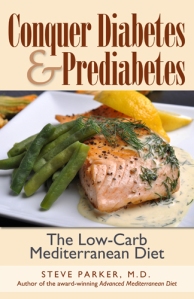
Click the pic to purchase at Amazon.com. E-book versions also available at Smashwords.com.
 Bible Verse of the Day
 Diabetic Mediterranean Diet