Category Archives: Uncategorized

New Podcast Episode Features Professional Low-Carb Diet Proponents

Jimmy Moore posted an interview with Dr. Troy Stapleton and Franziska Spritzler, R.D. They both advocate carbohydrate-restricted diets for management of blood sugars in diabetes. Dr. Stapleton, by the way, has type 1 diabetes; I’ve written about him before. Franziska is available for consultation either by phone, Skype, or in person.

Steve Parker, M.D.

1 Comment

Filed under Uncategorized

Dining Out and Obesity: Related?

No need to dine out if you have one of the four "Low-Carbing Among Friends" cookbooks

No need to dine out if you have one of the four “Low-Carbing Among Friends” cookbooks

The U.S. trend of increasing overweight and obesity started about 1970. I wonder if eating away from home is related to the trend. I found a USDA report with pertinent data from 1977 to 1995. It also has interesting info on snacking and total calories consumed. Some quotes:

“We define home and away-from-home foods based on where the foods are obtained, not where they are eaten. Food at home consists of foods purchased at a retail store, such as a grocery store, a convenience store, or a supermarket. Food away from home consists of foods obtained at various places other than retail stores (mainly food-service establishments).”

***

“Over the past two decades, the number of meals consumed has remained fairly stable at 2.6 to 2.7 per day. However, snacking has increased, from less than once a day in 1987-88 to 1.6 times per day in 1995. The increased popularity in dining out is evident as the proportion of meals away from home increased from 16 percent in 1977-78 to 29 percent in 1995, and the proportion of snacks away from home rose from 17 percent in 1977-78 to 22 percent in 1995. Overall, eating occasions (meals and snacks) away from home increased by more than two-thirds over the past two decades, from 16 percent of all eating occasions in 1977-78 to 27 percent in 1995.”

***

“Average caloric intake declined from 1,876 calories per person per day in 1977-78 to 1,807 calories per person per day in 1987-88, then rose steadily to 2,043 calories per person per day in 1995.”

***

“These numbers suggest that, when eating out, people either eat more or eat higher-calorie foods or both.”

Parker here. I’m well aware that these data points don’t prove that increased eating-out, increased snacking,  and increased total calorie consumption have caused our overweight and obesity problem. But they sure make you wonder, don’t they? None of these factors was on a recent list of potential causes of obesity.

If accurate, the increased calories alone could be the cause. Fast-food and other restaurants do all they possibly can to satisfy your cravings and earn your repeat business.

If you struggle with overweight, why not cut down on snacking and eating meals away from home?

Steve Parker, M.D.

Comments Off on Dining Out and Obesity: Related?

Filed under Overweight and Obesity, Uncategorized

Does Skipping Breakfast Affect Weight Loss?

It didn’t in this 16-week study. I don’t know what they ate nor how many calories. 

1 Comment

Filed under Uncategorized

Recipe: Eggs, Bacon, and Honeydew Melon


Bacon, eggs, black coffee, and Cholula hot sauce. A caveman wouldn't recognized any of this except for eggs.
Bacon, eggs, black coffee, and Cholula hot sauce

If you follow nutrition science literature, you’ll see periodic references to “processed meats” like bacon contributing to increased risk of cardiovascular disease, cancer, or premature death. I think the associations are pretty weak. Health-conscious cautious people aren’t going to go hog-wild on processed meats. I don’t. We may never have a definitive science-based resolution of the issue.

If you want to control the degree of processing in your bacon, make your own. The recipe at the link includes pink salt (sodium nitrite), maple syrup, and dark brown sugar. Many other recipes are available. My understanding is that sodium nitrite is a preservative and gives bacon meat that pink color. (Does it contribute to flavor?) If you’re not storing your bacon for a long time, you may not need the pink salt.

In any case, I thoroughly enjoyed three strips of bacon with my eggs recently. Mine was the Kirkland brand from Costco was $3.80/pound (USD). Two slices provide 80 calories (uncooked) and zero grams of carb although, if I recall correctly, it was honey-cured bacon.

Ingredients:

3 large eggs

3 strips of bacon, standard thin slices

Salt and pepper to taste

1/2 cup raw honeydew melon, cubed

Instructions:

Fry the bacon over medium or medium-high heat. If there’s too much grease leftover in the pan after cooking, poor out what you don’t want, for later use or drizzle over your dog’s dry kibble food. Leave a little grease in the pan so your eggs don’t stick. Then fry your eggs over medium heat. Enjoy with raw honeydew, which will cleanse your palate after eating bacon.

You can pay a lot more than $3.80 a pound for bacon

Servings: One

Nutritional Analysis per Serving: (from FitDay.com)

63 % fat

10 % carbohydrate

26 % protein

319 calories

9 carb grams

1 fiber grams

8 digestible carb grams

845 mg sodium

423 mg potassium

Prominent features: high in B12, riboflavin, selenium, protein, pantothenic acid, and phosphorus. Although this is low in calories, it’s adequately satiating because of the rich protein and fat content. The calorie count will be higher by 50 if you eat all the bacon grease.

2 Comments

Filed under Uncategorized

How To Put Out a Grease Fire

Of all the things I cook, bacon is the most likely to end up causing a grease fire. Imagine pouring excess bacon grease out of the frying pan and a little grease dribbles onto the outside of the pan. You set the pan back down on a hot burner, then the excitement starts.

How do you put out a grease fire? I knew water wouldn’t do the trick; my first thought was pour salt on it. That’s wrong! About.com says to simply smother it by putting a metal lid on the pan and turn off the heat. If you can’t find the fitted lid, use a cookie sheet. Fire won’t burn without a supply of oxygen. You could pour baking soda on the fire, but it takes a lotWikihow has more info on putting out a grease fire, mentioning a dry chemical fire extinguisher as a last resort if you’re going to handle the fire yourself. Think safety first.

Grease fire? Put a lid on it and turn off heat. If that fails, try a LOT of baking soda. Or fire extinguisher.

Grease fire? Put a lid on it and turn off heat. If that fails, try a LOT of baking soda. Or fire extinguisher.

Comments Off on How To Put Out a Grease Fire

Filed under Uncategorized

Metformin Works Twice as Well in Blacks as Whites

Diabetes Self-Management has some of the details.

The implication is that the genetically determined physiology of black diabetics is different from whites. There could be other explanations, admittedly.

Here’s why I bring this to your attention. You don’t see me review many scientific articles involving mice, rats, pigs, or rabbits. I take care of human patients. I suspect there are too many genetic differences between us and them that clinically pertinent studies are rare. If you read my blogs carefully, you’ll also note I often hesitate to generalize clinical study results from one ethnic group to others. The different black/white responses to metformin validates my approach.

Type 2 diabetes in whites and blacks may not be the same disease, and it could be different in Asians, Australian aborigines, and North American Native Americans.

You may also be starting to understand why there’s so much confusion about which diabetic drugs are the best. We have 12 different classes of drugs now; what’s best for me may not be best for you.

Steve Parker, M.D.

Comments Off on Metformin Works Twice as Well in Blacks as Whites

Filed under Uncategorized

Recipe: Chicken Fafita Wraps

paleobetic diet

It looks more appealing if you use green and red bell peppers

My earliest recollection of fajitas is from Austin, Texas, in 1981. I had just moved there from Oklahoma City to start my internship and residency in Internal Medicine. Back then fajitas were made with skirt steak, the diaphragm of a cow or steer. It was considered a cheap low-quality cut of meat. It’s not so cheap these days. You can also make fajitas with chicken. The contents of a traditional fajita are wrapped in a tortilla usually made with flour. To avoid blood sugar toxic blood sugar spikes, we’ll skip the tortilla. Use lettuce as a wrapper if you wish.

I wonder if the El Azteca Restaurant in Austin is still in business. Best Mexican food I ever had. I think it was on 6th Street or so, about 3/4 mile east of I-35. Good times.

By the way, the j in fajita is pronounced “h.” Accent on second syllable. “Fuh-HEET-uh.”

Today we’re using chicken and making four servings
paleobetic diet, paleo diet for diabetics

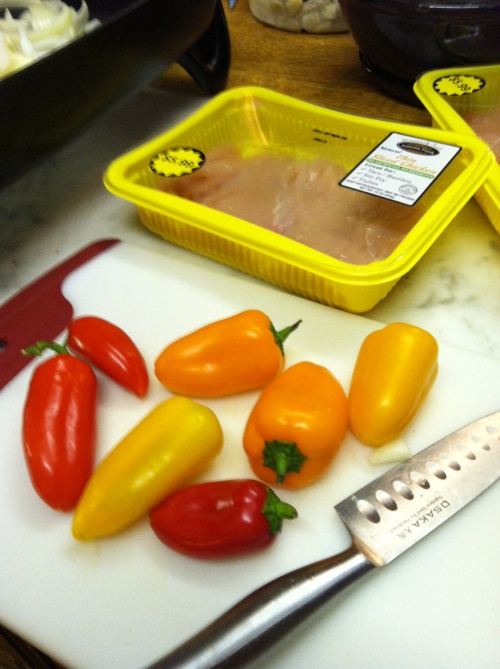
Pre-cut chicken breasts and sweet mini-peppers

Ingredients:

1 lb (454 kg) chicken breast, raw, boneless and skinless, cut in strips about 1/4-inch wide (you can often buy it this way)

7 oz onion, raw, cut in long crescent shapes about a 1/4-inch wide (0.6 cm)

6 oz (170 g) bell pepper, raw, cut in long strips roughly a 1/4-inch wide (these are also called sweet peppers; a combination of the red and green ones is eye-pleasing)

2 tbsp (30 ml) olive oil

5 or 6 oz (155 g) tomato, raw, cut in long strips

1 tsp (5 ml) salt

1/2 tsp (2.5 ml) pepper

1/2 tsp (2.5 ml) chili powder

1 tsp (5 ml) parsley flakes

1/2 tsp (2.5 ml) oregano leaves

1 pinch of cumin

1/2 tsp (2.5 ml) paprika

(Optional: You could replace all these spices with a 1-oz (28 g) pack of Lawry’s Chicken Fajitas Spices & Seasoning. The sodium and potassium values below would be different.)

1/3 cup (80 ml) water

16 oz (454 g) lettuce (e.g., iceberg, romaine, or bibb)

4 oz (113 g) walnuts

4 pears, small (about 1/3 lb or 150 g each))

Instructions:

Add the onions, peppers, and 1 tbsp (15 ml)  olive oil to a 12-inch (30 cm) skillet and cook at medium-high heat until tender, stirring occasionally. This’ll take about 10 minutes. Set the skillet contents aside.

paleobetic diet, paleo diet for diabetes

This is double the recipe amount since there are six humanoids in my household

paleobetic diet, paleo diet for diabetics

The vegetables reduce volume by half while cooking

In the same pan, add 1 tbsp (15 ml) olive oil and the chicken and cook at medium to medium-high heat, stirring frequently, until chicken is thoroughly cooked. For me, this cooked quicker than the vegetables. But don’t overcook or the chicken will get tough. Then add the water and all the spices. Bring to a boil while stirring occasionally, then simmer on low heat a few minutes. This is your fajita filling.

My original plan was to make “fajita wraps,” wrapping the cooked fajitas into a large leaf of iceberg lettuce. This was pretty messy, especially since I love the sauce in the bottom of the pan. I tried two leafs as a base: still messy. Finally I just made a bed of lettuce (4 oz) and loaded the fajita concoction right on top. Mess gone. Try a different lettuce? Skip the lettuce entirely and you can reduce digestible carb count in each serving by 2 grams.

Enjoy the walnuts and pear with your meal.

Leftovers taste just as good as fresh-cooked, perhaps even better.

I have another fajita recipe using skirt steak marinated in commercial Zesty Italian Dressing in the refrigerator overnight or for at least four hours. Grill it over coals outside. Yum! I don’t recall whether I added lemon juice to the marinade or squirted it on the meat just before serving. You would just cook the onions and peppers on a pan on the stove as above, with salt and pepper to taste. Garnish with a margarita and I’ll make you an honorary Texan.

Number of servings: 4

Serving size: A cup (240 ml) of the fajita mixture, 4 oz (113 g) lettuce, 1 oz (28 g) walnuts, 1 small pear. One cup makes two lettuce wraps.

Nutritional Analysis Per Serving:

48% fat

26% carbohydrate

26% protein

Calories: 514

37 g carbohydrate

10 g fiber grams

27 g digestible carbohydrate (25 g if you skip the lettuce)

928 mg sodium

904 mg potassium

Prominent features: Rich in protein, vitamin B6, vitamin B12, vitamin C,copper, iron, manganese, niacin, phosphorus, and selenium.

paleobetic diet

Another view, prior to rolling it up (wrapping)

1 Comment

Filed under Recipes, Uncategorized

Study Finds Shortened Lifespan From Obesity Even If “Metabolically Healthy”

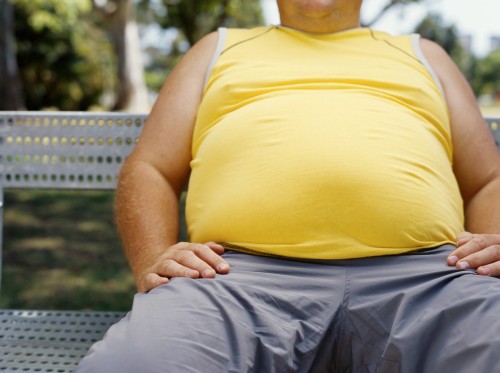
I'll eat my hat if this dude doesn't have metabolic syndrome

I’ll eat my hat if this dude doesn’t have metabolic syndrome

See details at MedPageToday.

Some studies suggest you can be healthy and long-lived while obese as long as you are “metabolically healthy.” That is, if you have normal blood pressure, LDL cholesterol, triglycerides, blood sugar, and waist circumference. A new meta-analysis finds that isn’t the case: you’re still at higher risk for death or cardiovascular events if you’re obese and free of metabolic syndrome features.

“Our results do not support this concept of ‘benign obesity’ and demonstrate that there is no ‘healthy’ pattern of obesity,” Kramer and colleagues wrote. “Even within the same category of metabolic status (healthy or unhealthy) we show that certain cardiovascular risk factors (blood pressure, waist circumference, low high-density lipoprotein cholesterol level, insulin resistance) progressively increase from normal weight to overweight to obese.”

Click for the scientific journal abstract.

This report does not directly address the “fat but fit” concept, whereby you can counteract some of the adverse health effects of obesity by being fit. By fit, I mean regularly exercising and achieving a decent level of capacity and tolerance for physical activity. Fat but fit still holds. In other words, if your choice is between being fat or physically fit, you’ll probably live longer and be healthier if you’re fit.

Steve Parker, M.D.

Comments Off on Study Finds Shortened Lifespan From Obesity Even If “Metabolically Healthy”

Filed under Longevity, Overweight and Obesity, Uncategorized

T1 and T2 Diabetes Are Both Rising in U.S. Youth

Between 2001 and 2009, the prevalence of type 1 diabetes and type 2 diabetes increased by 21% and 31%, respectively.

Reference: F. Bruder Stapleton, MD Reviewing Dabelea D et al., Journal of the American Medical Association 2014 May 7; 311:1778

Comments Off on T1 and T2 Diabetes Are Both Rising in U.S. Youth

June 18, 2014 · 11:26 AM

Do Pesticides Cause Type 1 Diabetes?

Maybe, according to a study done in Egypt.

“From the present findings, there is an observed strong association between
some types of pesticides (malathion, lindane, p.p.DDE, o.p.DDD, endrin and
p.p.DDA) and the risk of occurrence of childhood diabetes in relation to
the control non-diabetic group. To the best of our knowledge, this the
first study investigating the association between type 1 diabetes in
children and exposure to pesticides.”

Reference: El-Morsi DA, Rahman RHA, Abou-Arab AAK. Pesticides Residues in Egyptian
Diabetic Children: A Preliminary Study. J Clinic Toxicol. 2012;2:138.

Free full text: http://omicsonline.org/pesticides-residues-in-egyptian-diabetic-children-a-preliminary-study-2161-0495.1000138.pdf

Comments Off on Do Pesticides Cause Type 1 Diabetes?

Filed under Uncategorized