Tag Archives: diabetes

Latest Research: 1) Sleep Patterns and Diabetes, 2) Drop Metformin When You Start Insulin?

1) Lack of sleep coupled with disrupted day-night cycles predisposes to diabetes and prediabetes.  Night-shift workers take note.

2) Compared to those using metformin alone, type 2 diabetics who also took insulin needed less insulin and had better blood sugar levels.  Real-world benefits are not entirely clear.

Steve Parker, M.D. 

7 Comments

Filed under Drugs for Diabetes

Random Thoughts On Paleo Eating for People With Diabetes

Not really pertinent, but I like buffalo

I was interviewed a couple months ago by Amy Stockwell Mercer, author of Smart Woman’s Guide to Diabetes. All I knew beforehand was that she was interested in my thoughts on the paleo diet as applied to diabetes.  I think she had run across my PaleoDiabetic blog.

In preparation, I collected some random thoughts and did a little research.

What’s the paleo diet?

Fresh, minimally processed food. Meat (lean or not? supermarket vs yuppiefied?), poultry, eggs, fish, leafy greens and other vegetables, nuts, berries, fruit, and probably tubers.

Non-paleo: highly processed, grains, refined sugars, industrial plant/seed oils, legumes, milk, cheese, yogurt.

The paleo diet is also called Old Stone Age, caveman, ancestral, hunter-gatherer, and Paleolithic diet.

Is the paleo diet deficient in any nutrients?

A quick scan of Loren Cordain’s website found mention of possible calcium and vitamin D deficits. Paleoistas will get vitamin D via sun exposure and fish (especially cold-water fatty fish). Obtain calcium from broccoli, kale, sardines, almonds, collards. (I wonder if the Recommended Dietary Allowance for calcium is set too high.)

What About Carbohydrates and Diabetes and the Paleo Diet?

Diabetes is a disorder of carbohydrate metabolism. In a way, it’s an intolerance of carbohydrates. In type 1 diabetes, there’s a total or near-total lack of insulin production on an autoimmune basis. In type 2 diabetes, the body’s insulin just isn’t working adequately; insulin production can be high, normal or low. In both cases, ingested carboydrates can’t be processed in a normal healthy way, so they stack up in the bloodstream as high blood sugars. If not addressed adequately, high blood glucose levels sooner or later will poison body tissues . Sooner in type 1, later in type 2. (Yes, this is a gross over-simplification.)

Gluten-rich Neolithic food

If you’re intolerant of lactose or gluten, you avoid those. If you’re intolerant of carbohydrates, you could avoid eating them, or take drugs to help you overcome your intolerance. Type 1 diabetics must take insulin. Insulin’s more optional for type 2’s. We have 11 classes of drugs to treat type 2 diabetes; we don’t know the potential adverse effects of most of these drugs. Already, three diabetes drugs have been taken off the U.S. market or severely restricted due to unacceptable toxicity: phenformin, troglitazone, and rosiglitazone.

Humans need two “essential fatty acids” and nine “essential” amino acids derived from proteins. “Essential” means we can’t be healthy and live long without them. Our bodies can’t synthesize them. On the other hand, there are no essential carbohydrates. Our bodies can make all the carbohydrate (mainly glucose) we need.

Since there are no essential carbohydrates, and we know little about the long-term adverse side effects of many of the diabetes drugs, I favor carbohydrate restriction for people with carboydrate intolerance. (To be clear, insulin is safe, indeed life-saving, for those with type 1 diabetes.)

That being said, let’s think about the Standard American Diet (SAD) eaten by an adult. It provides an average of 2673 calories a day. Added sugars provide 459 of those calories, or 17% o the total. Grains provide 625 calories, or 23% of the total. And most of those sugars and grains are in processed, commercial foods. So added sugars and grains provide 40% of the total calories in the SAD. (Figures are from an April 5, 2011, infographic at Civil Eats.)

Anyone going from the SAD to pure Paleo eating will be drastically reducing intake of added sugars and grains, our current major sources of carbohydrate. Question is, what will they replace those calories with?

That’s why I gave a thumbnail sketch of the paleo diet above. Take a gander and you’ll see lots of low-carb and no-carb options, along with some carb options. For folks with carbohydrate intolerance, I’d favor lower-carb veggies and judicious amounts of fruits, berries, and higher-carb veggies and

Will these cause bladder cancer? Pancreatitis?

tubers. “Judicious” depends on the individual, considering factors such as degree of residual insulin production, insulin sensitivity, the need to lose excess weight, and desire to avoid diabetes drugs.

Compared to the standard “diabetic diet” (what’s that?) and the Standard American Diet, switching to paleo should lower the glycemic index and glycemic load of the diet. Theoretically, that should help with blood sugar control.

A well-designed low-carb paleo diet would likely have at least twice as much fiber as the typical American diet, which would also tend to limit high blood sugar excursions.

In general, I favor a carbohydrate-restricted paleo diet for those with diabetes who have already decided to “go paleo.” I’m not endorsing any paleo diet for anyone with diabetes at this point—I’m still doing my research. But if you’re going to do it, I’d keep it lower-carb.  E.g., under 100 g of digestible carb daily. It has a lot of potential.

Are There Any Immediate Dangers for a Person With Diabetes Switching to the Paleo Diet?

It depends on three things: 1) current diet, and 2) current drug therapy, and 3) the particular version of paleo diet followed.

Remember, the Standard American Diet provides 40% of total calories as added sugars and grains (nearly all highly refined). Switching from SAD to a low-carb paleo diet will cut carb intake and glycemic load substantially, raising the risk of hypoglycemia if the person is taking certain drugs.

Drugs with potential to cause hypoglycemia include insulin, sulfonylureas, meglitinides, pramlintide, and perhaps thiazolidinediones.

Who knows about carb content of the standard “diabetic diet”? Contrary to poplular belief, there is no monolithic “diabetic diet.” There is no ADA diet (American Diabetes Association). My impression, however, is that the ADA favors relatively high carbohydrate consumption, perhaps 45-60% of total calories. Switching to low-carb paleo could definitely cause hypoglycemia in those taking the aforementioned drugs.

One way to avoid diet-induced hypoglycemia is to reduce the diabetic drug dose.

A type 2 overweight diabetic eating a Standard American Diet—and I know there are many out there—would tend to see lower glucose levels by switching to probably any of the popular paleo diets. Be ready for hypoglycemia if you take those drugs.

Paleo diets are not necessarily low-carb. Konner and Eaton estimate that ancestral hunter-gatherers obtained 35 to 40% of total calories from carbohydrates. I’ve seen other estimates as low as 22%. Reality likely falls between 22 and 65%. When pressed for a brief answer as to how many carbohydrate calories are in the paleo diet, I say “about a third of the total.” By comparison, the typical U.S. diet provides 50% of calories from carbohydrate.

Someone could end up with a high-carb paleo diet easily, by emphasizing tubers (e.g., potatoes), higher-carb vegetables, fruits, berries, and nuts (especially cashews). Compared with the SAD, this could cause higher or lower blood sugars, or no net change.

A diabetic on a Bernstein-style diet or Ketogenic Mediterranean Diet (both very-low-carb) but switching to paleo or low-carb paleo (50-150 g?) would see elevated blood sugars. Perhaps dangerously high glucoses.

Any person with diabetes making a change in diet should do it in consultation with a personal physician or other qualified healthcare professional familiar with their case.

Steve Parker, M.D.

Fun Facts!

  • A typical carbonated soda contain the equivalent of 10 tsp (50 ml) of sugar.
  • The typical U.S. adult eats 30 tsp (150 ml) daily of added sweeteners and sugars.
  • U.S total grain product consumption was at record lows in the 1970s, at 138 pounds per person. By 2000, grain consumption was up by 45%, to 200 pounds per person.
  • Total caloric sweetener consumption (by dry weight) was 110 pounds per person in the 1950s. By 2000, it was up 39% to 150 pounds.
  • Between 1970 and 2003, consumption of added fats and oils rose by 63%, from 53 to 85 pounds. [How tasty would that be without starches and sugars? Not very.]
  • In 2008, “added fat” calories in the U.S. adult diet were 641 (24% of total calories).

Fun Facts provided by the U.S. Department of Agriculture.

 

5 Comments

Filed under Carbohydrate, Dairy Products, Drugs for Diabetes, Fat in Diet, Glycemic Index and Load, Grains, Paleo diet

Time to Update Your Strength Training Regimen?

Not Chris Highcock

Strength training, also called resistance training, is an important method for controlling blood sugars without drugs in folks with diabetes.

A few months ago I read Hillfit: Stength, an ebook  by Chris Highcock of Conditioning Research.  It’s about  improvement of hiking skills and enjoyment via strength training with without having to join a gym or buy lots of equipment.  I’ve been on Chris’s program for the last five weeks.

One of the scientific review articles he cites in support of his recommendations is an eye-opener.  Evidence-Based Resistance Training Recommendations is available free online.  It’s published in Medicina Sportiva, which I’m not familiar with.  I’ll confess I’ve read little of the hard-core literature on the science of strength training.  It’s one of my more recent interests.

An excerpt:

We recommend that appreciably the same muscular strength and endurance adaptations can be attained by performing a single set of ~8-12 repetitions to momentary muscular failure, at a repetition duration that maintains muscular tension throughout the entire range of motion, for most major muscle groups once or twice each week. All resistance types (e.g. free-weights, resistance machines, bodyweight, etc.) show potential for increases in strength, with no significant difference between them, although resistance machines appear to pose a lower risk of injury.

The article has got me questioning some of my long-held notions, such as how often to work out, number of reps moving a weight, speed of moving a weight, and whether I should stick with the free weights I tend to prefer.  Why not see if your dogma is supported?  Worth a look.

Steve Parker, M.D.

Fisher, James, et al.  Evidence-based resistance training recommendations.  Medicina Sportiva, 15 (2011): 147-162.

2 Comments

Filed under Exercise

Chronic Alcohol May Impair Vision in Diabetics

MedPage Today reported that long-term consumption of alcohol may impair vision in diabetics.  Drinkers performed less well on vision chart tests than non-drinkers. It’s not a diabetic retinopathy issue.

Beer and distilled spirits were riskier than wine.

The MedPage Today article didn’t comment on the potential health benefits of alcohol consumption. You can bet I’ll keep an eye on this.  (Did you get the pun?)

Steve Parker, M.D.

Comments Off on Chronic Alcohol May Impair Vision in Diabetics

Filed under Alcohol, Diabetes Complications

Dr. Richard Feinman on Carbohydrate Restriction for Diabetes

Dr. Feinman is a professor of biochemistry at Downstate Medical Center (SUNY) in New York.  A few days ago he wrote about the rationale behind carb restriction as an approach to diabetes.  We’re singin’ from the same page of the hymnal.

-Steve

1 Comment

Filed under Carbohydrate

White Rice Linked to Type 2 Diabetes

Did you see this?

http://ca.news.yahoo.com/white-rice-seen-type-2-diabetes-says-study-233837784.html

-Steve

Update March 15, 2012: I read the primary research article and blogged about it at Advanced Mediterranean Life.

2 Comments

Filed under Carbohydrate, Causes of Diabetes

Aerobic Versus Strength Training for People With Diabetes

“Resistance training, similarly to aerobic training, improves metabolic features and insulin sensitivity and reduces abdominal fat in type 2 diabetic patients,” according to a report in the current issue of Diabetes Care.

Italian researchers randomized 40 type 2 diabetics to follow either an aerobic or strength training program for four months.  The increase in peak oxygen consumption (VO2 peak) was greater in the aerobic group, whereas the strength training group gained more strength.  Hemoglobin A1c was similarly reduced in both groups, about 0.37%.  Body fat content was reduced in both groups, and insulin sensitivity and lean limb mass were similarly increased.  Pancreas beta-cell function didn’t change.

Per this one study, neither type of training seems superior overall.  If you’re just going to do one type of exercise program, choose your goal.  Do you want more strength, or more sustainable “windpower”? 

The Pennington Biomedical Research Center found somewhat different results in their larger and more complex study published in 2010.  However, they were primarily testing for diabetes control (as judged by hemoglobin A1c improvement), rather the improvements in strength or aerobic power.  The found the combination of aerobic and strength training is needed to improve diabetic blood sugar levels.  Both types of exercise—when considered alone—did not improve diabetes control. 

As for me, I do both strength and aerobic training.

By the way, I only read the abstract of the current research, not the full report. High-intensity intervals on a treadmill help me git’r done quicker.

Steve Parker, M.D.

PS: PWD = people or person with diabetes.  Do you like that term or would you prefer “diabetic”?

Reference:  Bacchi. Elizabeth, et al.  Metabolic Effects of Aerobic Training and Resistance Training in Type 2 Diabetic Subjects
A randomized controlled trial (the RAED2 study)
Diabetes Care.  Published online before print February 16, 2012, doi: 10.2337/dc11-1655

6 Comments

Filed under Exercise

173 Years of US Sugar Consumption

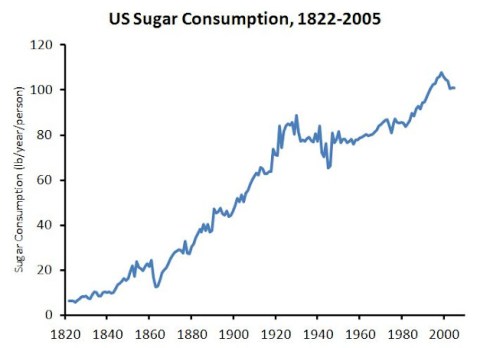
US Sugar Consumption: 1822-2005

 Thanks to Dr. Stephan Guyenet and Jeremy Landen for this sugar consumption graph.  I’d never seen one going this far back in time. 
 
Dr. Guyenet writes:
It’s a remarkably straight line, increasing steadily from 6.3 pounds per person per year in 1822 to a maximum of 107.7 lb/person/year in 1999.  Wrap your brain around this: in 1822, we ate the amount of added sugar in one 12 ounce can of soda every five days, while today we eat that much sugar every seven hours.
The U.S. Department of Agriculture estimates that added sugars provide 17% of the total calories in the average American diet.  A typical carbonated soda contain the equivalent of 10 tsp (50 ml) of sugar.  The average U.S. adult eats 30 tsp  (150 ml) daily of added sweeteners and sugars.
 
Note that added sugars overwhelmingly supply only one nutrient: pure carbohdyrate without vitamins, minerals, protein, fat, antioxidants, etc.
 
Do you think sugar consumption has anything to do with diseases of affluence, also known as diseases of modern civilization?  I do.
 
Was our pancreas designed to handle this much sugar?  Apparently not, judging from skyrocketing rates of diabetes and prediabetes.


4 Comments

Filed under Carbohydrate, Causes of Diabetes, Sugar

What About Sugar Alcohols?

Dietitian Brenna at Eating Simple recently posted an article on artificial sweeteners exclusive of sugar alcohols.  Now she’s reviewed sugar alcohols.  Many who have a sweet tooth, including myself, use sugar substitutes such as sugar alcohols.  Sometimes they affect blood sugar levels, although not as much as sugar.

Dr. Maria Collazo-Clavell at the Mayo Clinic wrote about use of artificial sweeteners by people with diabetes.  Like Brenna, she notes that sugar alcohols can raise blood sugar levels in people with diabetes.  The Mayo Clinic has another article on sugar substitutes.

Steve Parker, M.D.

2 Comments

Filed under Sugar Substitutes

UCSF Investigating Paleolithic Diet For Diabetics

  A May, 2010, press release from University of California San Francisco outlines the university’s research into use of the Paleolithic diet (aka Stone Age or caveman diet) for people with type 2 diabetes.  From the press release:

The initial research findings are striking. Without losing weight, participants in a preliminary study improved blood sugar control, blood pressure control and blood vessel elasticity. They lowered levels of blood fats such as cholesterol. And most amazingly, participants achieved these results in less than three weeks — simply by switching to a Paleolithic diet.

The lead researchers are nephrologist Lynda Frassetto and endocrinologist Umesh Masharani.  Frassetto and team had previously looked at metabolic improvements linked to the paleo diet.

We await publication of their current findings in a peer-reviewed scientific journal.  C’mon people, it’s 2012 already.  In the meantime, I prefer the Low-Carb Mediterranean Diet.

Steve Parker, M.D.

6 Comments

Filed under Paleo diet