Carbohydrates Can Kill

Carbohydrates Can KillI did a phone interview yesterday with Dr. Robert K. Su, author of Carbohydrates Can Kill.  It should be available in podcast form at Dr. Su’s website within the next three months.  Dr. Su is on a mission to educate the public on the dangers of excessive blood sugar levels, whether or not diabetes or prediabetes is present.  Visit Dr. Su’s website for a wealth of information on carbohydrates and their effects on blood sugar levels and health.

Steve Parker, M.D., author of Conquer Diabetes and Prediabetes: The Low-Carb Mediterranean Diet

Comments Off on Carbohydrates Can Kill

Filed under Uncategorized

Exercise, Part 8: Warnings and Precautions for Diabetics

Exercise clearly has many benefits, as discussed in prior installments of this series.  Yet we shouldn’t overlook the potential risks to diabetics either. 

Diabetic Retinopathy

Diabetics with retinopathy (an eye disease caused by diabetes) have an increased risk of retinal detachment and bleeding into the eyeball called vitreous hemorrhage. These can cause blindness. Vigorous aerobic or resistance training may increase the odds of these serious eye complications. Patients with retinopathy may not be able to safely participate. If you have any degree of retinopathy, avoid the straining and breath-holding that is so often done during weightlifting or other forms of resistance exercise. Vigorous aerobic exercise may also pose a risk. By all means, check with your ophthalmologist first. You don’t want to experiment with your eyes.

Diabetic Feet and Peripheral Neuropathy 

Diabetics are prone to foot ulcers, infections, and ingrown toenails, especially if peripheral neuropathy (numbness or loss of sensation) is present. Proper foot care, including frequent inspection, is more important than usual if a diabetic exercises with her feet. Daily inspection should include the soles and in-between the toes, looking for blisters, redness, calluses, cracks, scrapes, or breaks in the skin. See your physician or podiatrist for any abnormalities. Proper footwear is important (for example, don’t crowd your toes). Dry feet should be treated with a moisturizer regularly. In cases of severe peripheral neuropathy, non-weight-bearing exercise (e.g., swimming or cycling) may be preferable. Discuss with your physician or podiatrist.

Hypoglycemia

Low blood sugars are a risk during exercise if you take diabetic medications in the following classes: insulins, sulfonylureas, meglitinides, and possibly thiazolidinediones and bromocriptine. Hypoglycemia is very uncommon with thiazolidinediones. Bromocriptine is so new (for diabetes) that we have little experience with it; hypoglycemia is probably rare or non-existent. See drug details in chapter four. Diabetics treated with diet alone or other medications rarely have trouble with hypoglycemia during exercise.

Always check your blood sugar before an exercise session if you are at risk for hypoglycemia. Always have glucose tablets, such as Dextrotabs, available if you are at risk for hypoglycemia. Hold off on your exercise if your blood sugar is over 200 mg/dl (11.1 mmol/l) and you don’t feel well, because exercise has the potential to raise blood sugar even further early in the course of an exercise session.

As an exercise session continues, active muscles may soak up bloodstream glucose as an energy source, leaving less circulating glucose available for other tissues such as your brain. Vigorous exercise can reduce blood sugar levels below 60 mg/dl (3.33 mmol/l), although it’s rarely a problem in non-diabetics.

The degree of glucose removal from the bloodstream by exercising muscles depends on how much muscle is working, and how hard. Vigorous exercise by several large muscles will remove more glucose. Compare a long rowing race to a slow stroll around in the neighborhood. The rower is strenuously using large muscles in the legs, arms, and back. The rower will pull much more glucose out of circulation. Of course, other metabolic processes are working to put more glucose into circulation as exercising muscles remove it. Carbohydrate consumption and diabetic medications are going to affect this balance one way or the other.

If you are at risk for hypoglycemia, check your blood sugar before your exercise session. If under 90 mg/dl (5.0 mmol/l), eat a meal or chew some glucose tablets to prevent exercise-induced hypoglycemia. Re-test your blood sugar 30–60 minutes later, before you exercise, to be sure it’s over 90 mg/dl (5.0 mmol/l). The peak effect of the glucose tablets will be 30–60 minutes later. If the exercise session is long or strenuous, you may need to chew glucose tablets every 15–30 minutes. If you don’t have glucose tablets, keep a carbohydrate source with you or nearby in case you develop hypoglycemia during exercise.

Re-check your blood sugar 30–60 minutes after exercise since it may tend to go too low.

If you are at risk of hypoglycemia and performing moderately vigorous or strenuous exercise, you may need to check your blood sugar every 15–30 minutes during exercise sessions until you have established a predictable pattern. Reduce the frequency once you’re convinced that hypoglycemia won’t occur. Return to frequent blood sugar checks when your diet or exercise routine changes.

These general guidelines don’t apply across the board to each and every diabetic. Our metabolisms are all different. The best way to see what effect diet and exercise will have on your glucose levels is to monitor them with your home glucose measuring device, especially if you are new to exercise or you work out vigorously. You can pause during your exercise routine and check a glucose level, particularly if you don’t feel well. Carbohydrate or calorie restriction combined with a moderately strenuous or vigorous exercise program may necessitate a 50 percent or more reduction in your insulin, sulfonylurea, or meglitinide. Or the dosage may need to be reduced only on days of heavy workouts. Again, enlist the help of your personal physician, dietitian, diabetes nurse educator, and home glucose monitor.

Finally, insulin users should be aware that insulin injected over muscles that are about to be exercised may get faster absorption into the bloodstream. Blood sugar may then fall rapidly and too low. For example, injecting into the thigh and then going for a run may cause a more pronounced insulin effect compared to injection into the abdomen or arm.

Autonomic Neuropathy

This issue is pretty technical and pertains to function of automatic, unconscious body functions controlled by nerves. These reflexes can be abnormal, particularly in someone who’s had diabetes for many years, and are called autonomic neuropathy. Take your heart rate, for example. It’s there all the time, you don’t have to think about it. If you run to catch a bus or climb two flights of stairs, your heart rate increases automatically to supply more blood to exercising muscles. If that automatic reflex doesn’t work properly, exercise is more dangerous, possibly leading to passing out, dizziness, and poor exercise tolerance. Other automatic nerve systems control our body temperature regulation (exercise may overheat you), stomach emptying (your blood sugar may go too low), and blood pressure (it could drop too low). Only your doctor can tell for sure if you have autonomic neuropathy.

Steve Parker, M.D.

4 Comments

Filed under Diabetes Complications, Exercise

Mediterranean Diet Linked to Lower Childhood Asthma

Researchers note lower risk of asthma symptoms in Greek 10- to 12-year-olds following a traditional Mediterranean diet, according to a recent Journal of the American Dietetic Association.

I reported in 2008 on a Portuguese study that found much improved control of adult asthma in those eating a Mediterranean diet.  Why, I even seem to recall a study that found a lower incidence of asthma in children of mothers who ate Mediterranean-style.

If you’re an overweight adult with asthma, why not look into the Sonoma Diet by Connie Guttersen, or my Advanced Mediterranean Diet?  People with diabetes or prediabetes may do better with the Low-Carb Mediterranean Diet.

Steve Parker, M.D.

3 Comments

Filed under Health Benefits, Mediterranean Diet

Pilot Study: Paleo Diet Is More Satiating Than Mediterranean-Style

Swedish researchers reported recently that a Paleolithic diet was more satiating than a Mediterranean-style diet, when compared on a calorie-for-calorie basis in heart patients.  Both groups of study subjects reported equal degrees of satiety, but the paleo dieters ended up eating 24% fewer calories over the 12-week study.

The main differences in the diets were that the paleo dieters had much lower consumption of cereals (grains) and dairy products, and more fruit and nuts.  The paleos derived 40% of total calories from carbohydrate compared to 52% among the Mediterraneans.

Even though it wasn’t a weight-loss study, both groups lost weight.  The paleo dieters lost a bit more than the Mediterraneans: 5 kg vs 3.8 kg (11 lb vs 8.4 lb).  That’s fantastic weight loss for people not even trying.  Average starting weight of these 29 ischemic heart patients was 93 kg (205 lb).  Each intervention group had only 13 or 14 patients (I’ll let you figure out what happened to to the other two patients).

I blogged about this study population before.  Participants supposedly had diabetes or prediabetes, although certainly very mild cases (average hemoglobin A1c of 4.7% and none were taking diabetic drugs)

As I slogged through the research report, I had to keep reminding myself that this is a very small, pilot study.  So I’ll not bore you with all the details.

Bottom Line

This study suggests that the paleo diet may be particularly helpful for weight loss in heart patients.  No one knows how results would compare a year or two after starting the diet.  The typical weight-loss pattern is to start gaining the weight back at six months, with return to baseline at one or two years out.

Greek investigators found a link between the Mediterranean diet and better clinical outcomes in known ischemic heart disease patients.  On the other hand, researchers at the Heart Institute of Spokane found the Mediterranean diet equivalent to a low-fat diet in heart patients, again in terms of clinical outcomes.  U.S. investigators in 2007 found a positive link between the Mediterranean diet and lower rates of death from cardiovascular disease and cancer

We don’t yet have these kinds of studies looking at the potential benefits of the paleo diet.  I’m talking about hard clinical endpoints such as heart attacks, heart failure, cardiac deaths, and overall deaths.  The paleo diet definitely shows some promise.

I also note the Swedish investigators didn’t point out that weight loss in overweight heart patients may be detrimental.  This is the “obesity paradox,” called “reverse epidemiology” at Wikipedia.  That’s a whole ‘nother can o’ worms.

Keep your eye on the paleo diet.

Steve Parker, M.D.

Reference: Jonsson, Tommy, et al.  A paleolithic diet is more satiating per calorie than a mediterranean-like diet in individuals with ischemic heart diseaseNutrition and Metabolism, 2010, 7:85.

5 Comments

Filed under coronary heart disease, Mediterranean Diet

Book Review: Secrets of a Healthy Diet: What to Eat, What to Avoid, and What to Stop Worrying About

I recently read Secrets for a Healthy Diet: What to Eat, What to Avoid, and What to Stop Worrying About by Monica Reinagel (2011).  It’s aimed at the general public rather than people with diabetes or overweight.  I give it five stars on Amazon’s rating system (I love it). 

♦   ♦   ♦

This indispensible book cuts through the malarky of nearly all recent nutrition fads, sharing with us the science-based nutrition ideas that prevent disease and prolong life.  If you’re eating the Standard American Diet (SAD), you need this book.  The author gives highly practical suggestions on how to make your diet healthier immediately. 

In short, Ms. Reinagel focuses on minimally processed, whole foods, and preparing your own meals.  But there’s so much more here.  As you might expect, the Mediterranean diet was discussed very favorably.

I’ve been following Monica Reinagel’s nutrition writing carefully for the last three years.  She knows the nutrition science literature as well as anyone, if not better.

The book starts with an unusually detailed table of contents that helps you find what you’re interested in without wasting time.

As promised by the subtitle, the author tells you what you DON’T need to worry about.  Is mercury in fish a problem?  What about bisphenol-A in plastic containers and canned foods?  Does red meat cause cancer?  Is pesticide residue on our food a problem?  Is salt a killer?  

I stay up to date on nutrition much more than the average physician, but the author introduced me to several new concepts, such as hemp milk, oat milk, and the idea that “pregnant women and small children should avoid cured meats altogether.”  I was particularly interested in her thoughts on the intersection of nutrition and exercise since I recently started an exercise program called Core Performance.

She successfully debunks many nutrition myths, such as 1) the need to eat every 2-3 hours, 2) saturated fat is bad for your heart and arteries, 3) eggs are bad for you (too much cholesterol, you know), 4) grain products are essential for health.

Any deficiencies in the book?  The font size is on the small side for people over 45.  On page 150, vitamin K is confused with vitamin D – undoubtedly a simple misprint.  No mention of the raw milk controversy.  When discussing potassium chloride as a salt substitute, she doesn’t mention the potential risk to people with kidney impairment or taking certain fluid pills. Tips on how to select fresh fish would have been helpful.

In summary, this is a great book for anyone wanting to get healthier via nutrition, but who’s confused by all the recent controversies.  The book is without peer.  If everything you learned about healthy eating was acquired over 10 years ago, you’re way out of date and need this book.  I hope the author does an updated edition every five years or so.

Steve Parker, M.D., author of Conquer Diabetes and Prediabetes: The Low-Carb Mediterranean Diet and The Advanced Mediterranean Diet: Lose Weight, Feel Better, Live Longer.

Disclosure: Other than a free advance review copy of the book from the publisher, I received nothing of value for writing this review.

4 Comments

Filed under Book Reviews

Exercise, Part 7: Could Exercise Hurt Me?

To protect you from injury, I recommend that you obtain “medical clearance” from a personal physician before starting an exercise program.  A physician is in the best position to determine if your plans are safe for you, thereby avoiding complications such as injury and death.  Nevertheless, most adults can start a moderate-intensity exercise program with little risk.  An example of moderate intensity would be walking briskly (3–4 mph or 4.8–6.4 km/h) for 30 minutes daily.

Men over 40 and women over 50 who anticipate a more vigorous program should consult a physician to ensure safety.  The physician may well recommend diagnostic blood work, an electrocardiogram (heart electrical tracing), and an exercise stress test (often on a treadmill).  The goal is not to generate fees for the doctor, but to find the occasional person for whom exercise will be dangerous, if not fatal.  Those who drop dead at the start of a vigorous exercise program often have an undiagnosed heart condition, such as blockages in the arteries that supply the heart muscle.  The doctor will also look for other dangerous undiagnosed “silent” conditions, such as leaky heart valves, hereditary heart conditions, aneurysms, extremely high blood pressure, and severe diabetes.

The American Diabetes Association’s Standards of Care—2011 states that routine testing of all diabetics for heart artery blockages before an exercise program is not recommended; the doctor should use judgment case-by-case.  Many diabetics (and their doctors) are unaware that they already have “silent” coronary artery disease (CAD).  CAD is defined by blocked or clogged heart arteries, which reduced the blood flow to the hard-working heart muscle.  Your heart pumps 100,000 times a day, every day, for years without rest.  CAD raises the odds of fainting, heart attack, or sudden death during strenuous exercise.  I recommend a cardiac stress test (or the equivalent) to all diabetics prior to moderate or vigorous exercise programs, particularly if over 40 years old. CAD can thus be diagnosed and treated before complications arise.  Ask your personal physician for her opinion.

Regardless of age and diabetes, other folks who may benefit from a medical consultation before starting an exercise program include those with known high blood pressure, high cholesterol, joint problems (e.g., arthritis, degenerated discs), neurologic problems, poor circulation, lung disease, or any other significant chronic medical condition.  Also be sure to check with a doctor first if you’ve been experiencing chest pains, palpitations, dizziness, fainting spells, headaches, frequent urination, or any unusual symptoms (particularly during exertion).

Physicians, physiatrists, physical therapists, and exercise physiologists can also be helpful in design of a safe, effective exercise program for those with established chronic medical conditions. 

Steve Parker, M.D.

2 Comments

Filed under Exercise

Greater Risk of Death in Diabetics with Lower Salt Intake

Have you noticed the national push for lower salt consumption? It’s driven by the idea that lower consumption will reduce the risk of heart attacks, strokes, and death, supposedly mediated through lower blood pressure.

The latest issue of Diabetes Care has a research report showing a greater risk of death in type 2 diabetics with lower salt consumption over the course of 10 years. Yes, you read that right: greater risk of death with lower salt consumption.

Keep your eyes and ears open on this issue.

Steve Parker, M.D.

3 Comments

Filed under Uncategorized

Exercise, Part 6: Make It a Habit

So, I’ve convinced you that regular physical activity offers some great health benefits and you’re ready to get started. A couple weeks of intensive effort on your part, but then quitting, isn’t going to do you any good. In fact, it’s more likely to do harm (injury) than good.

The main objective at this point is to make regular physical activity a habit. Establishment of a habit requires frequent repetition over at least two or three months, regardless of the weather, whether you feel like it or not. Over time the chosen activity becomes part of your identity.

To avoid injury and burn out, begin your exercise program slowly and increase the intensity of your effort only every two or three weeks. Your body needs time to adjust to its new workload, but it will indeed adjust. Enhance your enjoyment with proper attire, equipment, and instruction, if needed. Use a portable radio or digital music system like an iPod or Zune if you tend to get bored exercising.

The “buddy system” works well for many of my patients: agree with a friend that you’ll meet regularly for walking, jogging, whatever. If you know your buddy is counting on you to show up at the park at 7 a.m., it may be just the motivation you need to get you out of bed. Others just can’t handle such regimentation and enjoy the flexibility and independence of solitary activity.

If you like to socialize, join a health club or sports team. Large cities have organized clubs that promote a wide range of physical activities. Find your niche.

Don’t be afraid to try something new. Expect some disappointment and failed experiments. Learn and grow from adversity and failure. Put a lot of thought into your choice of activity. Avoid built-in barriers. If you live in Florida you won’t have much opportunity for cross-country skiing. If joining a health club is a financial strain, walk instead. Perhaps pick different activities for cold and warm weather. Or do several types of exercise to avoid boredom.

 In summary, formation of the exercise habit requires forethought, repetition, and commitment. You must schedule time for physical activity. Make it a priority. Hundreds of my couch potato patients have done it, and I’m sure you can, too. I’ve seen 40-year-old unathletic, uncoordinated barnacles start exercising and run marathons two years later. (A marathon is 26.2 miles or 42.2 km.)

Part 7 of the series covers “medical clearance.”

Steve Parker, M.D.

Comments Off on Exercise, Part 6: Make It a Habit

Filed under Exercise

Exercise, Part 5: Aerobic Exercise

What’s “aerobic activity”? Just about anything that mostly makes you huff and puff. In other words, get short of breath to some degree. Examples are brisk walking, swimming, golf (pulling a cart or carrying clubs), lawn work, painting, home repair, racket sports and table tennis, house cleaning, leisurely canoeing, jogging, bicycling, jumping rope, and skiing. The possibilities are endless. A leisurely stroll in the shopping mall doesn’t qualify, unless that makes you short of breath. Don’t laugh: that is a workout for many who are obese.

But which aerobic physical activity is best? Glad you asked!

The most important criterion is that it be pleasant for you. If not outright fun, it should be often enjoyable and always tolerable.

Your exercise of choice should also be available year-round, affordable, safe, and utilize large muscle groups. The greater mass and number of muscles used, the more calories you will burn, which is important if you’re trying to lose weight or prevent gain. Compare tennis playing with sitting in a chair squeezing a tennis ball repetitively. The tennis player burns calories much faster. Your largest muscles are in your legs, so consider walking, biking, many team sports, ski machines, jogging, treadmill, swimming, water aerobics, stationary cycling, stair-steppers, tennis, volleyball, roller-skating, rowing, jumping rope, and yard work.

Walking is “just what the doctor ordered” for many people. It’s readily available, affordable, usually safe, and requires little instruction. If it’s too hot, too cold, or rainy outside, you can do it in a mall, gymnasium, or health club.

Another option is instructional exercise DVDs, often featuring either a celebrity or prominent fitness trainer. Many of these programs require only a pair of sneakers and loose clothing. Others include the option of using inexpensive equipment, such as light hand-held weights.

If exercise videos sound appealing, consider one of these: Walk Away the Pounds—Walk Strong, by Leslie Sansone; Tighter Assets With Tamilee: Weight Loss & Cardio, by Tamilee Webb; Burn & Firm—Circuit Training, by Karen Voight; Minna Optimizer—Balanced Blend, by Minna Lessig; Personal Training System, by Denise Austin; Timesaver—Lift Weights to Lose Weight (volumes 1 & 2), Super Slimdown Circuit, and Functionally Fit—Peak Fat Burning, by Kathy Smith. Search for these titles at Amazon.com, where you can read reviews of them by actual users. Although many of these are designed for weight loss, you’ll get a good workout even if you’re at a healthy weight. Several of them also feature strength training.

Another fun option for indoor aerobic exercise is Dance Dance Revolution by Konami. Perhaps you’ve seen a version of this video game in an arcade. You must use a video game console, such as a PlayStation or Xbox, and the Dance Dance Revolution Controller along with your TV screen. The controller is a 32 inch by 36 inch (81 x 91 cm) floor pad partitioned into several large squares. The TV screen shows you which squares to step on in sequence as the music plays, and you rack up points for accurate timing and foot placement. If you enjoy moving to music, it’s more fun than I can describe

The latest indoor computerized exercise gadgets are the Kinect for Microsoft’s Xbox 360, the PlayStation Move, and Wii Fit. Check’em out.

Steve Parker, M.D.

Comments Off on Exercise, Part 5: Aerobic Exercise

Filed under Exercise

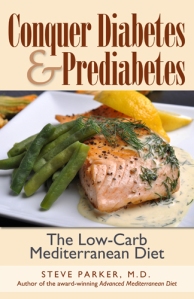
Unleashing “Conquer Diabetes and Prediabetes: The Low-Carb Mediterranean Diet”

My idea behind this blog has been to create an adaptation of the healthy Mediterranean diet for people with type 2 diabetes.  The Mediterranean diet alone has too many carbohydrates for the average diabetic. 

The initial adaptation has been done and available free here for many months.  The whole shebang is now available in book and ebook form, entitled Conquer Diabetes and Prediabetes: The Low-Carb Mediterranean Diet

You’ll find the printed version at Amazon.com and CreateSpace.  The ebook is available in multiple formats at Smashwords, and the Kindle version is at the Kindle Store.

Compared with jumping from page to page at this website and using your own printer, the book’s a pretty good deal.  It runs $16.95 (USD) at Amazon, and the ebook is $9.99.

What’s In the Book?

 Here’s the news release:

Dr. Steve Parker has created the first-ever low-carbohydrate Mediterranean diet, designed for people with type 2 diabetes and prediabetes.  His science-based plan blends the healthy components of the traditional Mediterranean diet with the ease and effectiveness of low-carb eating.  Conquer Diabetes and Prediabetes: The Low-Carb Mediterranean Diet teaches how to lower blood sugars naturally, reduce or eliminate diabetic medications, and lose excess weight if needed.

Type 2 diabetics and prediabetics have lost the ability to process carbohydrates safely.  Carbohydrates have become poisonous for them.  Carb toxicity too often leads to numb and painful limbs, impaired vision, kidney failure, amputations, cancer, and premature heart attacks, strokes, and death.

Nutrition experts worldwide agree that the Mediterranean diet is the healthiest way of eating for the general public.  It prolongs life and reduces rates of heart attack, stroke, cancer, and dementia.  The only problem for diabetics is that it provides too many toxic carbohydrates.

Dr. Parker initially recommends a very-low-carb ketogenic diet for 12 to 18 weeks, then teaches the reader how to gradually add more healthy carbohydrates depending on blood sugar and body weight changes.  Due to the toxic nature of carbohydrates in people with impaired blood sugar metabolism, most diabetics won’t be able to tolerate more than 80-100 grams of carbohydrate daily.  (The average Western diet provides 250 grams.)  

The book provides recipes, a week of menus, instruction on exercise, discussion of all available diabetic medications, advice on prevention of weight regain, lists of delicious doctor-approved foods, 71 scientific references, an annotated bibliography, and an index. All measurements are given both in U.S. customary and metric units.

Steve Parker, M.D., is a leading medical expert on the Mediterranean diet and author of the award-winning Advanced Mediterranean Diet: Lose Weight, Feel Better, Live Longer.   He has over two decades’ experience practicing Internal Medicine and treating patients with diabetes and prediabetes.

13 Comments

Filed under Shameless Self-Promotion