Mediterranean Diet for Diabetes

In 2009, Current Diabetes Reports published “The usefulness of a Mediterranean-based diet in individuals with type 2 diabetes,” by Catherine M. Champagne, Ph.D., R.D., L.D.N.  Unfortunately, the full article isn’t available to you at no cost.  But I read it.  Her article is a review of available scientific evidence related to the Mediterranean diet as applied to a diabetic population.  Here’s a quote:

This diet is a viable treatment option; advisors should stress not only adherence to a fairly traditional Mediterranean eating plan but also a lifestyle that includes sufficient physical activity.

I’ve been publishing my series on exercise here in dribs and drabs for the last several months.

Dr. Champagne was very favorably impressed with the DIRECT trial of Shai et al, which I covered extensively elsewhere.  DIRECT compared three diets over 24 months: Atkins, Mediterranean/calorie-restricted, and low-fat/calorie-restricted.  Mind you, it was a weight loss study, but a fair number of diabetics participated.  Mediterranean-style eating showed the most beneficial effects for diabetics. 

The author also mentions evidence that a modified Mediterranean diet may help counteract the build-up of fat in the liver, seen in up to 70% of type 2 diabetics.  I wrote recently about how a very-low-carb diet beat the low-fat diet so often recommended for this condition (hepatic steatosis or non-alcoholic fatty liver disease).

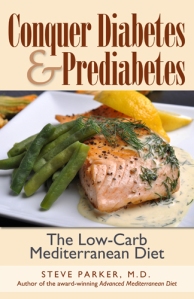
ResearchBlogging.orgIf you want full online access to Champagne’s 6-page article, you can purchase it for $34 (USD) at SpringerLink.  I cite many of the same scientific sources and provide a whole lot more in my 216-page Conquer Diabetes and Prediabetes: The Low-Carb Mediterranean Diet, at Amazon.com for $16.95 or $9.99 (the Kindle edition) or in multiple ebook formats from Smashwords.

Steve Parker, M.D.

Reference: Champagne, Catherine (2009). The usefulness of a Mediterranean-based diet in individuals with type 2 diabetes. Current Diabetes Reports DOI: 10.1007/s11892-009-0060-3

1 Comment

Filed under Health Benefits, Mediterranean Diet, Shameless Self-Promotion

Book Review: Zest For Life – The Mediterranean Anti-Cancer Diet

I recently read Zest For Life: The Mediterranean Anti-Cancer Diet, by Conner Middelmann-Whitney.  I give it five stars per Amazon.com’s rating system.

♦   ♦   ♦

The lifetime risk of developing invasive cancer in the U.S. is four in ten: a little higher for men, a little lower for women.  Those are scary odds.  Cancer is second only to heart disease as a cause of death in western societies.  The Mediterranean diet has a well established track record of protecting against cancers of the prostate, colon/rectum, uterus, and prostate.  Preliminary data suggest protection against melanoma and stomach cancer, too.  I’m not aware of any other way of eating that can make similar claims. 

So it makes great sense to spread the word on how to eat Mediterranean-style, to lower your risk of developing cancer.  Such is the goal of Ms. Conner Middelmann-Whitney.  The Mediterranean diet is mostly, although by no means excusively, plant-based.  It encourages consumption of natural, minimally processed, locally grown foods.  Generally, it’s rich in vegetables, fruits, legumes, oive oil, whole grains, red wine, and nuts.  It’s low to moderate in meat, chicken, fish, eggs, and dairy products (mostly cheese and yogurt).

Note that one of the four longevity hot spots featured in Dan Buettner’s Blue Zones was Mediterranean: Sardinia.  All four Blue Zones were characterized by plant-based diets of minimally processed, locally grown foods.  (I argue that Okinawa and the Nicoya Peninsula dwellers ate little meat simply due to economic factors.)

Proper diet won’t prevent all cancer, but perhaps 10-20% of common cancer cases, such as prostate, breast, colorectal, and uterine cancer.  A natural, nutrient-rich, mostly plant-based diet seems to bolster our defense against cancer.

Ms. Middelmann-Whitney is no wacko claiming you can cure your cancer with the right diet modifications.  She writes, “…I do not advocate food as a cancer treatment once the disease has declared itself….” 

She never brings it up herself, but I detect a streak of paleo diet advocacy in her.  Several of her references are from Loren Cordain, one of the gurus of the modern paleo diet movement.  She also mentions the ideas of Michael Pollan very favorably.

She’s not as high on whole grains as most of the other current nutrition writers.  She points out that, calorie for calorie, whole grains are not as nutrient-rich as vegetables and fruits.  Speaking of which, she notes that veggies generally have more nutrients than fruits.  Furthermore, she says, grain-based flours probably contribute to overweight and obesity.  She suggests that many people eat too many grains and would benefit by substituting more nutrient-rich foods, such as veggies and fruits.

Some interesting things I learned were 1) the 10 most dangerous foods to eat while driving, 2) the significance of organized religion in limiting meat consumption in some Mediterranean regions, 3) we probably eat too many omega-6 fatty acids, moving the omega-6/omega-3 ratio away from the ideal of 2:1 or 3:1, 4) one reason nitrites are added to processed meats is to create an pleasing red color (they impair bacterial growth, too), 5) fresh herbs are better added towards the end of cooking, whereas dried herbs can be added earlier, 6) 57% of calories in western societies are largely “empty calories:” refined sugar, flour, and industrially processed vegetable oils,  and 7) refined sugar consumption in the U.S. was 11 lb (5 kg) per person in the 1830s, rising to 155 lb (70 kg) by 2000.

Any problems with the book?  The font size is a bit small for me; if that worries you, get the Kindle edition and choose your size.  She mentions that omega-6 and omega-3 fatty acids as “essential” fats. I bet she meant to say that linolenic and linoleic fatty acids are essential (our bodies can’t make them); linolenic happens to be an omega-3, linoleic is an omega-6.  Reference #8 in chapter three is missing.  She states that red and processed meats cause cancer, or at least are strongly linked; in my view, the studies are inconclusive.  I’m not sure that cooking in or with polyunsaturated plant oils causes formation of free radicals that we need to worry about.

As would be expected, the author and I don’t see eye to eye on everything.  For example, she worries about bisphenol-A, pesticide residue, saturated fat, excessive red meat consumption, and strongly prefers pastured beef and free-range chickens and eggs.  I don’t worry.  She also subscribes to the “precautionary principle.”

The author shares over 150 recipes to get you started on your road to cancer prevention.  I easily found 15 I want to try.  She covers all the bases on shopping for food, cooking, outfitting a basic kitchen, dining out, shopping on a strict budget, etc.  Highly practical for beginning cooks.  Numerous scientific references are listed for you skeptics.

I recommend this book to all adults with normal carbohydrate metabolism, particularly for those with a strong family history of cancer.  But following the author’s recommendations would do more than lower your risk of cancer.  You’d likely have a longer lifespan, lose some excess fat weight,  and lower your risk of type 2 diabetes, dementia, heart disease, stroke, vision loss from macular degeneration, and obesity.  Particularly compared to the standard American diet. 

Steve Parker, M.D.

Disclosure: The author arranged a free copy of the book for me, otherwise I recieved nothing of value for writing this review.

3 Comments

Filed under Book Reviews, cancer, Health Benefits, Mediterranean Diet

Book Review: Which Comes First, Cardio or Weights?

I just read Which Comes First, Cardio or Weights?: Fitness Myths, Training Truths, and Other Surprising Discoveries from the Science of Exercise by Alex Hutchinson, published in 2011.  Per Amazon.com’s rating system, I give it five stars (I love it).

♦   ♦   ♦

Since starting Mark Verstegen’s Core Performance workout program four months ago, I’ve developed a serious interest in exercise.  I stumbled across one of Alex Hutchinson’s helpful (and recommended) blogs: Sweat Science.  That’s where I heard about this book.

Mr. Hutchinson uses a Q & A format to address 113 debatable issues facing people who exercise regularly.   The questions are independent although grouped according to subject matter, such as “Nutrition and Hydration.”  This is great for those who have time only for snippets of reading (bathroom reading, for example).

High-intensity interval training (HIIT) is a particular interest of mine lately.  I see it as way to replace five hours a week of traditional cardio (aerobic) training with just one hour.  The author gives a nice description of HIIT and succinctly and accurately summarizes the science in support of it, along with the risks.

Mr. Hutchinson typically answers controversial questions with the best available evidence from current scientific research.  Rarely, he has to depend simply on expert concensus, which is less reliable.  I envision a new edition every five years or so.

The book is easy to read.  The style is congenial and witty.  Contrary to a recent publishing trend, the font size is reasonably large. 

The audience for this is folks who have made a commitment to make regular physical activity part of their lifestyle.    Trust me, I’m a doctor: the guys at the gym and Internet sources are quite often wrong on these issues. 

If you refuse to do more than just stroll in the neighborhood for 30 minutes a day, you don’t need the book.  But I urge you to consider challenging yourself to do more.   

Steve Parker, M.D.

2 Comments

Filed under Book Reviews

France Pulling Diabetic Drug Pioglitazone From Pharmacy Shelves

Bloomberg reported yesterday that the French drug agency is pulling pioglitazone from the market in view of its recent association with bladder cancer.  I mentioned this here May 14.  Pioglitazone is sold in the U.S. as Actos.  I don’t expect the U.S. Food and Drug Administration to follow suit soon.

Steve Parker, M.D.

1 Comment

Filed under Drugs for Diabetes

Exercise, Part 10: What If I’m Markedly Obese?

The more overweight you are, the harder it will be to exercise.  At some point even light exercise becomes impossible.  Average-height women tipping the scales at about 280 pounds (127 kg) and men at 360 pounds (164 kg) aren’t going to be able to jog around the block, much less run a marathon.  These weights are 100 percent over ideal or healthy levels.  An actual “exercise program” probably won’t be possible until some weight is lost simply through very-low-carb eating, calorie restriction, or bariatric surgery.  The initial exercise goal for you may just be to get moving through activities of daily living and perhaps brief walks and calisthenics while sitting in a chair.

"I'll get started after I finish this cigarette."

Markedly obese people who aren’t up to the aforementioned extreme weights can usually tolerate a low-intensity physical activity program.  At 50 percent over ideal weight, an average-height woman of 210 pounds (95 kg) is carrying 70 excess pounds (32 kg) of fat.  Her male counter-part lugs around 90 pounds (41 kg) of unnecessary fat.  This weight burden causes dramatic breathlessness and fatigue upon exertion, and makes the joints and muscles more susceptible to aching and injury.  If you’re skinny, just imagine trying to walk or run a mile carrying a standard five-gallon (19 liter) water cooler bottle, which weighs only 43 pounds (19.5 kg) when full.  The burden of excess fat makes it quite difficult to exercise.    

If you’re markedly obese, several tricks will enhance your exercise success.  I want you to avoid injury, frustration, and burn out.  Start with light activity for only 10 or 15 minutes, gradually increase session length (e.g., by two to four minutes every two to four weeks) and increase exercise intensity only after several months.  Your joints and muscles may appreciate easy, low-impact exercises such as stationary cycling, walking, swimming, and pool calisthenics/water aerobics.  You may also benefit from the advice of a personal fitness trainer arranged through a health club, gym, or YMCA/YWCA.  Check out several health clubs before you join.  Some of them are primarily meat markets for beautiful slender yuppies.  You may feel more comfortable in a gym that welcomes and caters to overweight people. Hospitals are increasingly developing fitness centers with obese orthopedic, heart, and diabetic patients in mind.

Steve Parker, M.D.

3 Comments

Filed under Exercise

Quote of the Day

The first flavor we experience in infancy is the sweet taste of milk.  We learn to associate it with comfort, security and love.  During childhood, we are offered sweet treats to cheer us up when we are sad, to reward us for being brave at a difficult time, or for being good when our parents need us to be.  Thus, sugary food becomes a reward, an incentive or a token of love and is inextricably woven into our emotional fabric.

     —Conner Middelmann-Whitney in Zest For Life: The Mediterranean Anti-Cancer Diet

2 Comments

Filed under Quote of the Day

Dr. Robert Su Interviews Me

Ever wonder what I sound like? 

Dr. Robert K. Su interviewed me for his podcast recently.  That faint accent of mine is from Texas and Oklahoma.

Anyone with diabetes or prediabetes or worried about sugar toxicity is well-served by a close look at Dr. Su’s website, Carbohydrates Can Kill.  Dr. Su has a degree in Pharmacy as well as a medical degree.  He’s an anesthesiologist and pain managment specialist.

Steve Parker, M.D.

5 Comments

Filed under Shameless Self-Promotion

Egyptian Mummies with Atherosclerosis in the News Again

Remember about a year ago the report that hardening-of-the-arteries was found in Egyptian mummies?  The heart arteries were  also involved.  Princess Ahmose-Meryet-Amon is officially the first person in history diagnosed with coronary heart disease. 

This finding is noteworthy in view of the common view that atherosclerosis is a disease of modern civilization (usually referring to the last one or two hundred years).

You’ll find more details at this May 17 post at CardioBrief

We’ll know more if these researchers ever publish their findings in a peer-reviewed scientific journal.

Steve Parker, M.D.

3 Comments

Filed under Uncategorized

Diabetic Drug Pioglitazone Linked to Bladder Cancer

A recent report in Diabetes Care (doi 10.2337/dc10-2412) suggests a link between pioglitzone and the development of bladder cancer.  This is preliminary, not definitive proof.  Further study may erase all concern about bladder cancer.  The only other diabetic drug in this class (thiazolidinediones) is rosiglitazone: its use was just recently drastically reduced by the Food and Drug Administration.

Will pioglitazone eventually be pulled from the market because of this?  How many will suffer from bladder cancer in the meantime?  Nobody knows at this point.

We have 11 classes of drugs to treat diabetes.  Would you believe we don’t know all the potential long-term adverse effects of most of these drugs?  It’s true.

To me, that’s more reason to control diabetes with diet modification, such as the Low-Carb Mediterranean Diet or Dr. Bernstein’s Diabetes Solution.

Steve Parker, M.D.

4 Comments

Filed under Uncategorized

Penelope Cruz Touts Mediterranean Diet

Penelope Cruz credits the Mediterranean diet with helping her keep her weight under control, according to “The Times of India.”

1 Comment

Filed under Health Benefits, Mediterranean Diet, Weight Loss