
Dr. Feinman is a professor of biochemistry at Downstate Medical Center (SUNY) in New York. A few days ago he wrote about the rationale behind carb restriction as an approach to diabetes. We’re singin’ from the same page of the hymnal.
-Steve
Dr. Feinman is a professor of biochemistry at Downstate Medical Center (SUNY) in New York. A few days ago he wrote about the rationale behind carb restriction as an approach to diabetes. We’re singin’ from the same page of the hymnal.
-Steve
Filed under Carbohydrate
ScienceDaily on December 17, 2009, reported findings of a Canadian archeological team who found evidence of systematic grain consumption by ancient humans in Africa:
The consumption of wild cereals among prehistoric hunters and gatherers appears to be far more ancient than previously thought, according to a University of Calgary archaeologist who has found the oldest example of extensive reliance on cereal and root staples in the diet of early Homo sapiens more than 100,000 years ago.

This is interesting to me because I’m investigating whether the paleo diet is a good one for people with diabetes. In case you’re new to the paleo diet, grains are considered verboten by most adherents. (The paleo diet is also known as the Stone Age diet, caveman diet, and Paleolithic diet.) The cereal grain mentioned in the ScienceDaily article is wild sorghum.
Many in the paleosphere believe that such ancient humans didn’t have the technical skills to transform wild grains into something edible on a regular basis. I haven’t read the source material, nor do I have an opinion on whether the archeologists are correct. I’m just sayin’…
Reference: Mercader, Julio, et al. Mozambican grass seed consumption during the Middle Stone Age. Science, December 18, 2009.
Filed under Grains, Paleo diet
Men live longer if they maintain or improve their fitness level over time, according to research out of the Cooper Clinic in Dallas, Texas. Part of that improved longevity stems from reduced risk of death from cardiovascular disease (e.g., heart attack and stroke).
 Compared with men who lose fitness with aging, those who maintained their fitness had a 30% lower risk of death; those who improved their fitness had a 40% lower risk of death. Fitness was judged by performance on a maximal treadmill exercise stress test.
Body mass index over time didn’t have any effect on all-cause mortality but was linked to higher risk of cardiovascular death. The researchers, however, figured that losses in fitness were the more likely explanation for higher cardiovascular deaths. In other words, as men age, it’s more important to maintain or improve fitness than to lose excess body fat or avoid overweight.
Reference: Lee, Duck-chul, et al. Long-term effects of changes in cardiorespiratory fitness and bodly mass index on all-cause and cardiovascular disease mortality in men. Circulation, 124 (2011): 2,483-2,490
Filed under Exercise, Longevity, Overweight and Obesity
 Success is the sum of small efforts, repeated day in and day out…
—Robert Collier
Filed under Quote of the Day
It’s estimated that the Old Stone Age diet provided much more omega-3 fatty acids and much less omega-6s, compared to modern Western diets. This may have important implications for development of certain chronic diseases like cancer and heart disease.

I haven’t studied this issue in great detail but hope to do so at some point. Evelyn Tribole has strong opinions on it; I may get one of her books.
I saw an online video of William E.M.Lands, Ph.D., discussing the omega-6/omega-3 ratio. He mentioned free software available from the National Insitutes of Health that would help you monitor and adjust your ratio.
You can see the video here. Dr. Lands’ talk starts around minute 12 and lasts about 45 minutes. He says it’s just as important (if not more so) to reduce your omega-6 consumption as to increase your omega-3. And don’t overeat.
Filed under Fat in Diet
 Red meat and processed meat consumption are associated with “modest” increases in overall mortality and deaths from cancer and cardiovascular disease, according to National Institutes of Health researchers. This goes for both sexes.
Data are from the huge NIH-AARP Diet and Heart Study, a prospective cohort trial involving over 550,000 U.S. men and women aged 50-71 at the time of enrollment. Food consumption was determined by questionnaire. Over the course of 10 years’ follow-up, over 65,000 people died. Investigators looked to see if causes of death were related to meat consumption.
What do they mean by red meat, processed meat, and white meat?
Red meat: all types of beef and pork (wasn’t there a U.S. ad campaign calling pork “the other white meat”?}
White meat: chicken, turkey, fish
Processed meat: bacon, red meat sausage, poultry sausage, luncheon meats (red and white), cold cuts (red and white), ham, regular hotdogs, low-fat poultry hotdogs, etc.
What did they find?
See the first paragraph above.
Studies like this typically look at the folks who ate the very most of a given type of food, those who ate the very least, then compare differences in deaths between the two groups. That’s what they did here, too. For instance, the people who ate the very most red meat ate 63 grams per 1000 caories of food daily. Those who ate the least ate 10 grams per 1000 cal of food daily. That’s about a six-fold difference. Many folks eat 2000 calories a day. The high red meat eaters on 2000 cals a day would eat 123 grams, or 4.4 ounces of red meat. The low red meat eaters on 2000 cals/day ate 20 grams, or 0.7 ounces.
The heavy consumers of processed meats ate 23 grams per 1000 cal of food daily. The lowest consumers ate 1.6 grams per 1000 cal.
Comparing these two quintiles of high and low consumption of red and processed meats, overall mortality was 31-36% higher for the heavy red meat eaters, and 16-25% higher for the heavy processed meat eaters. (The higher numbers in the ranges are for women.) Similar numbers were found when looking at cancer deaths and cardiovascular deaths (heart attacks, strokes, ruptured aneurysms, etc).
It’s not proof that heavy consumption of red and processed meats is detrimental to longevity, but it’s suggestive. The “Discussion” section of the article reviews potential physiological mechanisms for premature death.
The researchers called these differences “modest.” I guess they use “modest” since most people eat somewhere between these extreme quintiles. The numbers incline me to stay out of that “highest red and processed meat consumer” category, and lean more towards white meat and fish.
The study at hand is from 2009. Another research report in Archives of Internal Medicine this month supported similar conclusions. (Click for Zoë Harcombe’s critique of the study.)
The traditional Mediterranean diet and Advanced Mediterranean Diet are naturally low in red and processed meats, but not designed specifically for folks with diabetes.
Reference: Sinha, Rashmi, et al. Meat intake and mortality: a prospective study of over half a million people. Archives of Internal Medicine, 169 (2009): 562-571.
Filed under cancer, coronary heart disease, Stroke
Did you see this?
http://ca.news.yahoo.com/white-rice-seen-type-2-diabetes-says-study-233837784.html
-Steve
Update March 15, 2012: I read the primary research article and blogged about it at Advanced Mediterranean Life.
Filed under Carbohydrate, Causes of Diabetes

Caveat emptor
In case you’ve forgotten, the process of pasteurization is designed to kill pathogenic organisms that raw milk may harbor. Campylobacter and Salmonella are two of the common pathogens.
The U.S. Centers for Disease Control and Prevention this month published an article on disease outbreaks associated with nonpasteurized dairy products. Bottom line: Nonpasteurized products are 150 times more likely to be associated with foodborne illness compared to pasteurized product. The CDC wants states to consider more stringent regulation.
It’s hard to be sure, but my sense is that foodborne illness related to nonpasteurized dairy products in the U.S. is pretty uncommon, if not rare.
Mark Crislip at Science-Based Medicine says pasteurization is a good thing.
As for me, I’m not going out of my way looking for nonpasteurized milk and cheese.
Comments Off on Is Raw Milk Safe?
Filed under Dairy Products
Mother Nature Network last January reported Alec Baldwin’s successful weight loss effort. An excerpt:
Filed under Sugar, Weight Loss
 Dr. Jay Wortman has been thinking about whether our bodies prefer to run on carbohydrates (as a source of glucose) or, instead, on fats. The standard American diet provides derives about half of its energy from carbs, 35% from fats, and 15% from proteins. So you might guess our bodies prefer carbohydrates as a fuel source. Dr. Wortman writes:
Now, consider the possibility that we weren’t meant to burn glucose at all as a primary fuel. Consider the possibility that fat was meant to be our primary fuel. In my current state of dietary practice, I am burning fat as my main source of energy. My liver is converting some of it to ketones which are needed to fuel the majority of my brain cells. A small fraction of the brain cells, around 15%, need glucose along with a few other tissues like the renal cortex, the lens of the eye, red blood cells and sperm.Their needs are met by glucose that my liver produces from proteins. The rest of my energy needs are met with fatty acids and these come from the fats I eat.
Dr. Wortman, who has type 2 diabetes, in the same long post also writes about oolichan grease (from fish), an ancestral food of Canandian west coast First Nations people.
Filed under Carbohydrate, Fat in Diet, Fish
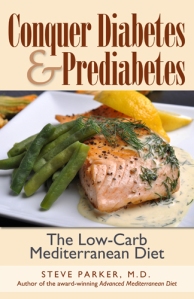
Click the pic to purchase at Amazon.com. E-book versions also available at Smashwords.com.
 Bible Verse of the Day

