Category Archives: Uncategorized

Diabetic Drug Pioglitazone Linked to Bladder Cancer

A recent report in Diabetes Care (doi 10.2337/dc10-2412) suggests a link between pioglitzone and the development of bladder cancer.  This is preliminary, not definitive proof.  Further study may erase all concern about bladder cancer.  The only other diabetic drug in this class (thiazolidinediones) is rosiglitazone: its use was just recently drastically reduced by the Food and Drug Administration.

Will pioglitazone eventually be pulled from the market because of this?  How many will suffer from bladder cancer in the meantime?  Nobody knows at this point.

We have 11 classes of drugs to treat diabetes.  Would you believe we don’t know all the potential long-term adverse effects of most of these drugs?  It’s true.

To me, that’s more reason to control diabetes with diet modification, such as the Low-Carb Mediterranean Diet or Dr. Bernstein’s Diabetes Solution.

Steve Parker, M.D.

4 Comments

Filed under Uncategorized

Mediterranean Diet Linked to Fewer Strokes on MRI Scans

The Mediterranean diet reduces the risk of strokes seen on brain MRI scans, according to a study earlier this year in Annals of Neurology

Brain researchers at various U.S. institutions studied a multi-ethnic population in upper Manhattan (the WHICAP cohort).  Average age of the  707 study participants was 80.  Baseline diet was determined by a questionairre.  A Mediterranean diet score was calculated to quantify adherence—or lack thereof—to the Mediterranean diet.  Participants without dementia at baseline underwent MRI scanning initially, then again an average of six years later.

What Did They Find?

One third of participants had MRI evidence for a stroke.  Higher adherence to the Mediterranean diet was linked to significantly lower odds of stroke.  Compared to those eating least like the Mediterranean diet, those with the highest adherence had 37% lower odds of an stroke being found on MRI scan.  Those with medium adherence had 20% lower odds.

So What?

This is the first study to show such an association between strokes on an MRI scan and the Mediterranean diet.  Be aware that you can find stroke on an MRI scan in someone who thought they were perfectly healthy; in other words a clinically silent stroke.  The authors note only one previous report finding lower risk of clinically obvious stroke with the Mediterranean diet, in women—I thought there were more. 

The same group of researchers had previously demonstrated that higher compliance with the Mediterranean diet is linked to lower risk of Alzheimers disease and mild cognitive impairment

If I wanted to protect my brain from stroke, I’d be sure follow a Mediterranean-style diet, keep my blood pressure under 140/90 mmHg, stay physically active, keep my weight under control, and not smoke. 

Steve Parker, M.D.

 
Reference:  Scarmeas, Nikolaos, et al.  Mediterranean diet and magnetic resonance imaging-assessed cerebrovascular disease.  Annals of Neurology, 69 (2011): 257-268.  doi: 10.1002/ana.22317

Comments Off on Mediterranean Diet Linked to Fewer Strokes on MRI Scans

Filed under Uncategorized

Two-Minute Online Diabetes and Prediabetes Risk Test

In the U.S., 24 million people have diabetes, mostly type 2.  That’s one in 10 adults.  The number for those over 60 is two in 10. 

Fifty-seven million have prediabetes; that’s one of every three adults.  Most of them are unaware of it.

The American Diabetes Association offers an online diabetes and prediabetes risk assesment.  The Centers for Disease Control says one of every three people born in 2000 will develop diabetes.   A few risk factors are age over 45, family history of diabetes, sedentary lifestyle, and overweight or obese.  Why not recommend the test to someone you know who may be at risk? 

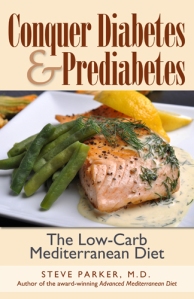
Steve Parker, M.D., author of Conquer Diabetes and Prediabetes: The Low-Carb Mediterranean Diet

2 Comments

Filed under Uncategorized

Eat Natural Food

Michael Pollan is credited with the aphorism, “Eat food.  Not too much.  Mostly plants.”

Bill Gottlieb interviewed me recently on the topic of prediabetes for a book due out later this year (Bottom Line’s Breakthroughs in Natural Healing 2012).  Bill had given me a preparatory list of potential questions, one of which was,”What are the best dietary recommendations? I’m looking for fun, fresh specificity here—along the lines of your book!”  Also, “What’s the best way for a person to implement it—specific, practical, small-step actions that would lead to actually changing the diet?”

We didn’t have a chance to get to those in the interview, but here are some of my thoughts:

  • Give up all man-made food*
  • Give up all sugar-sweetened sodas and “sports drinks”
  • Give up all flour products
  • Give up all flours, starches, and added sugars
  • Give up deserts

But “giving up” is not a message  people want to hear when contemplating a diet change, even if it’s for their own good.  “Avoid” and “cut back on” are not specific.  “Forego” works, but is just a euphemism for “give up.”  “Eat only God-made foods” might turn off the atheists and agnostics.

Here’s a more marketable catch-phrase that I rather like:

Eat natural food.*

By “natural,” I mean “present in or produced by nature.”  This would not include candy bars, potato and corn chips, soda pop, sports drinks, apple pie, bread and other flour products, cookies, etc.  That still leaves a lot of different foods to eat, including most  of the items on the Low-Carb Mediterranean Diet.  Whether modern, mass-produced versions of fruits and vegetables are natural is a debate for another day.  I suspect modern corn, for example, is nothing close to the maize cultivated by Native Americans 400  years ago. 

Why the asterisk?  The exceptions to the “eat natural food” rule are red wine, olive oil, and vinegar.  Those are partly natural, partly man-made.  (Where do we get vinegar?)  The red wine and olive oil are potentially healthful, and many of us like vinegar on our  natural salad vegetables.

Eat natural food.

I bet the average person eating the standard American diet would tend to lose excess weight and be healthier by making the switch.

Steve Parker, M.D.

* Exceptions: red wine, olive oil, vinegar

1 Comment

Filed under Uncategorized

Carbohydrates Can Kill

Carbohydrates Can KillI did a phone interview yesterday with Dr. Robert K. Su, author of Carbohydrates Can Kill.  It should be available in podcast form at Dr. Su’s website within the next three months.  Dr. Su is on a mission to educate the public on the dangers of excessive blood sugar levels, whether or not diabetes or prediabetes is present.  Visit Dr. Su’s website for a wealth of information on carbohydrates and their effects on blood sugar levels and health.

Steve Parker, M.D., author of Conquer Diabetes and Prediabetes: The Low-Carb Mediterranean Diet

Comments Off on Carbohydrates Can Kill

Filed under Uncategorized

Greater Risk of Death in Diabetics with Lower Salt Intake

Have you noticed the national push for lower salt consumption? It’s driven by the idea that lower consumption will reduce the risk of heart attacks, strokes, and death, supposedly mediated through lower blood pressure.

The latest issue of Diabetes Care has a research report showing a greater risk of death in type 2 diabetics with lower salt consumption over the course of 10 years. Yes, you read that right: greater risk of death with lower salt consumption.

Keep your eyes and ears open on this issue.

Steve Parker, M.D.

3 Comments

Filed under Uncategorized

Exercise, Part 4: Strength Training

What’s “strength training”? It’s also called muscle-strengthening activity, resistance training, weight training, and resistance exercise. Examples include lifting weights, work with resistance bands, digging, shoveling, yoga, push-ups, chin-ups, and other exercises that use your body weight or other loads for resistance.

Strength training three times a week increases your strength and endurance, allows you to sculpt your body to an extent, and counteracts the loss of lean body mass (muscle) so often seen during efforts to lose excess weight. It also helps maintain your functional abilities as you age. For example, it’s a major chore for many 80-year-olds to climb a flight of stairs, carry in a bag of groceries from the car, or vacuum a house. Strength training helps maintain these abilities that youngsters take for granted.

According to the U.S. Centers for Disease Control and Prevention: “To gain health benefits, muscle-strengthening activities need to be done to the point where it’s hard for you to do another repetition without help. A repetition is one complete movement of an activity, like lifting a weight or doing a sit-up. Try to do 8–12 repetitions per activity that count as 1 set. Try to do at least 1 set of muscle-strengthening activities, but to gain even more benefits, do 2 or 3 sets.”

 If this is starting to sound like Greek to you, consider instruction by a personal trainer at a local gym or health club. That’s a good investment for anyone unfamiliar with strength training, in view of its great benefits and the potential harm or waste of time from doing it wrong. Alternatives to a personal trainer would be help from an experienced friend or instructional DVD. If you’re determined to go it alone, Internet resources may help, but be careful. Consider “Growing Stronger: Strength Training for Older Adults” (http://www.cdc.gov/physicalactivity/downloads/growing_stronger.pdf). Don’t let the title turn you off if your young—its a good introduction to strenght training for folks of any age. Doug Robb’s blog, HealthHabits, is a wonderful source of strength training advice (http://www.healthhabits.ca/). The Internet resources I’ve mentioned are not designed specifically for people with diabetes.

Current strength training techniques are much different than what you remember from high school 30 years ago—modern methods are better. Some of the latest research suggests that strength training may be even more beneficial than aerobic exercise.

Next, Part 5 reviews aerobic training.

Steve Parker, M.D.

1 Comment

Filed under Uncategorized

Famous or Successful People with Diabetes

The “Nursing Schools” website has posted a list of 50 successful people with diabetes you may recognize. One is Ray Kroc, founder of McDonald’s restaurants. Just helps to show that diabetes doesn’t have to be a death sentence.
The link: http://www.nursingschools.net/blog/2011/01/50-famous-successful-people-who-are-diabetic/

-Steve

3 Comments

Filed under Uncategorized

Abbott Recalls Glucose Test Strips

Abbott is a major supplier of fingerstick blood sugar test strips.  If you use Abbott test strips, be aware that they’ve announced a recall of over 350 million strips because they tend to read falsely low.  Click for details at this Abbott website.

Steve Parker, M.D.

Comments Off on Abbott Recalls Glucose Test Strips

Filed under Uncategorized

Off for the Holiday

I’m taking some time off.  Hope to see you back here January 3, 2011.

Merry Christmas!

-Steve

4 Comments

Filed under Uncategorized