Tag Archives: low-carb

New Analysis Finds Low-Carb Diets Reduce Heart Disease Risk Factors

Obesity Reviews just published details of a recent meta-analyis of low-carbohydrate diet effects on cardiovascular risk factors.

A systematic review and meta-analysis were carried out to study the effects of low-carbohydrate diet (LCD) on weight loss and cardiovascular risk factors (search performed on PubMed, Cochrane Central Register of Controlled Trials and Scopus databases). A total of 23 reports, corresponding to 17 clinical investigations, were identified as meeting the pre-specified criteria.

Over a thousand obese patients were involved.  By eating low-carb, average body weight decreased by 7 kg (15 lb), body mass index dropped by 2, blood pressure dropped by 3-4 mmHg, triglycerides decreased by 30 mg/dl, hemoglobin A1c dropped by 0.21% (absolute decrease), insulin levels fell by 2.23 micro IU/ml, while HDL cholesterol rose by 1.73 mg/dl.  LDL cholesterol didn’t change.

The authors conclusion:

Low-carboydrate diet was shown to have favourable effects on body weight and major cardiovascular risk factors; however the effects on long-term health are unknown.

I haven’t see the full text of the article yet, so I don’t know the carbohydrate level under review.  I bet it’s under 50 g of digestible carb daily.  My Low-Carb Mediterranean Diet starts at 20-30 grams a day.

Steve Parker, M.D.

Reference:  Santos, F.L., et al. Systematic review and meta-analysis of clinical trials of the effects of low carbohydrate diets on cardiovascular risk factors. Obesity Reviews. Article first published online: 20 AUG 2012. DOI: 10.1111/j.1467-789X.2012.01021.x

2 Comments

Filed under Carbohydrate, Heart Disease, Weight Loss

Gluten-Free, Wheat-Free, Sugar-Free: “Low-Carbing Among Friends”

Low Carbing Among Friends: Low-carb and Gluten-free V1 (Low Carbing Among Friends, Volume-1)I’m very excited about a brand new cookbook for folks limiting their consumption of carbohydrates, wheat, and gluten.  It’s a unique collaboration among five chefs (Jennifer Eloff, Maria Emmerrich, Carolyn Ketchum, Lisa Marshall, and Kent Altena) and other low-carb luminaries like Jimmy Moore and Dana Carpender.  I was honored to contribute a couple pages myself.  The book is Low-Carbing Among Friends, volume 1.

All 325 recipes limit digestible carbohydrates to a maximum of 10 grams; many have five or fewer grams.  This should be great for people with diabetes and anyone trying to manage excess weight with low-carb eating.  All recipes are gluten-free, wheat-free, and sugar-free.

I can’t wait for my copy.  I’m “online friends” with several of the contributors, so I’m familiar with the great quality of their work.  You can get the book at Amazon.com, but I ordered mine from the book’s website, figuring the authors make more profit there.  (If we want good books, we have to support authors.)  It’s not too late to order this as a Christmas present.  Don’t you know someone who could use it?  

Steve Parker, M.D.


2 Comments

Filed under Book Reviews, Carbohydrate

Severe Carb Restriction in Type 2 Diabetes

U.K. researchers found major metabolic improvements in obese type 2 diabetics following a very low-carbohydrate diet, compared to a low-fat portion-controlled diet.  The latter is a standard recommendation in the U.S. for overweight type 2 diabetics.
 
This study is an oldie (2005) but a goodie.
 
Methodology
 
The investigators randomly assigned 102 poorly controlled diabetics to follow one of the two diets for three months.  Participants had average weights of 224 pounds (102 kg),  body mass index 36, age 58, hemoglobin A1c’s of 9%.  Half of them were men.  About 40% of the diabetics in both groups were on unspecified oral diabetic drugs; 20% were on insulin and 40% were using a combination of the two.  Sulfonylurea was mentioned, but not metformin. 
 
Participants were randomly assigned to either a low-fat portion-controlled weight-loss diet or a low-carbohydrate diet.  The goal with the low-carb diet was “up to 70 g of carbohydrate per day,” including at least a half a pint of milk and one piece of fruit.  (Is a UK pint the same as in the US?).  Increased physical activity was recommended to both groups. 
 
Only 79 of the 102 participants made it through the three-month diet intervention.  Drop-out rate was the same for both groups.
 
What Did They Find?
 
(Differences are statistically significant unless otherwise noted.)
Weight loss for the low-carb group was 3.55 kg (7.8 lb) compared to only 0.92 kg (2 lb) for the low-fat cohort.
 
The total/HDL cholesterol ratio improved for the low-carb group (absolute decrease of 0.48 versus 0.10). 
 
Hemoglobin A1c and systolic blood pressure tended to decrease more for the low-carb group, but did not reach statistical significance.  For instance, HgbA1c dropped 0.55% (in absolute terms) for the low-carb group, and 0.23% for the low-fat group.  Lower HgbA1c indicates improved blood sugar control.
 
Caloric intake was not different between the groups (about 1350 cals/day by diet recall method).
 
The low-carb group reduced carbs to 109 g/day compared to 168 g in the  low-fat cohort.
 
The low-carb group consumed 33% of energy as carbs compared to 45% for the low-fat group.
 
The low-carb group consumed 40% of energy as fat compared to 33% in the low-fat cohort.
 
Protein intake was 26% of energy for the low-carbers compared to 21% for the low-fatters.
 
Absolute saturated fatty acid intake was higher for the low-carbers, but still considered moderate.
 
Insulin dose was reduced in about 85% of the insulin users in the low-carb group but in only 22% of the low-fat group.  Oral diabetic pill use was unchanged in both groups.
 
Comments
 
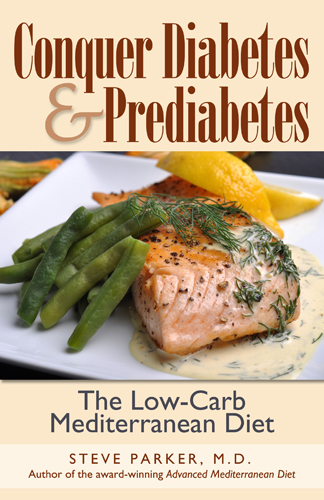
This is a classic research report that I cited in Conquer Diabetes and Prediabetes: The Low-Carb Mediterranean Diet.
 
The improved total/HDL cholesterol ratio in the low-carbers may reduce risk of heart and vascular disease.  These investigators didn’t look at LDL particle size.  Other studies have found that low-carb eating tends to shift LDL cholesterol (bad stuff) from small dense particles to light fluffy particles, which are thought to be less harmful to arteries.
 
The authors considered reduction of carbs to 109 grams a day to be “severe.”  That compares to 275 grams a day eating by the typical U.S. citizen.  I agree that a reduction of carbs by two-thirds is major restriction.  Dr. Richard Bernstein and I consider severe restriction to be 20–30 grams, or perhaps up to 50 g.
 
I suspect the improved metabolic numbers in the low-carbers would have been even more dramatic if they had reduced carbs well below 100 grams a day.  The Ketogenic Mediterranean Diet reduces digestible carbs to 20–30 grams daily.  Many diabetics start losing control of their blood sugars when daily carbs exceed 60–80 grams.
 
Low-carb diets often yield better weight loss than low-fat calorie-restricted diets, as was seen here.  This is often attributed to lower calorie consumption on the low-carb diets.  These investigators didn’t see that here.
 
Low-carb diets are often criticized as being hard to stick with.  The low-carbers here didn’t have any more drop-outs than the low-fat group.  Granted, it was only a three-month study.
 
Based on what we know today, the reduced need for insulin in these patients was entirely predictable. 
 
The authors had some concern about the higher relative saturated fatty acid consumption in the low-carbers.  In 2011, we know that’s not much, if any, cause for concern.


Reference: Daly, M.E., et al.  Short-term effects of severe dietary carbohydrate-restriction advice in Type 2 diabetes—a randomized controlled trialDiabetic Medicine, 23 (2006): 15-20.  doi: 10.1111/j.1464-5491.2005.01760.x

Comments Off on Severe Carb Restriction in Type 2 Diabetes

Filed under Carbohydrate, Weight Loss

Which Of Three Low-Carb Diets Reduces Future Risk of Diabetes?

Men eating low-carb diets featuring protein and fats from sources other than red and processed meats may reduce risk of developing type 2 diabetes later, compared to other types of low-carb diets.  The same Boston-based researchers previously looked for a similar association in women and found none.

The article in American Journal of Clinical Nutrition seems to me unusually complicated, like the first sentence of this post.  It was frustrating to read, searching for but not finding much useful for clinical practice.  How low-carb were these diets?  Thirty-seven to 43% of energy from carbs in the most dedicated dieters, compared to 50-60% in the standard American diet.

After wading through most of this article, I came away with the impression the authors were just data-mining a huge database, to add one more item to their CVs (curriculum vitae).  This article is a confusing mess, or maybe I’m just stupid. I regret wasting an hour on it.

Steve Parker, M.D.

Reference: De Konig, Lawrence, et al.  Low-carbohydrate diet scores and risk of type 2 diabetes in menAmercan Journal of Clinical Nutrition, 2011. doi: 10.3945/ajcn.110.004333

4 Comments

Filed under Causes of Diabetes, Fat in Diet, Protein

Research Round-Up


I have a stack of scientific articles I’ve been meaning to review in depth and blog about.  But I have to finally admit I don’t have the time.  Here they are.  Click through for details.

  1. Long-term calorie restriction in humans appears highly effective in reducing atherosclerosis risk factors (lab tests) and actual carotid artery atherosclerosis. Only 18 study subjects, however.
  2. A very-low-carbohydrate diet improved memory in older adults with mild cognitive impairment over six weeks.  Twenty-three subjects were randomized to either high-carb or very-low-carbohydrate diet.  The low-carbers improved verbal memory performance, lost weight, reduced fasting blood sugar and fasting insulin levels.  Ketone levels were positively correlated with memory performance.
  3. A high-fat diet impairs cognitive function and heart energy metabolism in young men.  Sixteen test subjects.  Crossover study design with a five-day high-fat diet deriving 75% of energy from fat, compared to a low-fat diet deriving 23% of energy from fat.  High-fat diet led to impaired attention, speed, and mood.  I’m sure low-carb bloggers have been all over this.  At first blush, it appears they were testing during “induction flu” phase of very-low-carb eating, between days 2 to 7 of a new ketogenic diet.  It takes several weeks to adapt metabolism to running almost entirely on fat rather than standard carbohydrates.  Suspect results would have been different if given time to adapt.
  4. Weight-loss with the laparoscopic gastric banding procedure has poor long-term outcome, according to Belgian surgeons reporting on 82 patients.  Four in 10 patients had major complications.  Nearly half of the 82 patients needed to have the bands removed, and six of every 10 required some kind of re-operation.
  5. Trust me, you DON’T want age-related macular degeneration.  Women, reduce your risk of ARMD with a healthy lifestyle, including regular exercise, avoidance of smoking,  and by eating abundant plant foods (vegetables [including orange and dark leafy green ones], fruits, and whole grains) and limit foods high in fat, refined starches, sugar, alcohol, and oils.  At least according to these researchers. 
  6. Leafy green vegetables and olive oil are linked to reduced heart disease (CHD) in Italian women.  Fruit consumption had no effect.  This is from a subset of the huge EPIC study, following 30,000 women over almost eight years.
  7. The Mediterranean diet protects against metabolic syndrome, reducing risk by about a third according to a huge meta-analysis from Greek and Italian investigators.  It works best in Mediterranean countries. 
  8. The Mediterranean diet was linked to slower rates of cognitive decline in Chicago residents over the course of almost eight years.  The comparison diet was the Healthy Eating Index-2005.  Of the 3,800 participants, about two-thirds were black.  A Manhattan population showed lower risk of dementia when eating Mediterranean-style.

There ya’ go.  This is better than letting the articles just sit in my briefcase for months on end, eventually to be thrown out.

Steve Parker, M.D.

Comments Off on Research Round-Up

Filed under Uncategorized

Spanish Ketogenic Mediterranean Diet Cures Metabolic Syndrome

The very-low-carb Spanish Ketogenic Mediterranean Diet cures metabolic syndrome, according to investigators at the University of Córdoba in Spain. 

The metabolic syndrome is a collection of clinical factors that are linked to high risk of developing type 2 diabetes and heart disease.  Individual components of the syndrome include elevated blood sugar, high trigylcerides, low HDL cholesterol, high blood pressure,  and abdominal fat accumulation.

Spanish researchers put 26 people with metabolic syndrome on the Spanish Ketogenic Mediterranean Diet for twelve weeks and monitored what happened.  At baseline, average age was 41 and average body mass index was 36.6.  Investigators didn’t say how many diabetics or prediabetics were included.  No participant was taking medication.

What’s the Spanish Ketogenic Mediterranean Diet?

Calories are unlimited, but dieters are encouraged to keep carbohydrate  consumption under 30 grams day.  They eat fish, lean meat, eggs, chicken, cheese, green vegetables and salad, at least 30 ml (2 tbsp) daily of virgin olive oil,  and 200-400 ml of red wine daily ( a cup or 8 fluid ounces  equals 240 ml).  On at least four days of the week, the primary protein food is fish.  On those four days, you don’t eat meat, chicken, eggs, or cheese.  On up to three days a week, you could eat non-fish protein foods but no fish on those days. 

How’s this different from my Ketogenic Mediterranean Diet?  The major differences are that mine includes one ounce (28 g) of nuts daily, less fish overall, and you can mix fish and non-fish protein foods every day.

Regular exercisers were excluded from participation, and my sense is that exercise during the diet trial was discouraged. 

What Were the Results?

Metabolic syndrome resolved in all participants.

Three of the original 26 participants were dropped from analysis because they weren’t compliant with the diet.  Another one was lost to follow-up.  Final analysis was based on the 22 who completed the study.

Eight of the 22 participants had adverse effects.  These were considered slight and mostly appeared and  disappeared during the first week.  Effects included weakness, headache, constipation, “sickness”, diarrhea, and insomnia. 

Average weight dropped from 106 kg (233 lb) to 92 kg (202 lb).

Body mass index fell from 36.6 to 32.

Average fasting blood sugar fell from 119 mg/dl (6.6 mmol/l) to 92 mg/dl (5.1 mmol/l).

Triglycerides fell from 225 mg/dl to 110 mg/dl.

Average systolic blood pressure fell from 142 mmHg to 124.

Average diastolic blood pressure fell from 89 to 76.

So What?

A majority of people labeled with metabolic sydrome continue in metabolic sydrome for years.  That’s because they don’t do anything effective to counteract it.  These researchers show that it can be cured in 12 weeks, at least temporarily, with the Spanish Ketogenic Mediterranean Diet.

ResearchBlogging.orgVery-low-carb diets are especially good at lowering trigylcerides, lowering blood sugar, and raising HDL cholesterol.  Overweight dieters tend to lose more weight, and more quickly, than on other diets.  Very-low-carb diets, therefore, should be particularly effective as an approach to metabolic syndrome.  It’s quite possible that other very-low-carb diets, such as Atkins Induction Phase, would have performed just as well as the Spanish Ketogenic Mediterranean Diet.  In fact, most effective reduced-calorie weight-loss diets would tend to improve metabolic syndrome, even curing some cases, regardless of carb content

Most physicians recommend that people with metabolic syndrome either start or intensify an exercise program.  The program at hand worked without exercise.  I recommend regular exercise for postponing death and other reasons.

Will the dieters of this study still be cured of metabolic syndrome a year later?  Unlikely.  Most will go back to their old ways of eating, regaining the weight, and moving their blood sugars, triglycerides, and HDL cholesterols in the wrong direction.

Steve Parker, M.D.

Reference: Pérez-Guisado J, & Muñoz-Serrano A (2011). A Pilot Study of the Spanish Ketogenic Mediterranean Diet: An Effective Therapy for the Metabolic Syndrome. Journal of medicinal food PMID: 21612461

Comments Off on Spanish Ketogenic Mediterranean Diet Cures Metabolic Syndrome

Filed under ketogenic diet, Mediterranean Diet, Overweight and Obesity

Low-Carb Recipe: Natchez Eggs

Natchez Eggs is an old family recipe.  It’s sort of an egg casserole, good for breakfast.  We tend to dust off this recipe when we have house guests—it feeds many people at once, quickly and easily. 

It’s not in my new book, Conquer Diabetes and Prediabetes: The Low-Carb Mediterranean Diet.  Note my use of both U.S. customary and metric measurements, which I also used in the book.  I have no idea how much it costs to ship a book from the U.S. to New Zealand, but the e-book version has no shipping charge.

Ingredients

Cheese, shredded (four-cheese mexican blend), 8 0z (224 g)
Sour cream, 16 oz (448 g)
Green chiles, diced, canned, 8 oz net weight (224g)
Eggs, large, 10 (50 g each)

Preparation

Pre-heat oven to 350°F (175°C).  Mix eggs thoroughly in a blender for 3–4 minutes on medium speed, then pour into bowl.  Coat a baking dish (9 x13 inches, or 22 x 34 cm) with butter, vegetable oil, PAM or no-stick baking spray.  Whisk eggs and sour cream together in bowl.  Drain excess water from the chile cans, then spread chiles evenly on the bottom of a dish, then layer the cheese evenly on top.  Next, ladle or pour the eggs/sour cream on top.  Bake for about 30 minutes, until the eggs are firm, not runny, and you see patches of thin light brown crust.

Makes 12 servings (about 4 oz or 110 g each).  Leftovers hold up well in refrigerator for eating over the next few days. 

Nutrient Analysis

A serving has 3 grams of digestible carbohydrate, 200 calories, 140 calories from fat, 8 grams of saturated fat, 10 grams of protein, 210 mg cholesterol, 4 grams of carboydrate, 1 gram of fiber.

 Options

After you add the cheese layer, sprinkle layer of  Hormel Real Crumbled Bacon (4 oz or 112 g) before finishing up with the  egg mixture.  This adds 33 calories and zero carbs per serving.  Or just serve with bacon on the side (my preference).  An alternative to the Hormel product is to cook and crumble your own bacon (12 oz or 340 g uncooked weight).  Using too much bacon will overwhelm the other flavors.  Experiment with different cheeses.

Steve Parker, M.D.

Comments Off on Low-Carb Recipe: Natchez Eggs

Filed under Recipes

Unleashing “Conquer Diabetes and Prediabetes: The Low-Carb Mediterranean Diet”

My idea behind this blog has been to create an adaptation of the healthy Mediterranean diet for people with type 2 diabetes.  The Mediterranean diet alone has too many carbohydrates for the average diabetic. 

The initial adaptation has been done and available free here for many months.  The whole shebang is now available in book and ebook form, entitled Conquer Diabetes and Prediabetes: The Low-Carb Mediterranean Diet

You’ll find the printed version at Amazon.com and CreateSpace.  The ebook is available in multiple formats at Smashwords, and the Kindle version is at the Kindle Store.

Compared with jumping from page to page at this website and using your own printer, the book’s a pretty good deal.  It runs $16.95 (USD) at Amazon, and the ebook is $9.99.

What’s In the Book?

 Here’s the news release:

Dr. Steve Parker has created the first-ever low-carbohydrate Mediterranean diet, designed for people with type 2 diabetes and prediabetes.  His science-based plan blends the healthy components of the traditional Mediterranean diet with the ease and effectiveness of low-carb eating.  Conquer Diabetes and Prediabetes: The Low-Carb Mediterranean Diet teaches how to lower blood sugars naturally, reduce or eliminate diabetic medications, and lose excess weight if needed.

Type 2 diabetics and prediabetics have lost the ability to process carbohydrates safely.  Carbohydrates have become poisonous for them.  Carb toxicity too often leads to numb and painful limbs, impaired vision, kidney failure, amputations, cancer, and premature heart attacks, strokes, and death.

Nutrition experts worldwide agree that the Mediterranean diet is the healthiest way of eating for the general public.  It prolongs life and reduces rates of heart attack, stroke, cancer, and dementia.  The only problem for diabetics is that it provides too many toxic carbohydrates.

Dr. Parker initially recommends a very-low-carb ketogenic diet for 12 to 18 weeks, then teaches the reader how to gradually add more healthy carbohydrates depending on blood sugar and body weight changes.  Due to the toxic nature of carbohydrates in people with impaired blood sugar metabolism, most diabetics won’t be able to tolerate more than 80-100 grams of carbohydrate daily.  (The average Western diet provides 250 grams.)  

The book provides recipes, a week of menus, instruction on exercise, discussion of all available diabetic medications, advice on prevention of weight regain, lists of delicious doctor-approved foods, 71 scientific references, an annotated bibliography, and an index. All measurements are given both in U.S. customary and metric units.

Steve Parker, M.D., is a leading medical expert on the Mediterranean diet and author of the award-winning Advanced Mediterranean Diet: Lose Weight, Feel Better, Live Longer.   He has over two decades’ experience practicing Internal Medicine and treating patients with diabetes and prediabetes.

13 Comments

Filed under Shameless Self-Promotion

Low-Carb Diets Killing People?

Animal-based low-carb diets are linked to higher death rates, according to a recent study in the Annals of Internal Medicine.  On the other hand, a vegetable-based low-carb diet was associated with a lower mortality rate, especially from cardiovascular disease.

As always, “association is not causation.”

It’s just a matter of time before someone asks me, “Haven’t you heard that low-carb diets cause premature death?”  So I figured I’d better take a close look at the new research by Fung and associates.

It’s pretty weak and unconvincing.  I have little to add to the cautious editorial by William Yancy, Matthew Maciejewski, and Kevin Schulman published in the same issue of Annals.

The study at hand was observational over many years, using data from the massive Nurses’ Health Study and Health Professionals’ Follow-up Study.  To find the putative differences in mortality, the researchers had to compare the participants eating the most extreme diets.  The 80% of study participants eating in between the extremes  were neutral in terms of death rates.

They report that “…the overall low-carbohydrate diet score was only weakly associated with all-cause mortality.”  Furthermore,

These results suggest that the health effects of a low-carbohydrate diet may depend on the type of protein and fat, and a diet that includes mostly vegetable sources of protein and fat is preferable to a diet with mostly animal sources of protein and fat.

In case you’re wondering, all these low-carb diets derived between 35 and 42% of energy (total calories) from carbohydrate, with an average of 37%.  Anecdotally, many committed low-carbers chronically derive 20% of calories form carbohydrate (100 g of carb out of 2,000 calories/day).  The average American eats 250 g of carb daily, 50-60% of total calories.

Yancy et al point out that “Fung and coworkers did not show a clear dose-response relationship in that there was not a clear progression of risk moving up or down the diet deciles.”  If animal proteins and fats are lethal, you’d expect to see some dose-response relationship, with more deaths as animal consumption gradually increases over the deciles.

ResearchBlogging.orgThe Fung study is suggestive but certainly not definitive.  Anyone predisposed to dietarycaution who wants to eat lower-carb might benefit from eating fewer animal sources of protein and fat, and more vegetable sources.  Fung leaves it entirely up to you to figure out how to do that. Compared to an animal-based low-carb diet, the healthier low-carb diet must subsitute more low-carb vegetables and higher-fat plants like nuts, seeds, seed oils and olive oil, and avocadoes, for example.  What are higher-protein plants?  Legumes?

You can see how much protein and fat are in your favorite vegetables at the USDA Nutrient Database.

The gist of Fung’s study dovetails with the health benefits linked to low-meat diets such as traditional Mediterranean and DASH.  On the other hand, if an animal-based low-carb diet helps keep a bad excess weight problem under control, it too may by healthier than the standard American diet.

See the Yancy editorial for a much more detailed and cogent analysis.  As is so often the case, “additional studies are needed.”

Steve Parker, M.D.

Reference: Fung TT, van Dam RM, Hankinson SE, Stampfer M, Willett WC, & Hu FB (2010). Low-carbohydrate diets and all-cause and cause-specific mortality: two cohort studies. Annals of internal medicine, 153 (5), 289-98 PMID: 20820038

1 Comment

Filed under Carbohydrate, coronary heart disease, Vegetables

Book Review: Why We Get Fat

Gary Taubes’s new book, Why We Get Fat: And What To Do About It, comes on the market later this month.  I give it five stars per Amazon.com’s ranking system (I love it).

♦   ♦   ♦

At the start of my medical career over two decades ago, many of my overweight patients were convinced they had a hormone problem causing it.  I carefully explained that’s rarely the case.  As it turns out, I may have been wrong.  And the hormone is insulin.
Mr. Taubes wrote this long-awaited book for two reasons: 1) to make the ideas in his 2007 masterpiece (Good Calories, Bad Calories) more accessible to the public, and 2) to speed up the process of changing conventional wisdom on overweight.  GCBC was the equivalent of a college-level course on nutrition, genetics, history, politics, science, physiology, and biochemistry. Many nutrition science geeks loved it while recognizing it was too difficult for the average person to digest.

Paradigm Shift

The author hopes to convince us that “We don’t get fat because we overeat; we overeat because we’re getting fat.”  We need to think of obesity as a disorder of excess fat accumulation, then ask why the fat tissue isn’t regulated properly.  A limited number of hormones and enzymes regulate fat storage; what’s the problem with them?

Mr. Taubes makes a great effort convince you the old “energy balance equation” doesn’t apply to fat storage.  You remember the equation: eat too many calories and you get fat, or fail to burn up enough calories with metabolism and exercise, and you get fat.  To lose fat, eat less and exercise more.  He prefers to call it the “calories-in/calories-out” theory.  He admits it has at least a little validity.  Problem is, the theory seems to have an awfully high failure rate when applied to weight management over the long run.  We’ve operated under that theory for the last half century, but keep getting fatter and fatter.  So the theory must be wrong on the face of it, right?  Is there a better one?

So, Why DO We Get Fat?

Here is Taubes’s explanation.  The hormone in charge of fat strorage is insulin; it works to make us fatter, building fat tissue.  If you’ve got too much fat, you must have too much insulin action.  And what drives insulin secretion from your pancreas?  Dietary carbohydrates, especially refined carbs such as sugars, flour, cereal grains, starchy vegetables (e.g., corn, beans, rice, potatoes), liquid carbs.  These are the “fattening carbs.”  Dozens of enzymes and hormones are at play either depositing fat into tissue, or mobilizing the fat to be used as energy.  It’s an active process going on continously.  Any regulatory derangement that favors fat accumulation will CAUSE gluttony (overeating) or sloth (inactivity).  So it’s not your fault. 

What To Do About It

Cut back on carb consumption to lower your fat-producing insulin levels, and you turn fat accumulation into fat mobilization.

Before you write off Taubes as a fly-by-night crackpot, be aware that he’s received three Science-in-Society Journalism Awards from the National Association of Science Writers.  He’s a respected, professional science writer.  Having read two of his books, it’s clear to me he’s very intelligent.  If he’s got a hidden agenda, it’s well hidden.

One example  illustrates how hormones control growth of tissues, including fat tissue.  Consider the transformation of a skinny 11-year-old girl into a voluptuous woman of 18. Various hormones make her grow and accumulate fat in the places we now see curves.  The hormones make her eat more, and they control the final product.  The girl has no choice.  Same with our adult fat tissue, but with different hormones. If some derangement is making us grow fatter, it’s going to make us more sedentary (so more energy can be diverted to fat tissue) or make us overeat, or both.  We can’t fight it.  At not least very well, as you can readily appreciate if look at the people around you at any American shopping mall.

This’N’That

Taubes’s writing is clear and persuasive.  He doesn’t beat you over the head with his conclusions. He lays out a logical series of facts and potential connections and explanations, helping you eventually see things his way.  If insulin controls fat storage by building and maintaining fat tissue, and if carboydrates drive insulin secretion, then the way to reduce overweight and obesity is carbohydrate-restricted eating, especially avoiding the fattening carbohydrates.  I’m sure that’s true for many folks, perhaps even a majority.

If you’re overweight and skeptical about this approach, you could try out a very-low-carb diet for a couple weeks or a month at little expense and risk (but not zero risk).  If Mr. Taubes and I are right, there’s a good chance you’ll lose weight.  At the back of the book is a university-affiliated low-carb eating plan.

If cutting carb consumption is so critical for long-term weight control, why is it that so many different diets—with no focus on carb restriction—seem to work, if only for the short run?  Taubes suggests it’s because nearly all diets reduce carb consumption to some degree, including the fattening carbs.  If you reduce your total daily calories by 500, for example, many of those calories will be from carbs.  Simply deciding to “eat healthy” works for some people: stopping soda pop, candy bars, cookies, desserts, beer, etc.  That cuts a lot of fattening carbs right there.

Losing excess weight or controlling weight by avoiding carbohydrates was the conventional wisdom prior to 1960, as documented by Mr. Taubes.  Low-carb diets for obesity date back almost 200 years.  The author attributes many of his ideas to German internist Gustav von Bergmann (1908).   

Taubes discusses the Paleolithic diet, mentioning that the average paleo diet derived about a third of total calories from carbohdyrates (compared to the standard American diet’s 55% of calories from carb).  My prior literature review  found 40-45% of paleo diet calories from carbohydrate.  I’m not sure who’s right.

Minor Bone of Contention RE: Coronary Heart Disease

Mr. Taubes provides numerous scientific references to back his assertions.  I checked out one in particular because it didn’t sound right.  Some background first. 

Reducing our total fat and saturated fat consumption over the last 40 years was supposed to lower our LDL cholesterol, thereby reducing the burden of coronary heart disease, which causes heart attacks.  Instead, we’ve experienced the obesity epidemic as those fats were replaced by carbohydrates.  Taubes mentions a 2009 medical journal article by Kuklina et al, in which Taubes says Kuklina points out the number of heart attacks has not decreased as we’ve made these diet changes.  Kuklina et al don’t say that.  In fact, age-standardized heart attack rates have decreased in the U.S. during the last decade. 

Furthermore, autopsy data document a reduced prevalence of anatomic coronary heart disease in people aged 20-59 from 1979 to 1994, but no change in prevalence for those over 60. The incidence of coronary heart disease decreased in the U.S. from 1971 to 1998 (the latest reliable data).  Death rates from heart disease and stroke have been decreasing steadily over the last 40 years in the U.S.; coronary heart disease death rates are down by 50%.  I do agree with Taubes that we shouldn’t credit those improvements to reduced total and saturated fat consumption.  [Reduced trans fat consumption may play a role, but that’s off-topic.] 

I think Mr. Taubes would like to believe that coronary artery disease is either more severe or unchanged in the last few decades because of low-fat, high-carb eating.  That would fit nicely with some of his theories, but it’s not the case.  Coronary artery disease is better now thanks to a variety of factors, but probably not diet (setting aside the trans-fat issue).

Going Forward

Low-carb dieting was vilified over the last half century partly out of concern that the accompanying high fat consumption would cause premature heart attacks, strokes, and death.  We know now that total dietary fat and saturated fat have little to do with coronary heart disease and atherosclerosis (hardening of the arteries), which sets the stage for a resurgence of low-carb eating.  

I advocate Mediterranean-style eating as the healthiest, in general.  It’s linked with prolonged life and lower risk of heart disease, stroke, dementia, diabetes, and cancer.  On the other hand, obesity is a strong risk factor for premature death and development of heart disease, stroke, diabetes, and cancer.  If consistent low-carb eating cures the obesity, is it healthier than the Mediterranean diet?  Maybe so.  Would a combination of low-carb and Mediterranean be better?  Maybe so.  I’m certain Mr. Taubes would welcome a decades-long interventional study comparing low-carb with the Mediterranean diet.  But that’s probably not going to happen in our lifetimes. 

Gary Taubes rejects the calories-in/calories-out theory of overweight that hasn’t done a very good job for us over the last 40 years.  Taubes’s alternative ideas deserve serious consideration.

Steve Parker, M.D.

Update December 18, 2010: I found Mr. Taubes’s reference for stating that Paleolithic diets provide about a third of calories from carbohydrate (22-40%), based on modern hunter-gatherer societies).  See References below.   

References:
Coronary heart disease autopsy data:  American Journal of Medicine, 110 (2001): 267-273.
Reduced heart attacks:  Circulation, 12 (2010): 1,322-1,328.
Reduced incidence of coronary heart disease:  www.UpToDate.com, topic: “Epidemiology of Coronary Heart Disease,” accessed December 11, 2010.
Death rates for coronary heart disease:  Journal of the American Medical Association, 294 (2005): 1,255-1,259.

Cordain, L., et al.  Plant-animal subsistance ratios and macronutrient energy estimations in worldwide hunter-gatherer dietsAmerican Journal of Clinical Nutrition, 71 (2000): 682-692.

Disclosure:  I don’t know Gary Taubes.  I requested from the publisher and received a free advance review copy of the book.  Otherwise I received nothing of value for this review.

Disclaimer:   All matters regarding your health require supervision by a personal physician or other appropriate health professional familiar with your current health status.  Always consult your personal physician before making any dietary or exercise changes.

Update April 22, 2013

As mentioned above, WWGF was based on Taubes’ 2007 book, Good Calories, Bad Calories. You may be interested in a highly critical review of GCBC by Seth at The Science of Nutrition.

18 Comments

Filed under Book Reviews, coronary heart disease, Fat in Diet, Mediterranean Diet