
FDA Approves New T2 Diabetes Drug: Alogliptin

It’s a DPP-4 inhibitor, a class with three other drugs in the U.S.  The brand name in the U.S. is Nesina.  It can be used with other drugs such as metformin and pioglitazone.  The FDA’s press release of Jan. 25 has a little more info.

Comments Off on FDA Approves New T2 Diabetes Drug: Alogliptin

Filed under Uncategorized

Could Resistance Training Replace Slow Steady Cardio?

I was planning to review for you an article, Resistance Training to Momentary Muscular Failure Improves Cardiovascular Fitness in Humans: A review of acute physiological responses and chronic physiological adaptations.  It’s by James Steele, et al, in the Journal of Exercise Physiology (Vol. 15, No. 3, June  2012).

Exercise to momentary muscular failure may be safer on a machine

But it’s too technical for most of my readers. Heck, it’s too technical for me!  Too much cell biology and cell metabolism.  You’re dismissed now.

I’m just going to pull out a few pearls from the article that are important to me.  I ran across this in my quest for efficient exercise.  By efficient, I mean minimal time involved yet still effective.

The authors question the widespread assumption that aerobic and endurance training are both necessary for development of cardiovascular fitness.  Like Dr. Doug McGuff, they wonder if resistance training alone is adequate for the development of cardiovascular fitness.  Their paper is a review of the scientific literature.  The authors say the literature is hampered by an inappropriate definition and control of resistance training intensity.  The only accurate measure of intensity, in their view, is when the exerciser reaches maximal effort or momentary muscular failure.

The authors, by the way, define cardiovascular fitness in terms of maximum oxygen consumption, economy of movement, and lactate threshold.

“It would appear that the most important variable with regards to producing improvement in cardiovascular fitness via resistance training is intensity [i.e., to muscle failure].”

The key to improving cardiovascular fitness with resistance training is high intensity.  These workouts are not what you’d call fun.

From a molecular viewpoint, “the adenosine monophosphate–activated protein kinase pathway (AMPK) is held as the key instigator of endurance adaptations in skeletal muscle.  Contrastingly, the mammalian target of rapamycin pathway (mTOR) induces a cascade of events leading to increased muscle protein synthesis (i.e.,[muscle] hypertrophy).”  Some studies suggest AMPK is an acute inhibitor of mTOR activation.  Others indicate that “resistance training to  failure should result in activation of AMPK through these processes, as well as the subsequent delayed activation of mTOR, which presents a molecular mechanism by which resistance training can produce improvement in cardiovascular fitness, strength, and hypertrophy.”

You’re not still with me, are you?

“… the acute metabolic and molecular responses to resistance training performed to failure appear not to differ from traditional endurance or aerobic training when intensity is appropriately controlled.”

Chronic resistance training to failure induces a reduction in type IIx muscle fiber phenotype and an increase in type I and IIa fibers.  (Click for Wikipedia article on skeletal muscle fiber types.)

“It is very likely that people who are either untrained or not involved in organized sporting competition, but have the desire to improve their cardiovascular fitness may find value in resistance training performed to failure.  In fact, this review suggests that resistance training to failure can produce cardiovascular fitness effects while simultaneously producing improvements in strength, power, and other health and fitness variables. This would present an efficient investment of time as the person would not have to perform several independent training programs for differing aspects of fitness.”  [These statements may not apply to trained athletes.]

Before listing their 157 references, the authors note:

“It is beyond the scope of this review to suggest optimal means of employing resistance training (i.e., load, set volume, and/or frequency) in order to improve cardiovascular fitness since there are no published studies on this topic.”

In conclusion, if you’re going to do resistance training but not traditional aerobic/cardio exercise, you may not be missing out on any health benefits if you train with high  intensity.  And you’ll be done sooner.

Steve Parker, M.D.

PS: See Evidence-based resistance training recommendations by Fisher, Steele, et al.

Comments Off on Could Resistance Training Replace Slow Steady Cardio?

Filed under Exercise

Is It Time To Worry About Chemical Pollution?

From Bix at Fanatic Cook:

“Everyone reading this likely has dozens of chemicals in their bodies that their grandparents did not have. And what we eat has a profound impact on our body burden. In particular, processed foods and animal foods (fish, meat, eggs, and dairy), especially fatty versions, present the greatest chemical exposure. 

It’s not far-fetched to think that the increase in metabolic and endocrine disorders (obesity and diabetes are two) is linked to the chemical revolution of the last half century. Yet in the years I’ve been reading about this link, very little has emerged in the media.”

I’m not sure what to think about this issue other than to admit I need to pay it more attention if and when time allows.  Despite man-made chemicals in us, we’re living much longer than our grandparents.  Is that despite the chemicals and thanks to advances in medical care and technology?  Or do the chemicals to more good than harm?    

Comments Off on Is It Time To Worry About Chemical Pollution?

Filed under Uncategorized

Five Tibetan Rituals for Back Pain

A position you’ll see in the video

I was browsing at author Jerry Pournelle’s blog recently and noticed his 2006 reference to five Tibetan rituals (sometimes called rites) that relieved his back pain.  I assume the author has garden-variety run-of-the-mill low back pain like most middle-aged folks.

I’m not recommending or endorsing these.  I may try them someday myself.  They just look like flexibility and strengthening exercises to me.

If interested, here’s a how-to article at eHow.com.  Here’s a video demonstration (ignore the top video of Dr. Oz; view the next one down).

Ignore any references you see to Ayurvedic medicine and chakras.

Don’t worry, I’m not going woo on you.

Please share if  you’ve had experience—good or bad—with these.

—Steve

Comments Off on Five Tibetan Rituals for Back Pain

Filed under Uncategorized

Hypoglycemia: A Few Causes

Insulin and sulfonylurea drugs are common causes of hypoglycemia

Insulin and sulfonylurea drugs are common causes of hypoglycemia

Low-carbohydrate diets are often so effective at controlling blood sugars that low blood sugar (hypoglycemia) becomes a serious risk for some diabetics. It’s rarely a problem for prediabetics. But people with diabetes using particular drugs could develop life-threatening hypoglycemia, particularly when switching to a reduced-calorie or low-carb style of eating.

CARBOHYDRATES AND BLOOD SUGAR

Never forget that carbohydrate consumption has a major effect on blood sugar (glucose) levels—often causing a rise—in many people with type 2 diabetes and prediabetes. Most folks with diabetes are taking medications to lower their glucose levels.

Remember that the main components of food—called macronutrients—are proteins, fats, and carbohydrates. Common carbohydrate sources are:

■  grains

■  fruits

■  starchy vegetables (e.g., potatoes, corn, peas, beans)

■  milk products

■  candy

■  sweetened beverages

■  other added sugars (e.g., table sugar, high fructose corn syrup, honey)

Low-carb and very-low-carb diets restrict the dieter’s carbohydrate consumption rather dramatically. The standard American diet, for instance, provides 250–300 grams of carbohydrate daily, or 50–60% of total energy (calories). A low-carb diet may provide in the range of 50–130 grams daily, or 10 to 25% of total calories. A very-low-carb diet provides under 50 grams of carb daily (under 10% of all calories), often starting at 20–30 grams. With very-low-carb diets, our bodies must use fats instead of carbohydrates as an energy source, and a result of this fat metabolism is the generation of ketone bodies in the bloodstream. So very-low-carb diets are often called ketogenic diets.

Plenty of carbs in this bread!

Plenty of carbs in this bread!

Many dietitians have been taught that you must eat at least 130 grams of carbohydrate daily to provide a rich, readily available source of energy—glucose, specifically—to your brain in particular, and other tissues. Millions of “low-carbers”—people with a low-carb way of eating—know that isn’t right, having proven it to themselves by experience. I personally lived on 30 grams (or less) daily for four months without problems with my brain or other organs. (Well, my wife might argue about the brain issue.) I felt fine and had plenty of energy.

In healthy people, prediabetics, and mild diabetics not treated with medication, carbohydrate restriction rarely causes low blood sugar problems. But in other diabetics, carbohydrate restriction can lead to serious, even life-threatening, symptoms of hypoglycemia.

DRUGS, DIET, AND HYPOGLYCEMIA

Traditional balanced diets for diabetics typically provide 50 to 60% of all calories as carbohydrates. Low-carb diets, remember, provide 25% or less of calories as carbohydrates. A diabetic trying to lose excess weight with a traditional balanced diet is told also to reduce total calories, which necessarily means lowering carbohydrate grams. So, hypoglycemia is also a potential problem for diabetics on these traditional reduced-calorie diets if they are taking particular diabetic medications.

Hypoglycemia, however, is an even greater risk for diabetics taking certain diabetic drugs while on a low-carb or very-low-carb diet. Serious, even life-threatening, symptoms of hypoglycemia may arise.

For diabetics taking certain diabetic drugs, carbohydrate restriction can lead to serious, even life-threatening, symptoms of hypoglycemia.

I hope I’ve made my point. This is dangerous territory. Review your diabetes drugs to see if they can cause hypoglycemia.

Steve Parker, M.D.


1 Comment

Filed under Diabetes Complications, Drugs for Diabetes

How About the Paleo Diet for Diabetes?

Not Dr. Frassetto

Dr. Lynda Frassetto is a Professor of Medicine and Nephrology at the University of California San Francisco.  She and her colleagues have completed a study of the Paleolithic diet as a treatment for diabetes (type 2, I think).  As far as I know, details have not yet been published in the medical literature.

Dr. Frassetto spoke at the Ancestral Health Symposium-2012 earlier this year.  You can view the 35-minute video here.

She is convinced that a paleo diet, compared to a Mediterranean-style diet, is better at controlling blood sugars and “reducing insulin” in diabetics (presumably type 2s).  Insulin sensitivity is improved, particularly in those with insulin resistance to start with.  The paleo diet group saw an average drop of fasting glucose by 23 mg/dl (1.3 mmol/l).  One slide you’ll see in the video indicates the paleo diet reduced absolute hemoglobin A1c by 0.3%, compared to 0.2% with the “Mediterranean” diet.  (Let me know if I got the numbers wrong.)

Color me underwhelmed so far.

Questions raised by the video include:

  • what is the UCSF version of the paleo diet?
  • how many participants were in her study?
  • how long did her study last?
  • did she study only type 2 diabetics?
  • what exactly was the control diet?
  • how severe were the cases of diabetes studied?

For answers, we await publication of the formal report.

Steve Parker, M.D.

PS: I’m quite interested in the paleo diet as a treatment for diabetes.  I explore the concept at the Paleo Diabetic blog.

2 Comments

Filed under Paleo diet

How Many Snacks Do You Eat Per Day?

Here’s some American data:

“So what is the current state of snacking in America? A recent study released by The Hartman Group, a market research company, sought to find out. As described in an article on the study at DrugStoreNews.com,Americans eat an average of 2.3 snacks per day. Most snacking takes place at home; only 12% of people eat snacks at work, and 7% consume them while traveling from one place to another. The at-home nature of snacking may be explained by another result from the study: Most snacking takes place in the afternoon and evening hours.”

Comments Off on How Many Snacks Do You Eat Per Day?

Filed under Uncategorized

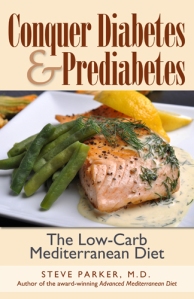
Meal Plans From “Conquer Diabetes and Prediabetes”

These recipes are from Conquer Diabetes and Prediabetes.

Day 3

Breakfast:  Bacon and Eggs

3 large eggs (50 g each)

1.5 tbsp (22 ml) olive oil

6 slices pork bacon, cured (about 50 g cooked)

Fry the eggs in olive oil. Bake or fry the bacon. Digestible carb grams: 2.

Lunch:  Chicken Salad Over Mixed Greens

1 large egg (50 g)

4 oz (110 g) cooked, diced chicken (canned or freshly sautéed in olive oil)

½ oz (14 g) raw onion, diced (about 2 tbsp)

8-inch stalk (40 g or 20-cm stalk) of raw celery, diced

2.5 tbsp (40 ml) Miracle Whip Dressing or regular Mayonnaise

2 oz (60 g) romaine lettuce

2 oz (60 g) raw baby spinach

1 oz (28 g) almonds

salt and pepper

Hard-boil an egg, then peel and dice. In a bowl, place the chicken and add the egg, onion, celery, and Miracle Whip Dressing or regular mayonnaise. Mix all together, with salt and pepper and/or a dash of lemon juice to taste. Place on bed of lettuce and baby spinach. Enjoy almonds around mealtime or later as a snack. Digestible carb grams: 10.

Dinner:  Baked Balsamic Salmon and Green Beans

16 oz (450 g) salmon filets

salt and pepper

4 cloves (12 g) garlic, minced

1 tbsp (15 ml) olive oil

1.5 oz (45 ml) white wine for the glaze

4.5 tsp (22 ml) mustard

4 tbsp (60 ml) balsamic vinegar

1 tbsp (15 ml) granulated Splenda (or 1 packet (1g) of tabletop Splenda)

1.5 tbsp (22 ml) fresh chopped oregano (or 1 tsp (5 ml) dried oregano)

200 g canned green beans (or fresh green beans sautéed in olive oil/garlic)

5 oz (150 ml) dry white wine

This makes two large servings.

Preheat oven to 400°F (200°C). Line a baking sheet or pan (8″ or 20 cm) with aluminum foil. Lightly salt and pepper the fish in the lined pan, with the skin side down.

Now the glaze. Sauté the minced garlic in olive oil in a small saucepan over medium heat for about three minutes, until it’s soft. Then add and mix white wine (1.5 oz), mustard, vinegar, granulated Splenda, and 1/8 tsp (0.625 ml) salt. Simmer uncovered over low or medium heat until slightly thickened, about three minutes. Remove glaze from heat and spoon about half of it into a separate container for later use.

Drizzle and brush the salmon in the pan with the glaze left in the saucepan. Sprinkle the oregano on top.

Bake the fish in the oven for about 10–13 minutes, or until it flakes easily with a fork. Cooking time depends on your oven and thickness of the fish. Over-cooking the fish will toughen it and dry it out. When done, use a turner to transfer the fish to plates, leaving the skin on the foil if able. Drizzle the glaze from the separate container over the filets with a spoon, or brush it on. Don’t use the unwashed brush you used earlier on the raw fish.

Heat canned green beans (200 g) on stovetop or serve at room temperature straight out of the can.

Enjoy a 5-oz glass of dry white wine with your meal. This recipe makes two servings of fish and green beans. Digestible carb grams in wine, half the fish, half the green beans: 14.

(The balsamic vinegar adds six g of carb to each serving. To reduce vinegar carbs to zero, you could try this recipe with red wine vinegar, white wine vinegar, or cider vinegar. I’ve not tried that. Digestible carbs per serving would drop to 8 g.)

1 Comment

Filed under Recipes

Higher Blood Sugar Levels at Time of Admission for Heart Failure are Linked to Higher Death Rates In Next 30 Days

Comments Off on Higher Blood Sugar Levels at Time of Admission for Heart Failure are Linked to Higher Death Rates In Next 30 Days

January 18, 2013 · 9:16 AM

QOTD: James Fisher on Efficient Resistance Exercise

We recommend that appreciably the same muscular strength and endurance adaptations can be attained by performing a single set of ~8–12 repetitions to momentary muscular failure, at a repetition duration that maintains muscular tension throughout the entire range of motion, for most major muscle groups once or twice each week. All resistance types (e.g. free-weights, resistance machines, bodyweight, etc.) show potential for increases in strength, with no significant difference between them, although resistance machines appear to pose a lower risk of injury.

—Fisher, James, et al.  Evidence-based resistance training recommendations.  Medicina Sportiva, 15 (2011): 147-162.

Comments Off on QOTD: James Fisher on Efficient Resistance Exercise

Filed under Exercise, Quote of the Day