What fits your busy schedule better, exercising 30 minutes a day or being dead 24 hours a day?
—Randy Glasbergen in a 2008 cartoon
What fits your busy schedule better, exercising 30 minutes a day or being dead 24 hours a day?
—Randy Glasbergen in a 2008 cartoon
Comments Off on QOTD: Exercise versus Death
Filed under Exercise, Quote of the Day
Some people with diabetes, particularly after having the condition for many years, lose the ability to detect hypoglycemia—low blood sugar—just by the way they feel. This “hypoglycemia unawareness” is obviously more dangerous than being able to detect and treat hypoglycemia early on. Blood sugar levels may continue to fall and reach a life-threatening degree. Hypoglycemia unawareness can be caused by impairment of the nervous system (autonomic neuropathy) or by beta blocker drugs prescribed for high blood pressure or heart disease. People with hypoglycemia unawareness need to check blood sugars more frequently, particularly if driving a car or operating dangerous machinery.
How Is Hypoglycemia Treated?
Folks who can indeed perceive signs or symptoms of hypoglycemia usually won’t notice them until their blood sugar is under 65 mg/dl (36 mmol/l).
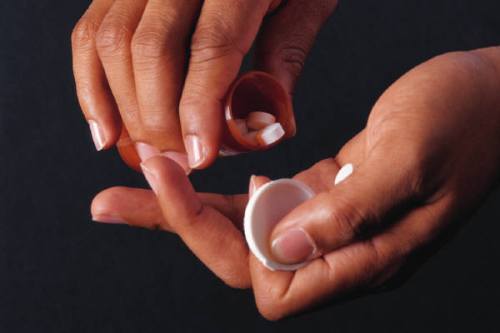
If you have diabetes, your personal physician and other healthcare team members should teach you how to recognize and manage hypoglycemia. Immediate early stage treatment involves ingestion of glucose as the preferred treatment—15 to 20 grams. You can get glucose tablets or paste at your local pharmacy without a prescription. Other carbohydrates will also work: six fl oz (180 ml) sweetened fruit juice, 12 fl oz (360 ml) milk, four tsp (20 ml) table sugar mixed in water, four fl oz (120 ml) soda pop, candy, etc. Fifteen to 30 grams of glucose or other carbohydrate should do the trick. Hypoglycemic symptoms respond within 20 minutes.
If level of consciousness is diminished such that the person cannot safely swallow, he’ll need a glucagon injection. Non-medical people can be trained to give the injection under the skin or into a muscle. Ask your doctor if you’re at risk for severe hypoglycemia. If so, ask him for a prescription so you can get an emergency glucagon kit from a pharmacy.
Filed under Diabetes Complications
You can incorporate this cabbage soup into any diabetic diet, even ketogenic ones. This version isn’t a powerhouse in any one particular nutrient but provides a fair amount of zinc, protein, and vitamins A, B12, and C.
If you’re a constipated, a bowl or two of cabbage soup may get things moving. It’s the raffinose in cabbage.
Ingredients:
Instructions:
Add raw meat to the water in a large pot and boil gently for 30 minutes. Then add tomato sauce, carrot, salt, pepper, parsley, and cabbage. Bring to boil over medium heat and them simmer for 45 minutes.
If it’s too bland for you, add a squeeze of fresh lemon. Or as a last resort, add some beef bouillon cube or powder.
Servings:
Makes four servings of 2 cups each (475 ml).
Nutritional Analysis Per Serving:
Steve Parker, M.D.
PS: Nutritional analysis done at FitDay.com. You can analyze you’re own recipes there, too.
MedPageToday has a series of articles looking at socioeconomic issues related to diabetes drugs that have come onto the market in the last decade. They call it their Diabetes Drugs Investigation. I recommend the entire series to you if you have type 2 diabetes. The authors’ have five major points:
1. “Diabetes drugs improve lab tests, but not much more, particularly in pre-diabetics.” FDA drug approvals were based mostly on whether hemoglobin A1c or blood sugar levels improved, not on improvements in hard clinical endpoints such as risk of death, heart attacks, stroke, blindness, amputations, etc.
2. “Physicians and drug makers have reported diabetes drugs as the “primary suspect” in thousands of deaths and hospitalizations.”
3. “Diabetes drug makers paid physicians on influential panels millions of dollars.” The implication is that the panelists were not totally unbiased in their assessments of drug effectiveness and safety.
4. “Risk of a risk now equals disease.” This is about the latest redefinition of prediabetes which created many more “patients.” Prediabetes can progress to type 2 diabetes over a number of years: one of every four adults with prediabetes develops diabetes over the next 3 to 5 years. Some doctors are even treating prediabetes with diabetic drugs. (I recommend a “diet and exercise” approach.) The authors think the prediabetic label—one third of U.S. adults, including half of all folks over 65—is over-used and over-treated.
5. “The clinical threshold for diagnosing diabetes has crept lower and lower over the past decade.” For instance, in 1997 expert panels lowered the threshold defining diabetes from a fasting blood glucose level of 140 mg/dl (7.8 mmol/l) to 125 mg/dl (6.9 mmol/l). Four million more American adults became diabetics overnight. In 2003, they lowered the threshold for prediabetes from a fasting blood glucose from 110 mg/dl (6.1 mmol/l) to 100 mg/dl (5.6 mmol/l). Boom! 46 million more American prediabetics.
I fully agree with the authors that we don’t know which drugs for type 2 diabetes are the best in terms of prolonging life, preventing diabetes complications, and postponing heart attacks and strokes. Furthermore, we don’t know all the adverse long-term effects of most of these drugs. For instance, metformin had been on the market for over a decade before we figured out it’s linked to vitamin B12 deficiency. That’s why I try to convince my patients to do as much as they can, when able, with diet and exercise before resorting to one or more drugs. (All type 1 diabetics and a minority of type 2 diabetics must take insulin.) Maybe it’s healthier to focus primarily on drug therapy…but I don’t think so.
RTWT.
Comments Off on Does Big Pharma Have Too Much Influence on Diabetes Management?
Filed under Drugs for Diabetes
MedPageToday has an article on the “Bittersweet Diabetes Economy” talking about the cost of treating diabetes, Big Pharma influence on diagnosis and treatment of diabetes and prediabetes, and the unknown long-term effectiveness of diabetes drugs. Most of the article pertains to type 2 diabetes. A quote:
Last year, sales of diabetes drugs reached $23 billion [worldwide or U.S.?], according to the data from IMS Health, a drug market research firm. That was more than the combined revenue of the National Football League, Major League Baseball, and the National Basketball Association.
But from 2004 to 2013, none of the 30 new diabetes drugs that came on the market were proven to improve key outcomes, such as reducing heart attacks or strokes, blindness, or other complications of the disease, an investigation by MedPage Today and the Milwaukee Journal Sentinel found.
The U.S. Food and Drug Administration approved all of those drugs based on a surrogate endpoint: the ability to lower blood sugar. Many of the new drugs have dubious benefit; some can be harmful.
Another key outcome we don’t know about is prevention or postponement of death via drug therapy for type 2 diabetes.
Now you have some inkling of why I exhort my patients to maximize diet and exercise interventions before resorting to drugs, increasing drug dosages, or adding more drugs. (I’m not talking about type 1 diabetes here.)
RTWT.
Filed under Drugs for Diabetes
A vegan diet was superior to a low-fat diet over the course of three weeks, in terms of blood sugar, hemoglobin A1c, total cholesterol and LDL cholesterol. The vegans were also able to use fewer drugs.
A specific vegan diet (Ma-Pi 2) was compared to a low-fat diet in a study published by Nutrition & Metabolism. Carbsane Evelyn dove into the study at her blog (recommended reading), or you can read the original research report yourself. Study subjects had fairly well-controlled type 2 diabetes and were elderly (66) and overweight (84 kg or 185 lb). The vegan diet was mostly whole grains, vegetables, legumes, and green tea. The low-fat and vegan diets both probably supplied 200–300 calories/day fewer than what the subjects were used to: 1900 cals for men, 1700 for women. The study had 25 patients in each group and lasted only three weeks.
The vegan group ate 335 grams/day of carbohydrate compared to 235 grams in the low-fat group. In contrast, the Low-Carb Mediterranean Diet provides 30–100 grams/day of digestible carb and the Ketogenic Mediterranean Diet allows a max of 20–30 grams.
The vegans in the study at hand ate 15–20 more grams/day of fiber. High fiber intake is linked to better blood sugar control.
From the study abstract:
After correcting for age, gender, BMI at baseline, and physical activity, there was a significantly greater reduction in the primary outcomes fasting blood glucose and after-meal glucose in those patients receiving the Ma-Pi 2 diet compared with those receiving the control diet [low-fat]. Statistically significantly greater reductions in the secondary outcomes, HbA1c, insulin resistance, total cholesterol, LDL cholesterol and LDL/HDL ratio, BMI, body weight, waist and hip circumference were also found in the Ma-Pi 2 diet group compared with the control diet group. The latter group had a significantly greater reduction of triglycerides compared with the Ma-Pi 2 diet group.
The take-home point for me is that overweight T2 diabetics can improve short-term diabetes numbers despite a high carbohydrate consumption if they restrict calories and eat the “right” carbs. Restrict calories enough—600/day?—and T2 diabetes might be curable.
I’ve written before about vegetarian/vegan diets for diabetes. My patients are more resistant to vegan diets than they are to low-carb.
I scanned the original report and don’t see any problems with Evelyn’s summary.
Filed under Vegetarian Diet
Read his amazingly detailed post at Diatribe. Adam, who has type 1 diabetes, figured out during his college days that eating no more that 30 grams of carbs at a time was “a complete gamechanger” for improving his blood sugars. He experimented on himself to see if there was a difference between his usual lower-carb diet (146 grams/day) versus 313 grams/day.
A quote:
To my utter surprise, both diets resulted in the same average glucose and estimated A1c. But there were major tradeoffs:
The higher-carb, whole-grain diet caused four times as much hypoglycemia, an extra 72 minutes per day spent high, and required 34% more insulin. (A less healthy high-carb diet would have been far worse.)
Doubling my daily carbs also added much more effort and produced far more feelings of exhaustion and diabetes failure. It was not fun at all, and the added roller coaster, or glycemic variation, from all the extra carbs made it more dangerous.
See more at: http://diatribe.org/low-carb-vs-high-carb-my-surprising-24-day-diabetes-diet-battle#sthash.pZOgCWVl.dpuf
I think the lower-carb approach is healthier over the long run. Check with your own healthcare provider before making any drastic change in your diabetic diet.
Filed under Carbohydrate
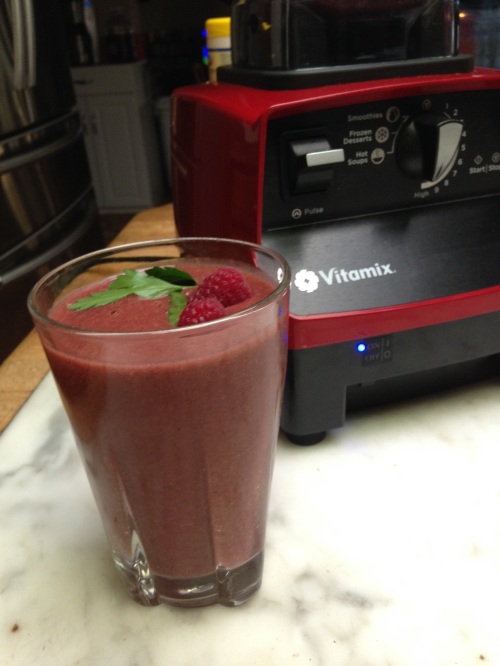
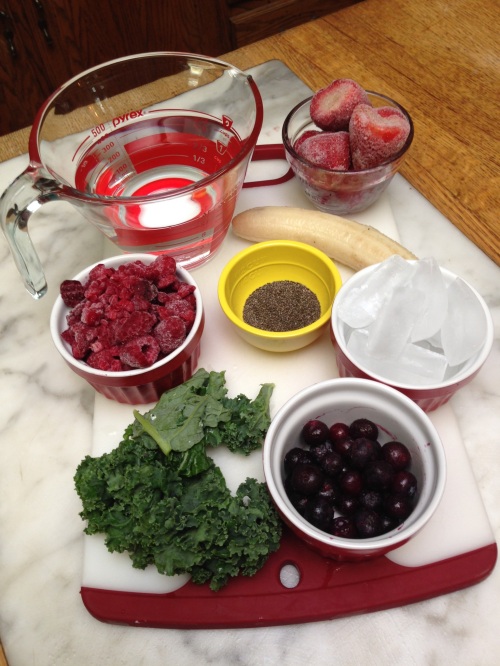
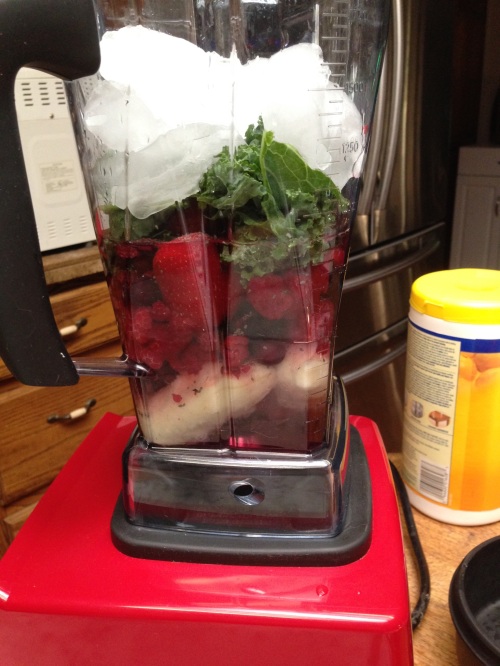
Smoothies are a great substitute for junk food desserts. My wife has been experimenting with them. Most Americans should probably eat more fruit; smoothies are one way to do that. Here’s one she made up. Note the trendy chia seeds and kale (or is that fad over?).
Since I provide the nutritional analysis below, you can easily incorporate this smoothie into a diabetic diet. Total digestible carb grams are 32; if that’s too much, cut the portion in half.
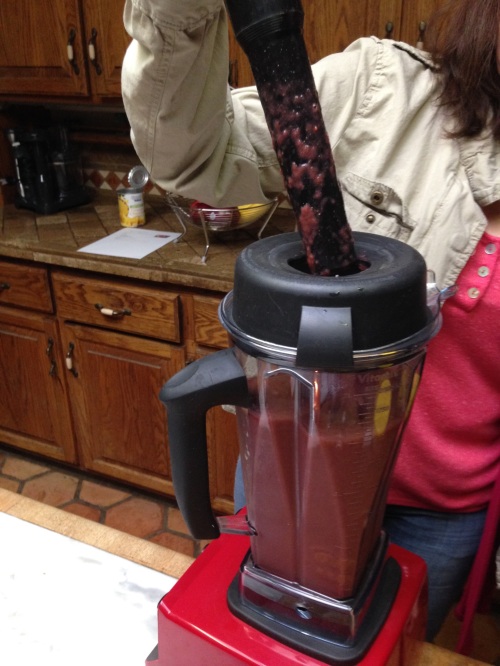
We’re using a Vitamix mixer. Other devices may be able to get the job done. The mixing speeds our device range from one to 10. (Tip for a competitor: make one that goes to 11.) We love our Vitamix and have no regrets about the purchase. It is hard to hear anything else when it’s running at top speed.

One potential advantage of blending these fruits is that one fruit may provide nutrients that the others lack
Ingredients
1 cup (240 ml) grapes, green seedless
1 mandarin orange, peeled, halved
1 banana (7 inches or 18 cm), peeled, cut into 3–4 pieces
1 pear, medium-size, cored, quartered (ok to leave peel on)
1/2 tbsp (7 g) chia seeds
1 cup (50 g) raw kale
Instructions
First put the water in the Vitamix, then grapes, pear, orange, banana, chia seeds, kale, and finally ice. Ice is always last. Then blend on variable speed 1 and gradually go up to high level (10). Total spin time is about 45 seconds.
Number of Servings: 2.5 consisting of 12 fl oz (350 ml) each.
Nutritional Analysis per Serving:
7% fat
88% carbohydrate
5% protein
160 calories
38 g carbohydrate
6 g fiber
32 g digestible carbohydrate
15 mg sodium
520 mg potassium
Prominent features: Good source of vitamin C, fair amount of fiber, miniscule sodium.
Filed under Recipes