Category Archives: Uncategorized

Another Study Demonizes Red Meat: Justifiable?

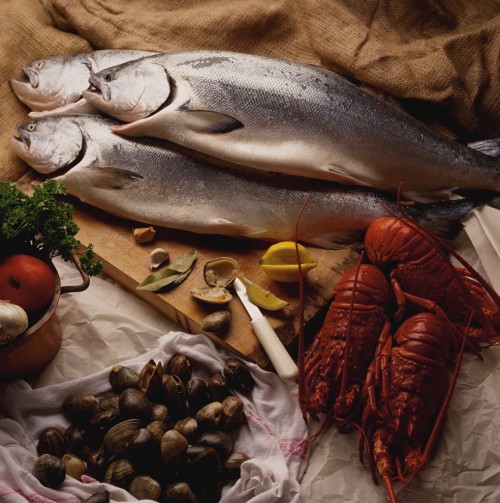
I don't know about these, but some fish have white meat (flesh), too

Lobster meat is white, too

If you hear elsewhere about a recent study blaming red meat for kidney failure, be aware that the headline should read “pork.” Read on for details.

Wait, what? I thought pork was “the other white meat.”

First they told us red meat caused cancer. Then cardiovascular disease. Then diabetes. And now kidney failure. Why eat it at all? I still do, but in moderation.

You have to take studies like this with a grain of salt. There are numerous confounding factors that may invalidate results. For instance, if you’re not Chinese and living in Singapore, results of this study may not apply to you. For another instance, Chinese pork may be different from English, Indian, Canadian, and U.S. pork.

A quote from the article at MNT:

“Researcher Woon-Puay Koh and her team delved into data from the Singapore Chinese Health Study, which included more than 63,000 adults, aged 45-74. They linked the data with the Singapore Renal Registry, which holds the records of all Singapore ESRD patients. The overall aim was to uncover the role of different protein sources on kidney health outcomes.

“We embarked on our study to see what advice should be given to chronic kidney disease patients or to the general population worried about their kidney health regarding types or sources of protein intake,” explains Koh.

In China, the primary red meat is pork, accounting for 97 percent of red meat intake. Other popular protein sources included eggs, dairy, shellfish, fish, soy, legumes, and poultry.

The participants were followed up for an average of 15.5 years. During that time, 951 cases of ESRD [end-stage renal disease] occurred; the resultant data showed a clear trend.

Red meat intake was associated with a dose-dependent increased ESRD risk. Individuals who consumed the highest amounts of red meat – the top 25 percent – showed a 40 percent higher risk of developing ESRD than those who consumed the least red meat – the bottom 25 percent.”

Source: Red meat consumption linked to kidney failure – Medical News Today

1 Comment

Filed under Uncategorized

Upcoming Changes

I need to reach more people. Last fall I tripled my blogging frequency and it did nothing to increase viewership. I plan to cut back on written blogging and Tweeting, but will be doing more videos. It’s an experiment.

I’ll try to keep all videos under six minutes out of respect for your time.

This video mentions the topics I’ll be covering. If they sound interesting, please subscribe to the pxHealth YouTube Channel.

Comments Off on Upcoming Changes

Filed under Uncategorized

From The Low Carb Diabetic: Drug Makers Accused of Fixing Prices on Insulin

“A lawsuit filed Monday accused three makers of insulin of conspiring to drive up the prices of their lifesaving drugs, harming patients who were being asked to pay for a growing share of their drug bills.The price of insulin has skyrocketed in recent years, with the three manufacturers — Sanofi, Novo Nordisk and Eli Lilly — raising the list prices of their products in near lock step, prompting outcry from patient groups and doctors who have pointed out that the rising prices appear to have little to do with increased production costs.”

Source: The Low Carb Diabetic: Drug Makers Accused of Fixing Prices on Insulin

Comments Off on From The Low Carb Diabetic: Drug Makers Accused of Fixing Prices on Insulin

Filed under Uncategorized

R.I.P., Mary Tyler Moore

Actress Mary Tyler Moore died today at the age of 80. She is probably the most famous type 1 diabetic of a certain generation, those watching TV in the 1960s and 1970s. According to her NYT obituary, her diabetes started in her 30s.

Average life expectancy in the U.S. is 78.8 years, based on 2014 data. It’s longer for women, shorter for men. That average is reduced by 10–12 years for those with type 1 diabetes.

It still amazes me that one of the very first users of insulin injections, Elizabeth Hughes, lived to be 73, having started insulin around age 22.

Steve Parker, M.D.

Comments Off on R.I.P., Mary Tyler Moore

Filed under Longevity, Uncategorized

Trick Question: Who’s Buried in Grant’s Tomb?

Thomas Twining started selling tea in London in 1706. His eponymous company has been doing it for 300 years, then. You’d think they know tea if anyone does. Here’s Twinings Green Tea:

Not to me

Green? Brown?  Golden brown? Tea-colored? Flax? Tannin? Purple? Polka-dotted?

Does that look green to you? I guess they specialize in black tea (which I bet isn’t black after brewing).

My quest for green “green tea” continues. I just ordered Kirkland Ito En Matcha Blend Japanese Green Tea from Amazon.

Steve Parker, M.D.

PS: If you don’t like green, you’ll find none of it inside my books.

PPS: The remains of Ulysses S. Grant and his wife are in a mausoleum referred to as Grant’s tomb. They are above ground, so technically they aren’t buried.

1 Comment

Filed under Uncategorized

Merry Christmas!

Credit: Zvonimir Atletic / Shutterstock.com

Credit: Zvonimir Atletic / Shutterstock.com

3 Comments

Filed under Uncategorized

Why Isn’t My Green Tea Green?

At least the box is green

At least the box is green

I’ve been reading for years how green tea is or might be particularly healthful for us. It’s not just hearsay. Respected journals like the American Journal of Clinical Nutrition suggest green tea’s virtues: longevity and less risk of type 2 diabetes, heart disease, and dementia, to name a few off the top of my head.

I’ve never been a tea drinker. Oh, sure, I’ve drunk iced tea at restaurants now and then. That’s black tea.

I drink coffee, about five cups a day. I work a fair number of night shifts, and the caffeine helps wake me up and keep me alert.

On a lark recently, I thought I’d cut back on the coffee and try green tea. In case you’re wondering, green tea has a third of the caffeine content of coffee.

So I go to the supermarket tea section and pick up a box of Bigelow green tea bags. There were five or 10 other options. Why Bigelow? I think I’ve heard the name before. Or the box appealed to me subconsciously. I brew it up easy-peasy per directions and this is what I see:

Mild, pleasant flavor but may not have the phytonutrients I seek

Mild, pleasant flavor but may not have the phytonutrients I seek

WTF?!

Does that look green to you?

I didn’t think so.

Naturally I start googling. The rest of this paragraph may or may not be true, like everything you read on the Internet. Green tea by tradition should be green. The supermarket teas are not traditional. They are oxidized, not fresh, or processed incorrectly. They’re a bastardization of traditional green teas with primary goals of mass distribution and adequate shelf life. They don’t have much of the “healthy” components you are looking for: anti-oxidants, polyphenols, EGCG, catechins, etc. Phytonutrient content of teas varies from batch to batch. The epidemiological studies that support green tea as healthful involved mostly Asian populations, often Japanese, who were drinking traditional green tea that’s green. Brewing is important: 170°F (77°C) for no more than 2–3 minutes. The fresher the tea leaves, the better. Special packaging may help preserve freshness. A Japanese-sounding brand may use tea grown outside of Japan.

I don’t know any avid green tea drinkers. So I go to Amazon.com and start reading reviews. Apparently there’s a whole world of green tea culture and I’ve just scratched the surface. I’ve already spent three hours on this green tea thing. Judging from Amazon reviews, here are some green teas that might be worth trying: Kirkland Ito En Matcha Blend Japanese Green Tea Bags and Yamamotoyama Green Tea—Sushi Style. (Kirkland is a Costco brand.) I probably also need to seek out a local Japanese ethnic food store and see what they’ve got or recommend.

I’m not raggin’on Bigelow green tea specifically. I bet most supermarket green teas in the U.S. will come out brown. For all I know, Bigelow may be jam-packed with healthy phytonutrients that will help you live to 110. It has a mild pleasant taste that I enjoyed. I didn’t miss the higher caffeine load of coffee. But it’s not traditional green tea.

I still want to try a green tea habit. If you can give me some pointers, please do so below or email me at steveparkermd AT gmail DoT com. (Do we still have to hide email addresses from bots?)

Steve Parker, M.D.

PS: Just because green tea may be healthful for Southeast Asians, that’s no guarantee it works for other ethnicities.

PPS: I’m not at all convinced that green tea is a panacea that will help me stay healthy or live longer.

PPPS: Green tea is one of Franziska Spritzler’s low-carb beauty foods.

LCHF Mediterranean diet

LCHF Mediterranean diet

3 Comments

Filed under Uncategorized

How Much Is Typical Holiday Weight Gain?

MB900446412

I originally published this last September, but few of you were concerned about holiday weight gain then.

MNT has the details:

“Around the world, weight gained from holiday feasting takes months to lose, a study found.

Christmas Day in particular is a holiday that appears to pack on the pounds: in a study of some 3,000 individuals in three countries, Americans showed an average 0.4% weight gain from 10 days before Christmas to 10 days after; Germans gained 0.6% more weight; and the Japanese 0.5%.

U.S. participants packed on 0.7% more weight in total during the full Christmas-New Year holiday season, but the Germans had us beat with a 1.0% weight gain, according to Brian Wansink, PhD, of Cornell University in Ithaca, N.Y. and colleagues.”

Source: Holiday Feasts Take Months-Long Weight Toll | Medpage Today

Those percentages aren’t very helpful, are they? In real life, if you weigh 180 lb (81.8 kg) and gain an extra 0.7%, you’re all the way up to a whopping 181.26 lb (82.4 kg). But if you do that—1.26 lb—every year for 20 years and fail to lose the weight, you’re up to 205 lb (93.2 kg) and now you’ve got diabetes and high blood pressure.

Here are a few tips to avoid the weight gain:

  • On the day of the major feast, just eat two meals, and make one of them small
  • Don’t  snack or graze; just eat at mealtimes
  • Work in some extra exercise
  • Minimize the alcohol that weakens your discipline
  • Click for more weight loss tips, many of which help you avoid weight gain

Steve Parker, M.D.

Pro Tip: Read one of my books before you make your annual New Year’s weight-loss resolutions.

PPS: Click for the research report in NEJM.

Comments Off on How Much Is Typical Holiday Weight Gain?

Filed under Uncategorized

Does LCHF Eating Help Indians With Diabetes?

Surfing the net, I ran across an Indian lady named Tina who is successfully treating her T2 diabetes with LCHF eating (low-carb, high-fat). Both she and her husband lost excess weight, too. Click for her website.

In turn, she directed my attention to a YouTube channel by Dr. S. Vijayaraghavan, who is also a LCHF advocate for people with diabetes, type 2 anyway. Check out Goodbye Diabetes.

Comments Off on Does LCHF Eating Help Indians With Diabetes?

Filed under India, Uncategorized

I Lost My Virginity at an Indian Restaurant


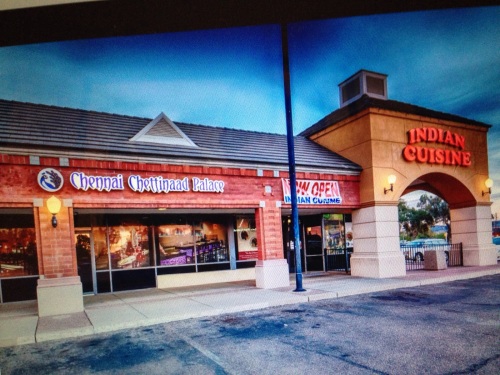
Chennai Chettinaad Palace in Phoenix, Arizona

Chennai Chettinaad Palace in Phoenix, Arizona

Tonight I ate at my first Indian restaurant, Chennai Chettinaad Palace, at 2814 W. Bell Rd., Phoenix AZ 85053. This post isn’t a restaurant review, however. It’s a thumbnail sketch of my introduction to Indian food.

img_3828

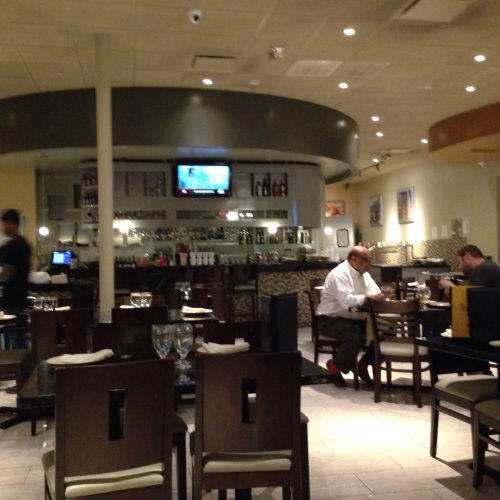
We ended up here because it was recommended to my wife by an Indian gentleman she happened to sit next to on a plane trip. The restaurant has an extensive menu of what they say is authentic North Indian, South Indian & Gujarati food, both vegetarian and non-vegetarian.

We arrived at 6:40 PM and there were few patrons present. One hour later the place was full of apparent Indians.

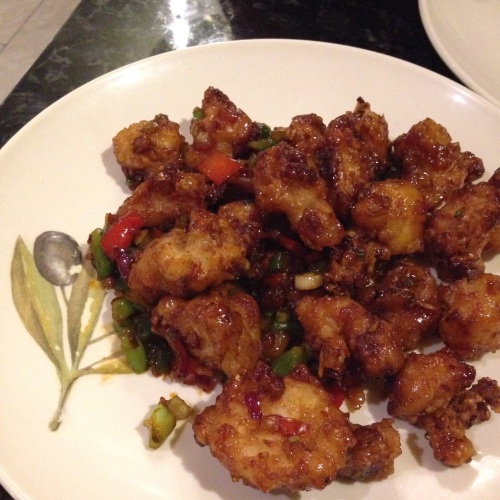
Two of us started out with, and enjoyed, an appetizer called Gobi Manchurian.

Gobi Manchurian: spicy cauliflower pieces lightly battered and fried.

Gobi Manchurian: spicy cauliflower pieces lightly battered and fried. Yum!

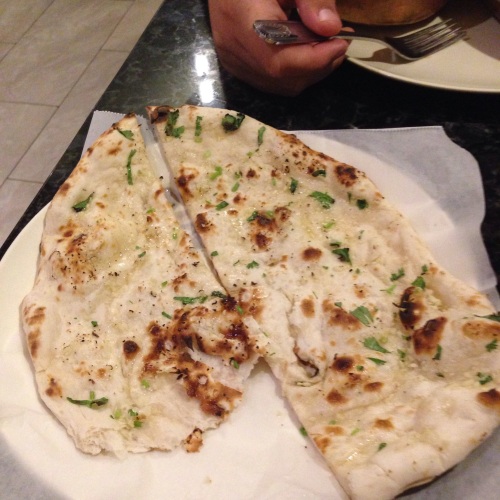
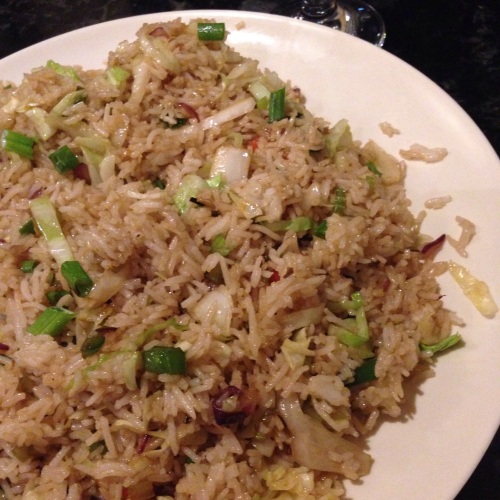
It would have been too spicy for my third dining mate, who simply ate garlic naan (bread) and vegetarian fried rice. Both were delightful, although the rice was a tad oily. The rice dish easily serves four diners. The naan is addictive; split an order with your mate or you’ll eat too much.

Garlic Naan, a type of flat bread

Garlic Naan, a type of flat bread

Vegetarian Fried Rice with bits of cabbage, carrot, celery, and (?) cilantro.

Vegetarian Fried Rice with bits of cabbage, carrot, celery, green onion, and (?) cilantro.

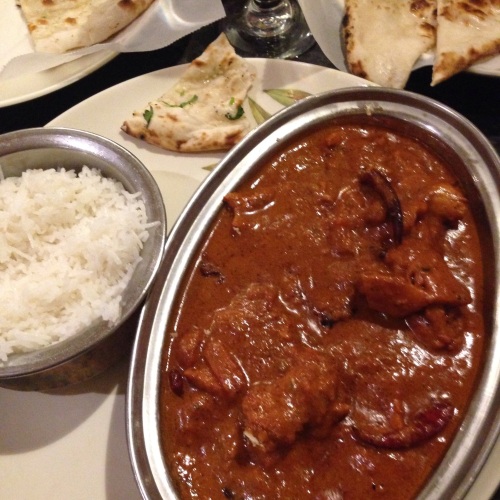
My main entree was Chicken Kolhapuri. I was forewarned it would by spicy hot. I enjoyed it. My wife wouldn’t dare taste it. I’d get it again. I dipped my naan in the copious chicken sauce (a curry?).

Chicken Kolhapuri. Sauce includes ginger, garlic, sesame, and red chilly (sic) paste.

Chicken Kolhapuri. Sauce includes ginger, garlic, sesame, and red chilly (sic) paste.

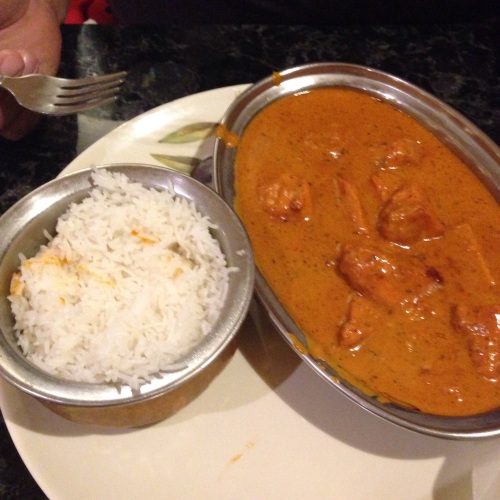
Brian ordered Chicken Tikka Masala but didn’t like it. I don’t think it was bad; it just didn’t suit his taste, the way some folks don’t like asparagus.

Chicken Tikka Masala with a "traditional North Indian sauce" of roma tomatoes, fenugreek, and garam masala.

Chicken Tikka Masala with a “traditional North Indian sauce” of roma tomatoes, fenugreek, and garam masala.

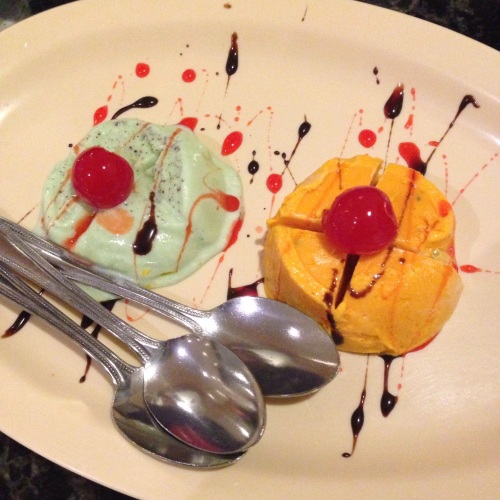
We finished with an ice-cream style dish. If you want ice cream, stop at Baskin-Robbins on your way home.

Mango and Pistachio Kulfi

Mango and Pistachio Kulfi

Service was good. Our waitress was patient with us Indian food virgins. If you’re not familiar with Indian food, you won’t make sense of much of the menu. The restaurant was too cold for my wife, but fortunately she had brought a jacket. The bill for three of us was $63.42 (USD). We brought home two platefuls of leftovers.

I’ll visit again. I’m interested in vegetarian dishes, lamb, goat, and seafood. The secret to Indian food may be in the spices.

The rice, naan, and desert have too many carbohydrates for many diabetics. I’m sure there are low-carb alternatives, even if you have to make them yourself.

Steve Parker, M.D.

PS: The restaurant offered a 10% discount for customers paying with cash instead of credit. I always thought the credit card companies cut of credit card payments was only 3-4%.


5 Comments

Filed under India, Uncategorized