
ScienceDaily has the report. This is exciting. But don’t hold your breath; human trials are years away.
Man’s Best Friend was also instrumental in the discovery of insulin.
h/t David Fisher RD
ScienceDaily has the report. This is exciting. But don’t hold your breath; human trials are years away.
Man’s Best Friend was also instrumental in the discovery of insulin.
h/t David Fisher RD
Comments Off on Gene Therapy Cure of Type 1 Diabetes: Dogs First, Then Humans?
Filed under Uncategorized
Maybe his method works only for him, but I doubt it. David has diabetes, by the way. See his 2012 article at HealthCentral for details. Here’s a bit:
One cornerstone of this new way to lose weight and maintain weight loss is a twist on a standard dieting recommendation. But instead of weighing myself once a week, I weigh myself every morning.
Supposedly people get discouraged from daily weigh-ins because our weight seems to fluctuate up or down a couple of pounds every day for no good reason, or for at least for no reason that we can figure out. The fluctuations are certainly true in my experience. But, of course, the same fluctuations happen when we make our weigh-ins once a week, and that would be even more misleading.
Then, when the scales tell me that my weight is up that morning from the previous morning, I make an immediate course correction, which we know is easier in the long run than to wait until things get totally out of hand. My immediate course correction is simple. I skip dinner that day.
Note well, however, that skipping dinner could lead to major hypoglycemia if you’re taking certain diabetes drugs. Work with your personal healthcare provider on drug dose adjustments.
Filed under Uncategorized

First Nation people traditionally ate salmon, a great source of marine omega-3 fatty acids
DietDoctor Andreas Eenfeldt recently interviewed Jay Wortman, M.D., and posted it at his blog. Dr. Wortman apparently cured his type 2 diabetes with a low carb diet. The interview doesn’t reveal how many carbohydrate grams Dr. Wortman eats daily, but I’m guessing under 60 g, perhaps as low as 30. He avoids sugars and starches.
Dr. Wortman also did research on application of the ancestral diet (low-carb) among aborigines on the west coast of Canada. I think they call them First Nation people. The low-carb diet helped them get off diabetes and high blood pressure drugs while losing excess weight. Dr. Wortman mentioned the diet improved heartburn, too. Folks who go low-carb frequently report an improvement in heartburn. That’s even been studied scientifically.
Comments Off on Dr. Jay Wortman Cured His Type 2 Diabetes With Low-Carb Eating
Filed under Inspiration
The general population doesn’t need to worry about eggs causing strokes or heart attacks according to a new meta-analysis reviewed at Forbes. We still have a question about high egg consumption and heart attacks in diabetics.
Comments Off on Eggs Are Linked to Heart Attacks in Diabetics?
Filed under Heart Disease
Eric is a Crossfitter who owns a Crossfit gym (or box, as they say). Kelly asks him about low-carb eating (even ketogenic) and how to manage food and insulin in the setting of vigorous exercise. Well worth a read, especially if you have type 1 diabetes.
Filed under Exercise, ketogenic diet

“Vegan? Vegetarian? Mediterranean? Low-Carb? ADA? Low GI? SAD?
Remember that recent report on the best diet for diabetes from American Journal of Clinical Nutrition? I didn’t think so. Here’s Dr. Axel Sugurdsson’s summary:
Ajala and coworkers conclude that their review provides evidence that modifying the amount of macronutrients can improve glycemic control, weight and lipids in type 2 diabetes. In their analysis, low carbohydrate diets appeared to provide superior weight loss, better control of blood glucose, and better lipid profile, compared with low fat diets. The authors also conclude that vegan and vegetarian diet may improve glucose control and promote weight loss in type 2 diabetes.
Here’s the verbatim conclusion of the researchers from the article abstract:
Low-carbohydrate, low-GI, Mediterranean, and high-protein diets are effective in improving various markers of cardiovascular risk in people with diabetes and should be considered in the overall strategy of diabetes management.
No mention of vegan and vegetarian diets per se.
And now Dr. Sigurdsson’s concluding opinion:
What is the best diet for diabetes? Although, there is probably not a simple answer, the question reflects one of the main challenges of modern medicine. It is likely that our dietary recommendations will have to be tailored to the needs of the individual. A one-size-fits-all approach is unrealistic. Although not providing any definitive answers, the study by Ajala and coworkers is an important contribution to our understanding of this highly important issue.
I’ve reviewed some of the literature supporting vegetarian diets for diabetes. I’ve seen some evidence that the paleo diet may be beneficial. Regular readers here know that I currently favor a carbohydrate-restricted Mediterranean-style diet for control of diabetes.
Filed under Carbohydrate, Mediterranean Diet, Vegetarian Diet

He’s at high risk for metabolic syndrome
“Metabolic syndrome” may be a new term for you. It’s a constellation of clinical factors that are associated with increased future risk of type 2 diabetes and atherosclerotic complications such as heart attack and stroke. One in six Americans has metabolic syndrome. Diagnosis requires at least three of the following five conditions:
What To Do About It
Metabolic syndrome and simple excess weight often involve impaired carbohydrate metabolism. Over time, excessive carbohydrate consumption can turn overweight and metabolic syndrome into prediabetes, then type 2 diabetes. Carbohydrate restriction directly addresses impaired carbohydrate metabolism naturally. When my patients have metabolic syndrome, some of my recommendations are:
If these work, the patient can often avoid costly drugs and their potential adverse effects.
Ask your doctor what she thinks.
Filed under Causes of Diabetes, Prediabetes

Not Dr. Frassetto
Dr. Lynda Frassetto is a Professor of Medicine and Nephrology at the University of California San Francisco. She and her colleagues have completed a study of the Paleolithic diet as a treatment for diabetes (type 2, I think). As far as I know, details have not yet been published in the medical literature.
Dr. Frassetto spoke at the Ancestral Health Symposium-2012 earlier this year. You can view the 35-minute video here.
She is convinced that a paleo diet, compared to a Mediterranean-style diet, is better at controlling blood sugars and “reducing insulin” in diabetics (presumably type 2s). Insulin sensitivity is improved, particularly in those with insulin resistance to start with. The paleo diet group saw an average drop of fasting glucose by 23 mg/dl (1.3 mmol/l). One slide you’ll see in the video indicates the paleo diet reduced absolute hemoglobin A1c by 0.3%, compared to 0.2% with the “Mediterranean” diet. (Let me know if I got the numbers wrong.)
Color me underwhelmed so far.
Questions raised by the video include:
For answers, we await publication of the formal report.
PS: I’m quite interested in the paleo diet as a treatment for diabetes. I explore the concept at the Paleo Diabetic blog.
Filed under Paleo diet
For the last year, I’ve been pondering whether the paleo diet has anything to offer folks with diabetes or prediabetes. The paleo diet, by the way, is also called the Paleolithic, Stone Age, Old Stone Age, hunter-gatherer, or caveman diet. It definitely has some potential as a diabetes management approach. I’ve been eating paleo-style for the last three months.
Why am I trying it?

My first Parker Paleo Diet meal: sautéed mixed veggies and pan-fried chicken breast
My current version of paleo is not designed for someone with diabetes or prediabetes. That may come in the future. By “current version,” I mean I’ll quite likely tweak it over the coming months.
Here’s what I’ve been eating (or not) on the Parker Paleo Diet:
FORBIDDEN FOODS: Grains (e.g., corn, wheat, rice), Dairy, Legumes (peanuts, beans, peas, green beans), Industrial Vegetable Oils (soybean, corn, safflower, etc.), Alcohol, Refined Sugars.
PROTEINS: Meat, fish/seafood, eggs, poultry, and wild game. Bacon OK; minimize other processed meats.
NUTS & SEEDS: Especially walnuts, macadamia, cachews, almonds. Limit to 1-2 oz/day.
FRUITS: Limit 2 pieces/day?
VEGETABLES:
Lower-Carb: Greens (lettuce, spinach, chard, collard, mustard geen, kale), radicchio, endive, bok choy, herbs, celery, radishes, mushrooms, cabbage, jicama, avocado, asparagus, okra, cucumbers, cauliflower, broccoli, peppers, summer squash, zucchini, Brussels sprouts, green onions, tomatoes, eggplant, tomatillos, eggplant, artichokes, turnips, rutabagas, spaghetti squash, carrots, onions, leeks, water chestnuts (small serving). This list generally starts with the lower carb items and gradually increases to higher carb grams. All these have 5 or fewer carbs per serving; most are much less.
Starchy, Higher-Carb: Beets (6 g, GI 64), winter squashes (acorn, butternut), water chestnuts, parsnips (9 g, GI 97), potatoes (35 g, GI 87), sweet potatoes, (20 g, GI 61), cassava (37 g), taro (21 g), plantains. Some categorize carrots as starchy.
HERBS & SPICES: Cilantro, parsley, basil, rosemary, thyme, etc. Salt (minimal), pepper, vinegar.
OILS: Extra virgin olive, canola, flax, avocado.
CONDIMENTS: Olive oil vinaigrettes, mayonnaise from olive oil & egg yolk, and ?
LIQUIDS: H2O, coffee, tea
After two months of paleo eating, I summarized my experience at Paleo Diabetic.
By the way, I don’t have diabetes or prediabetes. The paleo diet has some potential benefit for those conditions, particularly as compared to the standard American diet. Ideally, I’d like to see more clinical studies before recommending it. Dr. Frassetto and colleagues at the University of California-San Francisco should be publishing their results soon.
Steve Parker, M.D.
Filed under Paleo diet
An eating pattern similar to the traditional Mediterranean diet can be integrated with existing national guidelines for the management of diabetes, blood pressure, and cholesterol. Existing data suggest that the Mediterranean diet has health benefits, including improved glycemic control and reduced cardiovascular risk, and may offer benefits to diabetes patients and clinicians alike in terms of palatability, ease of explanation and use, and promotion of improved health.

Olive oil and vinegar
This excerpt is from an article by three dietitians writing in Diabetes Spectrum in 2009. Click through for details if interested.
—Steve
Reference: doi: 10.2337/diaspect.24.1.36 Diabetes Spectrum January 1, 2011 vol. 24, no. 1, p.36-40
Filed under Health Benefits, Mediterranean Diet
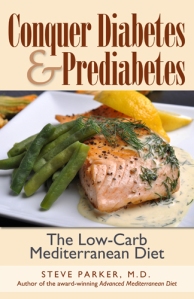
Click the pic to purchase at Amazon.com. E-book versions also available at Smashwords.com.
 Bible Verse of the Day
 Diabetic Mediterranean Diet