

"No weight-loss supplements for me!"
Recommended reading:
Janet Helm at her Nutrition Unplugged blog yesterday wrote about fitness guru Jillian Michaels’ endorsement of highly questionable weight-loss supplements.
"No weight-loss supplements for me!"
Recommended reading:
Janet Helm at her Nutrition Unplugged blog yesterday wrote about fitness guru Jillian Michaels’ endorsement of highly questionable weight-loss supplements.
Comments Off on How Much Is a Good Reputation Worth?
Filed under Weight Loss

Judicious alcohol consumption is linked to lower risk of developing type 2 diabetes: 40% lower risk in women, 13% lower in men.
The latest issue of Diabetes Care reports the comparison of lifetime abstainers with alcohol drinkers. The protective “dose” of alcohol is 22–24 grams a day. I’ll leave it to you to figure out how much alcohol that is. Prior studies looking at overall health benefits of alcohol indicate that judicious consumption is ≤ one drink daily, on average, for women, and ≤ 2 drinks a day for men.
Of course, many people shouldn’t drink any alcohol.
Reference: Baliunas, D., et al. Alcohol as a risk factor for type 2 diabetes: A systematic review and meta-analysis. Diabetes Care, 32 (2009): 2,123-2,132.
Filed under Alcohol, Prevention of T2 Diabetes
I’ve finalized—at least for now—the latest supplements for dieters on the Ketogenic Mediterranean Diet, and tinkered with the original plan: Version 2.0 is published.
Daily supplements:
- 1 or 2 plain Centrum multivitamin/multimineral supplements (two if over 250 lb or 114 kg)
- Magnesium oxide 250 mg
- Calcium carbonate 500 mg elemental calcium (500 mg twice daily if over 250 lb or 114 kg)
- Extra vitamin D to reach total of 1,000–1,200 IU (each Centrum has 400 IU)
- Potassium gluconate 2,750 mg (450 mg elemental potassium) or Morton Salt Substitute (potassium chloride) ¼ tsp (1.2 g)
- If prone to constipation: sugar-free Metamucil powder 1–2 rounded tsp (5.8–11.6 g) in water
- At least three quarts or liters of water
The published version 2.0 of KMD has a misprint: “1,000–2,ooo IU of vitamin D.” Should be 1,000–1,200 IU. I’ll fix it soon and label it version 2.1.
Filed under Uncategorized
![MPj01779580000[1]](https://diabeticmediterraneandiet.com/wp-content/uploads/2009/10/mpj017795800001.jpg?w=150&h=100 "MPj01779580000[1]") Weight: 153 lb (69.5 kg)
Weight: 153 lb (69.5 kg)
Transgressions: blew it big time!
Exercise: 60 minutes horse grooming and trail riding
Comments
Zucchini
In an effort to add variety to my diet, I ate zucchini with my breakfast eggs. Sautéd this summer squash in 50:50 butter and extra virgin olive oil. A small serving of raw zucchini—100 g—provides 1 g fiber, 2 g digestible carbs, 7% of the Daily Value for vitamin K and folate, 8% of riboflavin, 9% of manganese, 11% of B6, and 28% of vitamin C. Many very low-carb diets by themselves don’t provide enought vitamin C to satisfy most dietitians. 28% is a good start on reaching 100% naturally.
You can look at various individual foods in detail and find some that are high in this, low in that. Eating a great variety of foods will make it easier to get all the nutrients you need for optimal health. The food database at NutritionData will give you a breakdown of 30-40 nutrients in most foods.
Darya Pino at Summer Tomato has great ideas on choosing and preparing fresh vegetables.
Today’s Transgressions
We had another family celebration today. I had mentioned to my wife four months ago that I wanted an ice cream/cake combo from Baskin-Robbins: chocolate cake on the bottom, mint chocolate chip ice cream on top. My son also remembered that I love candy corn, so he got me a bag. Overall today I ate 2,970 calories, including 240 g of digestible carbs. I’m not proud of my behavior, but I’m not going to beat myself up over only my second major “cheat” in 60 days of very low-carb eating. Tomorrow’s a new day!
I may have someone hide the candy corn.
Going Forward . . .
I’ll not be reporting in this fashion daily anymore. I plan on sticking with very low-carb eating for a while longer, partially to encourage someone I love to stay with it. I don’t expect to lose any more weight. The question is, what will happen now that I’m stopping my compulsive record-keeping?
Update October 31, 2009
Weight today is 155.5 lb, up 2.5 lb after my carb overdose yesterday. There’s a lesson here.
Update November 1, 2009
Weight: 155 lb
Filed under My KMD Experience
 Weight: 154 lb
Transgressions: none
Exercise: 90 minutes horse grooming and trail riding
Comments
I’ve finalized the latest supplements for dieters on the Ketogenic Mediterranean Diet, and tinkered with the original plan: Version 2.0 is published.
Daily supplements:
- 1 or 2 plain Centrum multivitamin/multimineral supplements (two if over 250 lb or 114 kg)
- Magnesium oxide 250 mg
- Calcium carbonate 500 mg elemental calcium (500 mg twice daily if over 250 lb or 114 kg)
- Extra vitamin D to reach total of 1,000–1,2000 IU (each Centrum has 400 IU)
- Potassium gluconate 2,750 mg (450 mg elemental potassium) or Morton Salt Substitute (potassium chloride) ¼ tsp (1.2 g)
- If prone to constipation: sugar-free Metamucil powder 1–2 rounded tsp (5.8–11.6 g) in water
- At least three quarts or liters of water
Comments Off on My Ketogenic Mediterranean Diet: Day 59 + Updated Supplement Recommendations
Filed under My KMD Experience

Can't get enough
Weight: 155 lb
Transgressions: 1 Metamucil fiber wafer
Exercise: none
Comments
At least I didn’t exceed my quota of veggies again today.
I sautéd spinach and mushrooms in butter to accompany my eggs this AM. Good combo.
Comments Off on My Ketogenic Mediterranean Diet: Day 58
Filed under My KMD Experience

Just weeks after I reported about fish consumption being linked to higher risk of type 2 diabetes, a different study reports the opposite.
The Norfolk, England, wing of the European Prospective Investigation of Cancer found a 25% lower risk of developing diabetes in adults who ate one or more servings of fish weekly, compared with those who ate less than that. What kind of fish? White fish and oily fish.
Contradictory results like this are not uncommon in the field of science.
Reference: Patel, P., et al. Association between type of dietary fish and seafood intake and the risk of incident type 2 diabetes. The EPIC-Norfolk cohort study. Diabetes Care, 32 (2009): 1,857-1,863.
Comments Off on THIS Week, Fish Consumption is Linked to Lower Diabetes Risk
Filed under Fish, Prevention of T2 Diabetes
![MPj04031620000[1]](https://diabeticmediterraneandiet.com/wp-content/uploads/2009/10/mpj040316200001.jpg?w=150&h=100 "MPj04031620000[1]") Nut consumption is strongly linked to reduced coronary heart disease, with less rigorous evidence for several other health benefits, according to a recent article in the American Journal of Clinical Nutrition.
Nut consumption is strongly linked to reduced coronary heart disease, with less rigorous evidence for several other health benefits, according to a recent article in the American Journal of Clinical Nutrition.
This is why I’ve included nuts as integral components of the Ketogenic Mediterranean Diet and the Advanced Mediterranean Diet.
Regular nut consumption is associated with health benefits in observational studies of various populations, within which are people eating few nuts and others eating nuts frequently. Health outcomes of the two groups are compared over time. Frequent and long-term nut consumption is linked to:
The heart-protective dose of nuts is three to five 1-ounce servings a week.
Reference: Sabaté, Joan and Ang, Yen. Nuts and health outcomes: New epidemiologic evidence. American Journal of Clinical Nutrition, 89 (2009): 1,643S-1,648S.
Comments Off on Nuts: The Healthy Snack
Filed under Health Benefits, Mediterranean Diet, Prevention of T2 Diabetes
 Weight: 154 lb
Transgressions: Exceeded veggie quota by 4.5 oz
Exercise: 90 minutes of horse grooming and trail riding
Comments
After lunch I was already over my veggie allotment by 4.5 oz. It’s the tomatoes. They’re heavy. Will have to cut back.
I disagree with those who say, “You’ll lose your desire for carbs after you’ve done the low-carb lifestyle for a while.” Is eight weeks enough? Not for me! Set me loose on an apple pie or Cinnabon and I’ll show you a desire for carbs.
Week 8 Recap
Weight is hovering around 154–155 for several weeks now. I doubt I’ll lose any more weight unless I exercise more or consciously cut back on calories, or both. It’s possible that simply monitoring my caloric intake is somewhat inhibitory, subconsciously. I see no health or vanity reason to shoot for a lower weight at this point.
Average Daily Calories: 1,750
Micronutrient Percentages: carbohydrate 9%, fat 53%, protein 25%, alcohol 13%
Average Daily Digestible Carbohydrates: 28 g
Average Daily Fiber: 12 g
Daily fats, cholesterol, micronutrients: Not calculated. See Week 5-7 Recap. Should be about the same.
Filed under My KMD Experience
![MPPH02842J0000[1]](https://diabeticmediterraneandiet.com/wp-content/uploads/2009/10/mpph02842j00001.jpg?w=116&h=150 "MPPH02842J0000[1]") Weight: 155 lb
Weight: 155 lb
Transgressions: Ate oysters instead of fish, and 22 oz salad greens instead of maximum 14 oz
Exercise: Four hours of barnyard chores: clearing brush, moving rocks, adjusting fences.
Comments
My recent cheat day didn’t seem to set me back, other than increasing temporarily my desire for more carbs.
I tried the Morton Salt Substitute on my eggs this morning. Tastes fine. Even drank 8 fl oz of water containing one quarter teaspoon (1.2 g) of this potassium chloride product. That’s 610 mg potassium in one fell swoop. Regulators in the U.S. limit potassium in over-the-counter supplements to 99 mg. But remember the potential health benefits of high potassium diets are tied to fruit and vegetable consumption—markers of potassium intake—rather than potassium supplements.
My leg cramps could be related to deficiency of magnesium, calcium, or potassium. This is probably an issue with most very low-carb ketogenic diets. Easy enough to supplement, especially if you know that salt substitutes contain much more potassium than bottled potassium supplements.
I found an example of carbs sneaking into food you might not suspect: ham. I bought some “fully cooked cubed ham, water added, ground and formed.” A two-ounce (56 g) serving has 3 g of carbohydrate: dextrose and modified food starch. Like many processed meats, it also contained sodium nitrite, which might be good to avoid. Some studies link nitrites—a preservative added to processed meats—to cancer. Others do not.
Tracking nutrients in processed foods like this ham is also a little problematic. The food database at NutritionData has about 60 entries for ham. The closest product I found was “pork, cured, ham and water product, slice, boneless, separable lean and fat, heated, roasted.” Close enough.
Smoked oysters were right next to the canned tuna on my last shopping trip, so I grabbed a couple cans. Turns out they are relatively high in carbohydrates—6 g per 2 ounce serving. Also found out they are an excellent source of protein, B12, zinc, copper, and iron. This is an example of why food variety is important. The other foods I’ve been eating tend leave me lacking iron, copper, and zinc.
Again, I lost track of my veggie intake and exceeded the max.
Filed under My KMD Experience
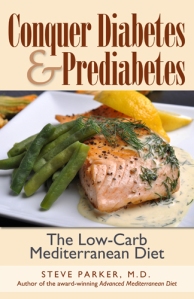
Click the pic to purchase at Amazon.com. E-book versions also available at Smashwords.com.
 Bible Verse of the Day

