Category Archives: Uncategorized

Does Diet Affect Irritable Bowel Syndrome?

"Dr. Parker, what can I do about these severe belly cramps?"

“Dr. Parker, what can I do about these belly cramps?”

Four weeks of fermentable carbohydrate restriction reduces symptoms of irritable bowel syndrome, according to UK and Australian researchers.

Here’s the theory of how it works.  Our intestines—colon, mostly—are loaded with bacteria.  The food you feed your bacteria—fermentable carbohydrates, for example—may have an effect on the bacteria.  Changes in bacterial populations in response to feeding, in turn, may lead to changes in irritable bowel syndrome and other aspects of health.  This “gut microbiome” is a hot area of research and speculation.

I don’t have irritable bowel syndrome (IBS), but did notice a major decrease in gastrointestinal gas production when I reduced my digestible carbohydrate consumption to less than 50 g/day.  That alone has at least potential to reduce IBS symptoms.

IBS is extremely common, affecting 10–15% of individuals in the developed world. Only 15% of those bother to seek medical attention. Of all referrals to gastroenterologists (stomach specialists), at least 25% are for IBS.  There are few reliable treatments and cures. In some cases it mysteriously resolves on its own.

So I got excited when I ran across the study I reference above.  I’m not going to spend a lot of time on it because I’ve already spent too much trudging through the article, and I don’t have much to show for it.

The way the investigators wrote their report gave me some heartburn:

  • They never bothered to define “fermentable.”  In this context it probably refers to digestion or breakdown of food by gut bacteria rather than by human hosts.
  • They never bother to spell out exactly what foods the experimental subjects were eating as they restricted fermentable carbohydrate consumption.
  • The intervention group (n=19) was instructed to restrict foods “high in fructans (e.g., wheat products, onions), galacto-oligosaccharide (e.g., legumes), polyols (e.g., pear, sugar-free gums), lactose (e.g., mammalian milk), and excess fructose (e.g., honey).”  Does “restrict” mean “cut back a little” or “avoid entirely upon penalty of death”?  Your guess is as good as mine.  (It’s a joke—I know they wouldn’t kill’em.)

Have you heard of FODMAPs?  That seems to be the intervention diet that restricted fermentable carbohydrates. FODMAP stands for fermentable oligosaccharides, disaccharides, monosaccharides, and polyols.

You need a break. Enjoy.

You need a break. Enjoy.

Let me summarize their results simply by saying they found changes in gut bacteria and a reduction in irritable bowel syndrome symptoms, as compared with control subjects.  The particularly responsive symptoms were bloating, borborygmi, and the urge to defecate.  Abdominal pain strongly tended to improve but didn’t quite reach statistical significance.  Diarrhea wasn’t affected.  Also note that the IBS patients allowed into the study were not the type with constipation as a major issue.

So What? 

If you want to try a FODMAP diet for your IBS, you won’t be able to figure out what to eat based on this report. Consult your own physician about it. I wonder whether many of them have even heard of FODMAP.  Barbara Bolen, Ph.D., at About.com says the diet should be undertaken only with the supervision of a qualified nutritionist.

Steve Parker, M.D.

Reference:  Staudacher, Heidi, et al.  Fermentable Carbohydrate Restriction Reduces Luminal Bifidobacteria and Gastrointestinal Symptoms in Patients with Irritable Bowel Syndrome.  Journal of Nutrition, 142: 1520-1518 (2012)
2 Comments

Filed under Uncategorized

Good News: Death Rates in Diabetics Are Falling

Although the incidence of diabetes has doubled in the U.K. and Canada, death rates in diabetics have fallen significantly over the last decade. This story is mostly about type 2 diabetes. An article at MedPageToday suggests explanations for the trend:

“Although caution should be exercised in identifying a trend-shift in the prognosis of patients with diabetes, more aggressive treatment during recent decades may be applicable to the present results,” Lind and colleagues observed.

Factors that may have contributed include the greater emphasis placed on glycemic control, lowering blood pressure, and use of statins.

However, the decrease in excess mortality also may relate to shorter duration of disease, the researchers pointed out.

Comments Off on Good News: Death Rates in Diabetics Are Falling

Filed under Uncategorized

Hemoglobin A1c Test May Miss Many Cases of Diabetes

…according to a report at MedPageToday. If there’s any doubt about a new case of diabetes, consider a fasting blood sugar test or glucose tolerance test.

Comments Off on Hemoglobin A1c Test May Miss Many Cases of Diabetes

Filed under Uncategorized

A Walk After Meals Helps With Blood Sugar Control

No surprise here. But some researchers got a paper out of it.

2 Comments

Filed under Uncategorized

David Mendosa Shares His Weight Management Expertise

Maybe his method works only for him, but I doubt it. David has diabetes, by the way. See his 2012 article at HealthCentral for details. Here’s a bit:

One cornerstone of this new way to lose weight and maintain weight loss is a twist on a standard dieting recommendation. But instead of weighing myself once a week, I weigh myself every morning.

Supposedly people get discouraged from daily weigh-ins because our weight seems to fluctuate up or down a couple of pounds every day for no good reason, or for at least for no reason that we can figure out. The fluctuations are certainly true in my experience. But, of course, the same fluctuations happen when we make our weigh-ins once a week, and that would be even more misleading.

Then, when the scales tell me that my weight is up that morning from the previous morning, I make an immediate course correction, which we know is easier in the long run than to wait until things get totally out of hand. My immediate course correction is simple. I skip dinner that day.

Note well, however, that skipping dinner could lead to major hypoglycemia if you’re taking certain diabetes drugs. Work with your personal healthcare provider on drug dose adjustments.

Steve Parker, M.D.

1 Comment

Filed under Uncategorized

Joslin Diabetes Blog Summarizes Type 2 Diabetes Treatment Guidelines

…of the American Association of Clinical Endocrinologists. A quote:

For newly diagnosed patients, the algorithm lays out treatment decisions based on starting A1C levels. Medication management is recommended for all patients in addition to lifestyle modification. Metformin, incretins, DPP4-inhibitors and alpha-glucosidase inhibitors are the drugs of choice, in the order listed, for initial therapy.

Sulfonylureas and thiazoladinediones are not first-line drugs.

A New York Times opinion piece by a doctor injects a note of caution. Were the guidelines unduly influenced by Big Pharma?

Comments Off on Joslin Diabetes Blog Summarizes Type 2 Diabetes Treatment Guidelines

Filed under Uncategorized

Panel Says Tight Control of Blood Sugar In Intensive Care Isn’t Needed, May Be Harmful

The biggest risk is hypoglycemia.

A decade ago some early studies convinced us that tight blood sugar control (e.g., glucose under 120 mg/dl or 6.7 mmol/l) lead to better outcomes in ICU patients, particularly in coronary bypass surgical cases. The American College of Physicians says 140 to 200 mg/dl is good enough (7.8 to 11.1 mmol/l). The article at MedPageToday didn’t mention open heart surgery specifically, however.

Science marches forward!

1 Comment

Filed under Uncategorized

Can Prediabetes Be Cured?

Nurse Jean Jeffers writes about one person’s cure for prediabetes. Much of it makes sense to me and is consistent with the scientific literature. Ms. Jeffers is a bit too alarmist about prediabetes complications, so don’t let that scare you. But this is scary: half of Americans over 65 have prediabetes. An edited quote:

Some of Dot’s very doable ways to help with prediabetes include:

1.      Experiment with a variety of new fruits in your diet.

2.      Experiment with new vegetables. Try one new one every week or so.

6.      Make the five-percent resolution: Resolve to lose five percent of your body weight. You’ll be surprised at the benefits. Then lose another five percent.

8.      Walk for fun, with friends, or in solitude. Some individuals meditate while walking.

10.   Go light on carbohydrates in your meals. Eat dessert maybe only one time per week.

The bit about losing 5% of you body weight usually only applies if you have excess fat to begin with.

Comments Off on Can Prediabetes Be Cured?

Filed under Prediabetes, Uncategorized

Are the New Diabetes Drugs For You?

Clay Wirestone writes about some of the new diabetes drugs over at DiabetesHealth. Check it out if interested in Symlin, Byetta, or Invokana. A snippet:

A lot of potential patients means that scientists are working on a lot of potential breakthroughs. But it’s hard to know, sometimes, which drugs are the real breakthroughs and which ones are simply hyped-up versions of already available treatments. Your team of medical professionals will help you. It pays to stay informed, as well, so you’re not surprised if a new treatment is suggested.

His writing isn’t as dry as my Drugs for Diabetes. But I cover all 12 available drug classes.


Comments Off on Are the New Diabetes Drugs For You?

Filed under Uncategorized

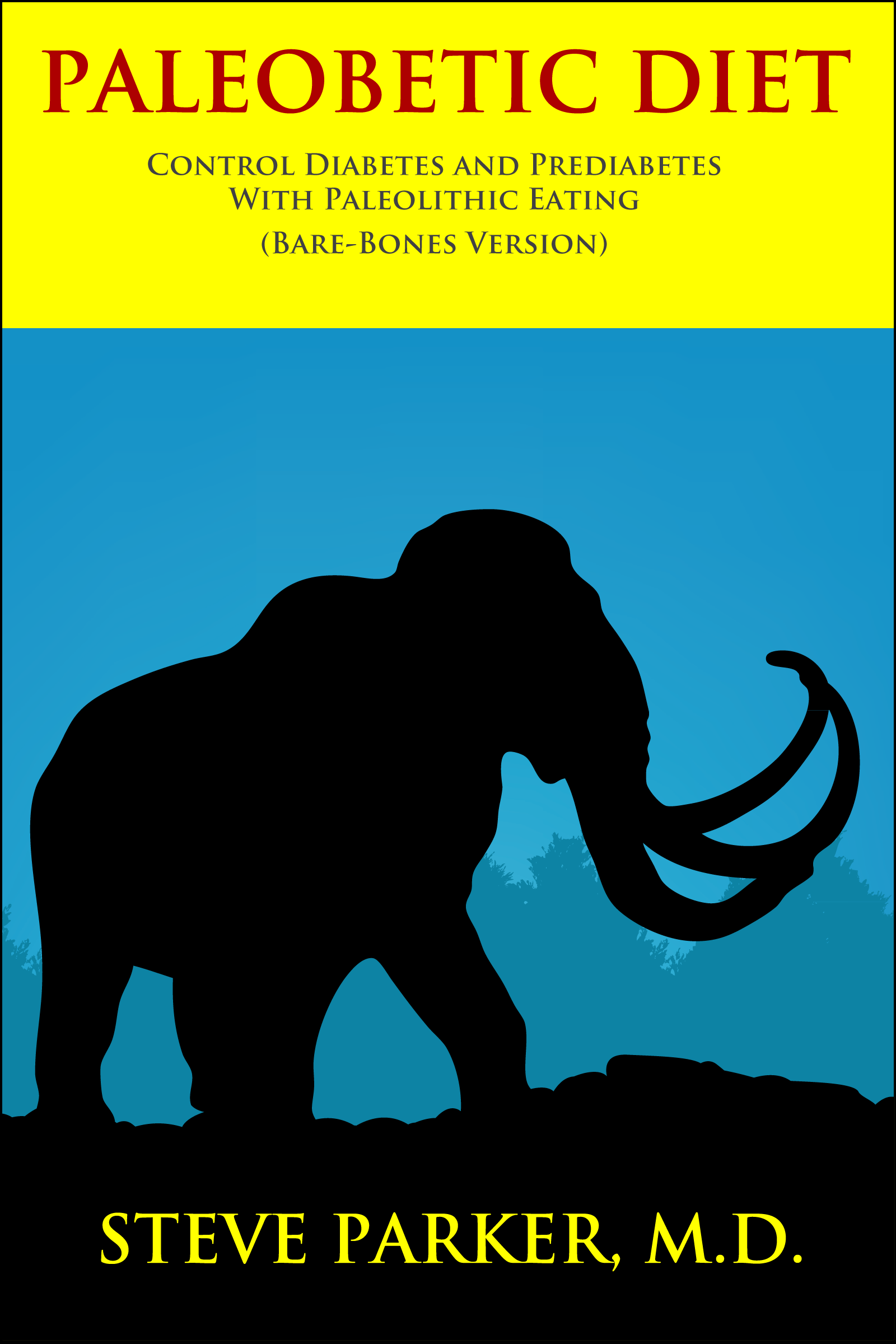
Paleo Diet + Diabetes = Paleobetic Diet

Paleobetic Diet, Steve Parker MD, paleo diet, Paleolithic diet, diabetes, diabetic diet

E-book cover

Almost two years ago, a few patients asked me if the up-and-coming paleo diet might help with diabetes management. I had no idea. I’ve been studying the issue since then and have concluded that it may be healthful. Perhaps you’ve been following my intellectual journey at the Paleo Diabetic blog.

At this point there are many versions of the paleo diet out there. They vary widely in terms of carbohydrate content, which could be a major problem if you have diabetes. On the plus side, most paleo diets favor low-glycemic-index carbohydrates instead of high-GI. That would tend to smooth out blood sugar spikes. As far as I know, none of the published programs are designed specifically for people with diabetes. Until now.

I’m prepared when my next patient asks me about a paleo diabetic diet. I’ll refer him to the Paleobetic Diet.

Steve Parker, M.D.

Comments Off on Paleo Diet + Diabetes = Paleobetic Diet

Filed under Uncategorized