Category Archives: Carbohydrate

What’s Our Preferred Fuel?

Dr. Jay Wortman has been thinking about whether our bodies prefer to run on carbohydrates (as a source of glucose) or, instead, on fats.  The standard American diet provides derives about half of its energy from carbs, 35% from fats, and 15% from proteins.  So you might guess our bodies prefer carbohydrates as a fuel source.  Dr. Wortman writes:

Now, consider the possibility that we weren’t meant to burn glucose at all as a primary fuel. Consider the possibility that fat was meant to be our primary fuel. In my current state of dietary practice, I am burning fat as my main source of energy. My liver is converting some of it to ketones which are needed to fuel the majority of my brain cells. A small fraction of the brain cells, around 15%, need glucose along with a few other tissues like the renal cortex, the lens of the eye, red blood cells and sperm.Their needs are met by glucose that my liver produces from proteins. The rest of my energy needs are met with fatty acids and these come from the fats I eat.

Dr. Wortman, who has type 2 diabetes,  in the same long post also writes about oolichan grease (from fish), an ancestral food of Canandian west coast First Nations people. 

Steve Parker, M.D.

4 Comments

Filed under Carbohydrate, Fat in Diet, Fish

173 Years of US Sugar Consumption

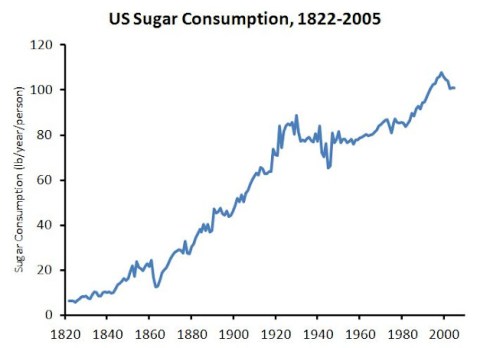
US Sugar Consumption: 1822-2005

 Thanks to Dr. Stephan Guyenet and Jeremy Landen for this sugar consumption graph.  I’d never seen one going this far back in time. 
 
Dr. Guyenet writes:
It’s a remarkably straight line, increasing steadily from 6.3 pounds per person per year in 1822 to a maximum of 107.7 lb/person/year in 1999.  Wrap your brain around this: in 1822, we ate the amount of added sugar in one 12 ounce can of soda every five days, while today we eat that much sugar every seven hours.
The U.S. Department of Agriculture estimates that added sugars provide 17% of the total calories in the average American diet.  A typical carbonated soda contain the equivalent of 10 tsp (50 ml) of sugar.  The average U.S. adult eats 30 tsp  (150 ml) daily of added sweeteners and sugars.
 
Note that added sugars overwhelmingly supply only one nutrient: pure carbohdyrate without vitamins, minerals, protein, fat, antioxidants, etc.
 
Do you think sugar consumption has anything to do with diseases of affluence, also known as diseases of modern civilization?  I do.
 
Was our pancreas designed to handle this much sugar?  Apparently not, judging from skyrocketing rates of diabetes and prediabetes.


4 Comments

Filed under Carbohydrate, Causes of Diabetes, Sugar

Food Reward versus Carbohydrate/Insulin Theory of Obesity


God, help us figure this out

A few months ago, several of the bloggers/writers I follow were involved in an online debate about two competing theories that attempt to explain the current epidemic of overweight and obesity.  The theories:

  1. Carboydrate/Insulin (as argued by Gary Taubes)
  2. Food Reward (as argued by Stephan Guyenet)

The whole dustup was about as interesting to me as debating how may angels can dance on the head of pin.

Regular readers here know I’m an advocate of the Carboydrate/Insulin theory.  I cite it in Conquer Diabetes and Prediabetes: The Low-Carb Mediterranean Diet and The Advanced Mediterranean Diet: Lose Weight, Feel Better, Live Longer (2nd edition).  But the Food Reward theory also has validity.  They’re both right, to an extent.  They’re not mutually exclusive.  The Food Reward theory isn’t as well publiziced as Carbohydrate/Insulin.

Dr. Guyenet lays out a masterful defense of the Food Reward theory at his blog.  Mr. Taubes presents his side here, here, here, here, and here.  If you have a couple hours to wade through this, I’d start with Taubes’ posts in the order I list them.  Finish with Guyenet. 

You’d think I’d be more interested in this.  I’m still not.

Moving from theory to real world practicality, I do see that limiting consumption of concentrated refined sugars and starches helps with loss of excess body fat and prevention of weight regain.  Not for everbody, but many.  Whether that’s mediated through lower insulin action or through lower food reward, I don’t care so much. 

Any thoughts?

Steve Parker, M.D.

h/t Dr. Emily Deans


5 Comments

Filed under Carbohydrate, Overweight and Obesity

Gluten-Free, Wheat-Free, Sugar-Free: “Low-Carbing Among Friends”

Low Carbing Among Friends: Low-carb and Gluten-free V1 (Low Carbing Among Friends, Volume-1)I’m very excited about a brand new cookbook for folks limiting their consumption of carbohydrates, wheat, and gluten.  It’s a unique collaboration among five chefs (Jennifer Eloff, Maria Emmerrich, Carolyn Ketchum, Lisa Marshall, and Kent Altena) and other low-carb luminaries like Jimmy Moore and Dana Carpender.  I was honored to contribute a couple pages myself.  The book is Low-Carbing Among Friends, volume 1.

All 325 recipes limit digestible carbohydrates to a maximum of 10 grams; many have five or fewer grams.  This should be great for people with diabetes and anyone trying to manage excess weight with low-carb eating.  All recipes are gluten-free, wheat-free, and sugar-free.

I can’t wait for my copy.  I’m “online friends” with several of the contributors, so I’m familiar with the great quality of their work.  You can get the book at Amazon.com, but I ordered mine from the book’s website, figuring the authors make more profit there.  (If we want good books, we have to support authors.)  It’s not too late to order this as a Christmas present.  Don’t you know someone who could use it?  

Steve Parker, M.D.


2 Comments

Filed under Book Reviews, Carbohydrate

Severe Carb Restriction in Type 2 Diabetes

U.K. researchers found major metabolic improvements in obese type 2 diabetics following a very low-carbohydrate diet, compared to a low-fat portion-controlled diet.  The latter is a standard recommendation in the U.S. for overweight type 2 diabetics.
 
This study is an oldie (2005) but a goodie.
 
Methodology
 
The investigators randomly assigned 102 poorly controlled diabetics to follow one of the two diets for three months.  Participants had average weights of 224 pounds (102 kg),  body mass index 36, age 58, hemoglobin A1c’s of 9%.  Half of them were men.  About 40% of the diabetics in both groups were on unspecified oral diabetic drugs; 20% were on insulin and 40% were using a combination of the two.  Sulfonylurea was mentioned, but not metformin. 
 
Participants were randomly assigned to either a low-fat portion-controlled weight-loss diet or a low-carbohydrate diet.  The goal with the low-carb diet was “up to 70 g of carbohydrate per day,” including at least a half a pint of milk and one piece of fruit.  (Is a UK pint the same as in the US?).  Increased physical activity was recommended to both groups. 
 
Only 79 of the 102 participants made it through the three-month diet intervention.  Drop-out rate was the same for both groups.
 
What Did They Find?
 
(Differences are statistically significant unless otherwise noted.)
Weight loss for the low-carb group was 3.55 kg (7.8 lb) compared to only 0.92 kg (2 lb) for the low-fat cohort.
 
The total/HDL cholesterol ratio improved for the low-carb group (absolute decrease of 0.48 versus 0.10). 
 
Hemoglobin A1c and systolic blood pressure tended to decrease more for the low-carb group, but did not reach statistical significance.  For instance, HgbA1c dropped 0.55% (in absolute terms) for the low-carb group, and 0.23% for the low-fat group.  Lower HgbA1c indicates improved blood sugar control.
 
Caloric intake was not different between the groups (about 1350 cals/day by diet recall method).
 
The low-carb group reduced carbs to 109 g/day compared to 168 g in the  low-fat cohort.
 
The low-carb group consumed 33% of energy as carbs compared to 45% for the low-fat group.
 
The low-carb group consumed 40% of energy as fat compared to 33% in the low-fat cohort.
 
Protein intake was 26% of energy for the low-carbers compared to 21% for the low-fatters.
 
Absolute saturated fatty acid intake was higher for the low-carbers, but still considered moderate.
 
Insulin dose was reduced in about 85% of the insulin users in the low-carb group but in only 22% of the low-fat group.  Oral diabetic pill use was unchanged in both groups.
 
Comments
 
This is a classic research report that I cited in Conquer Diabetes and Prediabetes: The Low-Carb Mediterranean Diet.
 
The improved total/HDL cholesterol ratio in the low-carbers may reduce risk of heart and vascular disease.  These investigators didn’t look at LDL particle size.  Other studies have found that low-carb eating tends to shift LDL cholesterol (bad stuff) from small dense particles to light fluffy particles, which are thought to be less harmful to arteries.
 
The authors considered reduction of carbs to 109 grams a day to be “severe.”  That compares to 275 grams a day eating by the typical U.S. citizen.  I agree that a reduction of carbs by two-thirds is major restriction.  Dr. Richard Bernstein and I consider severe restriction to be 20–30 grams, or perhaps up to 50 g.
 
I suspect the improved metabolic numbers in the low-carbers would have been even more dramatic if they had reduced carbs well below 100 grams a day.  The Ketogenic Mediterranean Diet reduces digestible carbs to 20–30 grams daily.  Many diabetics start losing control of their blood sugars when daily carbs exceed 60–80 grams.
 
Low-carb diets often yield better weight loss than low-fat calorie-restricted diets, as was seen here.  This is often attributed to lower calorie consumption on the low-carb diets.  These investigators didn’t see that here.
 
Low-carb diets are often criticized as being hard to stick with.  The low-carbers here didn’t have any more drop-outs than the low-fat group.  Granted, it was only a three-month study.
 
Based on what we know today, the reduced need for insulin in these patients was entirely predictable. 
 
The authors had some concern about the higher relative saturated fatty acid consumption in the low-carbers.  In 2011, we know that’s not much, if any, cause for concern.


Reference: Daly, M.E., et al.  Short-term effects of severe dietary carbohydrate-restriction advice in Type 2 diabetes—a randomized controlled trialDiabetic Medicine, 23 (2006): 15-20.  doi: 10.1111/j.1464-5491.2005.01760.x

Comments Off on Severe Carb Restriction in Type 2 Diabetes

Filed under Carbohydrate, Weight Loss

Dr. Andreas Eenfeldt Explains LCHF Diet

LCHF Cheese

Dr. Eenfeldt of DietDoctor.com gave a talk at the recent Ancestral Health Symposium in California, on the rationale of the current low-carb, high-fat diet (LCHF) so popular in his home country of Sweden.  It’s very understandable to the general public and is a good introduction to low-carb eating.  The entire YouTube video is 55 minutes; if you’re pressed for time, skip the 10-minute Q&A at the end.

He also discusses the benefits of LCHF eating for his patients with diabetes.

If you reduce carbohydrate, you’re going to replace it with either protein, fat, or both.  As Dr. Eenfeldt recommends, the Ketogenic Mediterranean and Low-Carb Mediterranean Diets replace carbs more with fats than protein.

Steve Parker, M.D.

Comments Off on Dr. Andreas Eenfeldt Explains LCHF Diet

Filed under Carbohydrate, Fat in Diet

Low-Carb Diet Reduces Weight AND Increases Adiponectin

Compared to a low-fat diet, a very-low-carb diet yielded better fat loss and improved adiponectin levels, according to researchers at the University of Cincinnati.  Read on to find out why this matters.

Adiponectin is a hormone-like protein secreted by fat cells. But the fatter you are, the less adiponectin you have in your bloodstream.  This hormone has several effects:

    • it’s anti-inflammatory
    • high levels of one form of it (a high molecular weight oligomer) are linked to lower rates of diabetes
    • low circulating levels are associatedwith athersclerosis (hardening of the arteries), high blood pressure, and impaired function of cells lining our arteries
    • it sensitizes the liver and muscles to insulin, which helps keep blood sugars under control

    In summary, it’s a good thing to have around.  Low levels are linked to illnesses.  Overweight and obesity tend to lower your levels of adiponectin.  If you’re overweight and have low levels of adiponectin, you should be healthier if you can raise your levels.  How do you do that?  Lose weight.

U. of Cincinnati investigators wanted to know if a very-low-carb diet would increase adiponectin levels better than a common low-fat weight loss diet.  They randomized 81 obese women to follow either a low-fat diet (American Heart Association Step 1) or a very-low-carbohydrate diet based on the Atkins diet.  Women followed the diets for either four or six months.

Findings

Both groups lost weight, but the very-low-carb group lost more: 9.1 kg loss for very-low-carb vs 4.97  for the low-fat group.

The very-low-carb group lost more body fat: 5.45 kg vs 2.62 kg.  (Fat loss was determined by DEXA scan.)

Adiponectin increased in the VLC group but not the LF group.

Discussion

We can’t tell from this article if adiponectin results would be the same in men.  The authors didn’t mention.

ResearchBlogging.orgIn fairness, the authors cite another similar study that found equal degrees of weight loss and adiponectin increase in both low-fat and low-carb groups.  It was a year-long intervention and average weight loss was 13.5% for both groups, a greater degree of weight loss than in the study at hand, in which the very-low-carb group lost 10% of body weight and the low-fat group lost 5.4%.  So you can probably increase your leptin with a low-fat diet if you lose enough excess weight.

Would the Ketogenic Mediterranean Diet work just as well as the very-low carb diet used in this study?  I suspect so, but don’t have the $500,000 it would take to do the research.  Care to donate?

Steve Parker, M.D.

Reference:
Summer, S., Brehm, B., Benoit, S., & D’Alessio, D. (2011). Adiponectin Changes in Relation to the Macronutrient Composition of a Weight-Loss Diet Obesity DOI: 10.1038/oby.2011.60

8 Comments

Filed under Carbohydrate, Overweight and Obesity, Weight Regain

Book Review: The Art and Science of Low Carbohydrate Living

I just finished reading The Art and Science of Low Carbohydrate Living: An Expert Guide to Making the Life-Saving Benefits of Carbohydrate Restriction Sustainable and Enjoyable, by Stephen Phinney, M.D., Ph.D., and Jeff Volek, Ph.D. published this year.  I give it four stars per Amazon.com’s rating system ( I like it).

♦    ♦    ♦

The authors medicalize overweight and obesity by naming the cause of most cases to be “carbohydrate intolerance,” along the lines of lactose intolerance and gluten intolerance.  Given the myriad illnesses and shortened lifespan associated with obesity, medicalizing it isreasonable.  Ask Gary Taubes why we get fat, and he’ll say it’s excessive consumption of carbohydrates, especially sugars and refined flours.  Ask Phinney and Volek, and they’ll say “carbohdyrate intolerance.”  For them, the “treatment” is avoidance of carbs.

If a patient asks me why he’s fat, I guess I’d prefer to say “you have carbohydrate intolerance,” rather than “you eat too many carbs.”  It’s less confrontational and doesn’t blame the patient.

So how many of us in the U.S. have carbohydrate intolerance?  The authors estimate a hundred million or more – about a third of the total poplulation, or more, who could directly benefit from carbohydrate restriction.  I agree.

Before reading this book, I was convinced that carbohydrates are indeed major contributors to overweight and obesity, especially concentrated sugars and refined grains.  The authors cite much of the pertinent scientific/medical literature. 

Gary Taubes made the same case in his brilliant book, Good Calories, Bad Calories.  Dr. Robert Atkins argued the same in Dr. Atkins New Diet Revolution.  The problem is that many healthcare providers such as physicians and dietitians are biased against those sources.  Physicians resist a non-physician such as Taubes giving them advice about the practice of medicine.  And most physicians over 45 still labor under the misconception that dietary cholesterol and total and saturated fat are major-league killers, so they’ve already dismissed Dr. Atkins and don’t have time to get caught up to date on the recent research.

Phinney and Volek have wisely targeted this work towards healthcare providers such as physicians, so it’s somewhat technical and clinical.  Both have Ph.D.s and Phinney is also an M.D.  The authors are respected researchers who thoroughly review the science behind low-carb eating.  They explain how high blood pressure, metabolic syndrome, type 2 diabetes, and other conditions are related to carb consumption.

I rate the book four stars instead of five only because it’s a little pricey at $29 (US).

Smart nutrition- and fitness-minded folks will also benefit from a reading.  For a more consumer-oriented book, I recommend the authors’ The New Atkins for a New You or Taubes’ Why We Get Fat.

Steve Parker, M.D.

8 Comments

Filed under Book Reviews, Carbohydrate

ADA Weight-Loss Guidelines for 2011

Earlier this month the American Diabetes Association published its Standards of Care in Diabetes—2011

The ADA recommends weight loss for all overweight diabetics.

For weight loss, either low-carbohydrate [under 130 g/day], low-fat calorie-restricted, or Mediterranean diets may be effective in the short-term (up to two years).  For those on low-carb diets, monitor lipids, kidney function, and protein consumption, and adjust diabetic drugs as needed…The optimal macronutrient composition of weight loss diets has not been established. [Macronutients are carbohydrates, proteins, and fats.]

Until three years ago, the ADA recommended against carbohydrate-restricted diets for overweight diabetics.  In January, 2008, their position statement noted that such diets may be effective for up to one year.  My recollection is that their 2010 guidelines also said “up to one year” and didn’t mention the  Mediterranean diet. 

Progress!

Looks like the timing of my Low-Carb Mediterranean Diet is good.

Steve Parker, M.D.

4 Comments

Filed under Carbohydrate, Mediterranean Diet, Weight Loss

Low-Carb Diets Killing People?

Animal-based low-carb diets are linked to higher death rates, according to a recent study in the Annals of Internal Medicine.  On the other hand, a vegetable-based low-carb diet was associated with a lower mortality rate, especially from cardiovascular disease.

As always, “association is not causation.”

It’s just a matter of time before someone asks me, “Haven’t you heard that low-carb diets cause premature death?”  So I figured I’d better take a close look at the new research by Fung and associates.

It’s pretty weak and unconvincing.  I have little to add to the cautious editorial by William Yancy, Matthew Maciejewski, and Kevin Schulman published in the same issue of Annals.

The study at hand was observational over many years, using data from the massive Nurses’ Health Study and Health Professionals’ Follow-up Study.  To find the putative differences in mortality, the researchers had to compare the participants eating the most extreme diets.  The 80% of study participants eating in between the extremes  were neutral in terms of death rates.

They report that “…the overall low-carbohydrate diet score was only weakly associated with all-cause mortality.”  Furthermore,

These results suggest that the health effects of a low-carbohydrate diet may depend on the type of protein and fat, and a diet that includes mostly vegetable sources of protein and fat is preferable to a diet with mostly animal sources of protein and fat.

In case you’re wondering, all these low-carb diets derived between 35 and 42% of energy (total calories) from carbohydrate, with an average of 37%.  Anecdotally, many committed low-carbers chronically derive 20% of calories form carbohydrate (100 g of carb out of 2,000 calories/day).  The average American eats 250 g of carb daily, 50-60% of total calories.

Yancy et al point out that “Fung and coworkers did not show a clear dose-response relationship in that there was not a clear progression of risk moving up or down the diet deciles.”  If animal proteins and fats are lethal, you’d expect to see some dose-response relationship, with more deaths as animal consumption gradually increases over the deciles.

ResearchBlogging.orgThe Fung study is suggestive but certainly not definitive.  Anyone predisposed to dietarycaution who wants to eat lower-carb might benefit from eating fewer animal sources of protein and fat, and more vegetable sources.  Fung leaves it entirely up to you to figure out how to do that. Compared to an animal-based low-carb diet, the healthier low-carb diet must subsitute more low-carb vegetables and higher-fat plants like nuts, seeds, seed oils and olive oil, and avocadoes, for example.  What are higher-protein plants?  Legumes?

You can see how much protein and fat are in your favorite vegetables at the USDA Nutrient Database.

The gist of Fung’s study dovetails with the health benefits linked to low-meat diets such as traditional Mediterranean and DASH.  On the other hand, if an animal-based low-carb diet helps keep a bad excess weight problem under control, it too may by healthier than the standard American diet.

See the Yancy editorial for a much more detailed and cogent analysis.  As is so often the case, “additional studies are needed.”

Steve Parker, M.D.

Reference: Fung TT, van Dam RM, Hankinson SE, Stampfer M, Willett WC, & Hu FB (2010). Low-carbohydrate diets and all-cause and cause-specific mortality: two cohort studies. Annals of internal medicine, 153 (5), 289-98 PMID: 20820038


1 Comment

Filed under Carbohydrate, coronary heart disease, Vegetables