Will Doctors and Nurses Show Up for Work When Ebola Hits the U.S. Again?

Hazmat-suited healthcare worker in a decontamination shower. What happens to the run-off water or bleach or whatever?

Don’t count on nurse Aesop. I’m sure he’s not alone. Few healthcare providers got into the business to put their lives on the line every day. The Ebola virus is highly contagious and often lethal. Prevention of the spread of Ebola to healthcare providers and the general population requires high-level isolation units. Aesop says there are only 15 such beds in the U.S. (He calls them BL-IV beds). There are zero at most hospitals and zero in most cities.

What follows are Aesop’s words:

We aren’t set up for this [virus], and we’re doing nothing to stop it getting here (rather the opposite in fact).

And when it does, after those first 15 beds are occupied, we’ve done nothing anywhere close to adequate to handle things properly and nip it in the bud.

But everyone in charge pretends we’ve done exactly that, when nothing could be further from the truth.

Maybe you can bullshit the Low Information Viewers in flyover country, but you can’t bullshit me or countless other doctors, nurses, and ancillary staff who’ll be on the frontlines (for about 20 seconds, in my case) before we drop our clipboards where we’re standing, and head for the parking lot.

I may make a bullshit excuse about not feeling well, I may pass off report on my patients to someone else who stays, but go I will, and I mean within minutes.

I can’t collect paychecks at Forest Lawn [cemetery], and I won’t be helping anyone shitting my intestines into my scrub pants, and both of those are slam-dunk outcomes with the present (and perpetual) half-assed level of preparedness for Ebola or any one of 27 other pandemic-worthy infections at every hospital (but for a small part of a bare few) from Anchorage to Miami, and Maine to Hawaii.

Anyone wants to go to medical or nursing school, and go work on the frontlines of Ebola with WHO or the CDC, rolling the dice you’ll live to retirement every time you scrub in or out, operators are standing by. (When every hospital has an actual 24/7 BL-IV capability, and staffs and supplies and trains for its use regularly – by which I mean more than once a year or three to salve their own charred consciences and pen-whip JCAHO’s lackadaisical clipboard commandos – we can talk. Otherwise: F**K that noise. Sideways, with a rusty chainsaw.)

In such an epidemic, there is no such thing as a valiant death.There’s just death.

I’ll do my damnedest to save your life if you come into my ER.

But I won’t kill myself to do it, and I won’t die for you because TPTB [the powers that be] at every level are too half-assed and cheapskate to prepare for this as if it was Really A Thing, too stupid to know that, and too evil to care. That ain’t in my contract, and unlike joining the Marines, I took no such oath, and it isn’t part of the deal.

I don’t know how many out of 4,000,000 medical practitioners will be that honest and tell you that up front.

I just did.

Source: Raconteur Report: Where The Problem Is

Have a great day! 🙂

Steve Parker, M.D.

low-carb mediterranean diet

Click the pic to purchase at Amazon.com

1 Comment

Filed under healthcare reform

Often Imitated But Never Duplicated: My Ketogenic Mediterranean Diet

I don’t know Dodie’s Doodles but she reviewed a competitor to my KMD: Ketogenic Mediterranean Diet at Amazon.com on May 30, 2018. She gave it two stars out of five. Here’s her review in toto:

This book, by Robert Santos-Prowse, a dietician, is not what you want. It’s a little over 180 pages, and the first 50 PAGES are how your digestive system works. Seriously, from the fact that your teeth chew your food all the way down your intestine, as if that’s why you bought the book. Yawn. No offense, but stick with the original by Dr. Steve Parker, who also has an acclaimed cookbook, and I recommend that. He’s the one you want and he has an author’s page here on Amazon.

The book Dodie reviewed is The Ketogenic Mediterranean Diet: A Low-Carb Approach to the Fresh-and-Delicious, Heart-Smart Healthy Lifestyle.

For a free taste of my Ketogenic Mediterranean Diet, click here. If you have my Conquer Diabetes and Prediabetes book, you already have the KMD and much much more.

Steve Parker, M.D.

low-carb mediterranean diet

Click the pics to purchase at Amazon.com in the U.S.

Probably under $13 at Amazon.com in the U.S.

1 Comment

Filed under ketogenic diet

Prevent Macular Degeneration With Mediterranean Diet

Photo of the retina at the back of the eyeball

I thought we knew this already. Yet another reason to love the Mediterranean diet. Macular degeneration is a leading cause of blindness in the developed world. Prevention is much better than treatment.

High adherence to a Mediterranean diet and regular physical activity seem to be protective factors for AMD in a Portuguese population. The effect of the diet is likely driven by the increased consumption of vegetables, fruits, and nuts.

Source: Adherence to a Mediterranean diet and its association with age-related macular degeneration. The Coimbra Eye Study–Report 4 – Nutrition

Hmmm…No mention of heart-healthy whole grains.

Steve Parker, M.D.

low-carb mediterranean diet

Click the pic to purchase at Amazon.com

3 Comments

Filed under Health Benefits, Mediterranean Diet

Does High Protein Diet Help With Weight Loss?

Sous vide chicken and sautéed sugar snap peas. Chicken is a good source of high biologic value protein.

P.D. Mangan makes the case for high-protein diets for those hoping to shed pounds of fat:

In humans, data collected from 38 different trials of food consumption that used widely varying intakes of protein, from 8 to 54% of energy, showed: “Percent dietary protein was negatively associated with total energy intake (F = 6.9, P < 0.0001) irrespective of whether carbohydrate (F = 0, P = 0.7) or fat (F = 0, P = 0.5) were the diluents of protein. The analysis strongly supports a role for protein leverage in lean, overweight and obese humans.”

In obese humans, substitution of carbohydrate with protein leads to far greater weight loss, nearly twice as much.

In a human trial, decreasing the percentage of protein in food from 15% to 10% led to increased calorie intake of 12%. However, increasing the protein percentage from 15 to 25% did not affect calorie intake, which shows that humans may target a certain amount of protein, and eat no more or less when they get it.

There’s more at the link.

Source: Higher Protein for Greater Weight Loss – Rogue Health and Fitness

low-carb mediterranean diet

Click the pic to purchase at Amazon.com

2 Comments

Filed under Weight Loss

Dr Maria Muccioli: The Low-Carb Diabetes Revolution (Part I) – Type 1 Diabetes 

Published at Diabetes Daily:

Not long ago, low-carbohydrate diets were considered to be on the fringes of medically-recommended strategies for diabetes control. Long regarded as a “fad diet” and with the health effects often called into question, many patients were routinely discouraged from attempting such an approach. However, in recent years, as more and more research demonstrated the potential benefits of a low-carbohydrate approach for people with diabetes and prediabetes, we have seen a rapid change in the nutritional guidelines and the professional recommendations for patients.

At the 79th American Diabetes Association (ADA) Scientific Sessions, we saw a symposium addressing the changes in the nutrition consensus report for adults with diabetes. Notably, a one-size-fits-all approach is no longer recommended, with experts suggesting now that various eating strategies and macronutrient distributions can work well for patients from a nutritional and glycemic control perspective. Moreover, low-carbohydrate diets were explicitly addressed as a relevant and effective strategy, that is “garnering more attention and support”, as per Dr. William S. Yancy, MD, MHS, who chaired the symposium titled “Providing Options – Using a Low-Carbohydrate or Very Low-Carbohydrate Diet with Adults with Type 1 Diabetes, Type 2 Diabetes or Prediabetes”. In this series, we explore the research and surrounding conversations regarding low-carbohydrate approaches for these distinct patient subgroups.

RTWT!

Source: The Low-Carb Diabetes Revolution (Part I): Type 1 Diabetes (ADA 2019) – Diabetes Daily

low-carb mediterranean diet

Click the pic to purchase at Amazon.com in the U.S.

3 Comments

Filed under Carbohydrate, Fat in Diet

From Vox: Why Do Diets Fail…or Succeed?

Julia Belluz has interesting article at Vox regarding low-fat and low-carb diet success over the course of 12 months. Her focus is on a few individuals who participated and were outliers.

As I read this, I was reminded that successful long-term weight management starts and ends in the kitchen. It also took me back to 2009, when I determined that low-carb diets were just as legitimate as low-fat.

I don’t recall the author mentioning the typical pattern with 12-month weight loss studies: most folks lose significant weight in the first few months, then at six months they start gaining it back. Cuz they go back to their old eating habits. Sure, diets don’t work………..if you don’t follow them.

From Ms. Belluz:

As a longtime health reporter, I see new diet studies just about every week, and I’ve noticed a few patterns emerge from the data. In even the most rigorous scientific experiments, people tend to lose little weight on average. All diets, whether they’re low in fat or carbs, perform about equally miserably on average in the long term.

But there’s always quite a bit of variability among participants in these studies. Just check out this chart from a fascinating February study called DIETFITS, which was published in JAMA by researchers at Stanford.

The randomized controlled trial involved 609 participants who were assigned to follow either a low-carb or a low-fat diet, centered on fresh and high-quality foods, for one year. The study was rigorous; enrollees were educated about food and nutrition at 22 group sessions. They were also closely monitored by researchers, counselors, and dietitians, who checked their weight, waist circumference, blood pressure, cholesterol, and other metabolic measures throughout the year.

Overall, dieters in both groups lost a similar amount of weight on average — 11 pounds in the low-fat group, 13 pounds in the low-carb group — suggesting different diets perform comparably. But as you can see in the chart, hidden within the averages were strong variations in individual responses. Some people lost more than 60 pounds, and others gained more than 20 during the year.

Read the whole thing. It’s not long.

Source: Why do dieters succeed or fail? The answers have little to do with food. – Vox

The DIETFITS Trial

Steve Parker, M.D.

low-carb mediterranean diet

Click the pic to purchase at Amazon.com in the U.S.

3 Comments

Filed under Weight Loss, Weight Regain

Does the Mediterranean Diet Actually Prevent Chronic Diseases?


Told ya so!

A couple PhD nutritionists with the University of Arizona Cancer Center reviewed the literature for or against the healthfulness of the Mediterranean diet in 2017. They agree with me that the health claims hold up to scrutiny. From the abstract:

A large body of research data suggests that traditional dietary habits and lifestyle unique to the Mediterranean region (Mediterranean diet, MD) lower the incidence of chronic diseases and improve longevity. These data contrast with troubling statistics in the United States and other high income countries pointing to an increase in the incidence of chronic diseases and the projected explosion in cost of medical care associated with an aging population. In 2013, the MD was inscribed by UNESCO in the “Representative List of the Intangible Cultural Heritage of Humanity.” The 2015–2020 Dietary Guidelines for Americans included the MD as a healthy dietary pattern. Therefore, specific objectives of this article are to provide an overview of the nutritional basis of this healthful diet, its metabolic benefits, and its role in multiple aspects of disease prevention and healthy aging.

Source: Mediterranean Diet and Prevention of Chronic Diseases

Steve Parker, M.D.

Low-Carb Mediterranean Diet, front cover


3 Comments

Filed under Longevity

Mediterranean Diet Improves Brain Function in Type 2 Diabetes

I don’t know if the study at hand is valid or not. The abstract is poorly written. The study population was Boston Puerto Ricans only, so may not apply to other ethnic groups. I’m not paying $35 to get access to the full article. Diabetes Self-Management has coverage that will be more digestible than the abstract below.

OBJECTIVE To determine associations of a Mediterranean diet score (MeDS) with 2-year change in cognitive function by type 2 diabetes and glycemic control status and contrast it against other diet quality scores.

RESEARCH DESIGN AND METHODS We used data from the longitudinal Boston Puerto Rican Health Study (n = 913; 42.6% with type 2 diabetes at 2 years). Glycemic control at baseline was categorized as uncontrolled (hemoglobin A1c ≥7% [53 mmol/mol]) versus controlled. Two-year change in glycemic control was defined as stable/improved versus poor/declined. We defined MeDS, Healthy Eating Index, Alternate Healthy Eating Index, and Dietary Approaches to Stop Hypertension scores. Adjusted mixed linear models assessed 2-year change in global cognitive function z score, executive and memory function, and nine individual cognitive tests.

RESULTS Higher MeDS, but no other diet quality score, was associated with higher 2-year change in global cognitive function in adults with type 2 diabetes (β ± SE = 0.027 ± 0.011; P = 0.016) but not without (P = 0.80). Similar results were noted for Mini-Mental State Examination, word recognition, digit span, and clock drawing tests. Results remained consistent for individuals under glycemic control at baseline (0.062 ± 0.020; P = 0.004) and stable/improved over 2 years (0.053 ± 0.019; P = 0.007), but not for uncontrolled or poor/declined glycemic control. All diet quality scores were associated with higher 2-year memory function in adults without type 2 diabetes.

CONCLUSIONS Both adhering to a Mediterranean diet and effectively managing type 2 diabetes may support optimal cognitive function. Healthy diets, in general, can help improve memory function among adults without type 2 diabetes.

Source: The Mediterranean Diet and 2-Year Change in Cognitive Function by Status of Type 2 Diabetes and Glycemic Control | Diabetes Care

Steve Parker, M.D.

low-carb mediterranean diet

Click the pic to purchase at Amazon.com in the U.S.


1 Comment

Filed under Dementia

From 2003: Oral Magnesium Supplementation Improves Insulin Sensitivity and Metabolic Control in Type 2 Diabetes

Not the magnesium used in the study at hand

The study was done in northern Mexico and all participants were taking glibenclamide, a sulfonylurea known as glyburide in the U.S. Importantly, study participants had low blood magnesium levels at the outset.

So if you’re not a hypomagnesemic Mexican taking glibenclamide, results may not apply to you.

Nevertheless, results were impressive. Compared to the control group, magnesium supplementation…

  • reduced insulin resistance
  • fasting glucose was 144 mg/dl (185 in controls)
  • Hemoglobin A1c was 8% (10% in controls)

The experiment lasted 16 weeks and the specific form of magnesium used was magnesium chloride solution.

Maybe we should be checking magnesium levels more often. BTW, magnesium supplements are difficult for our bodies to absorb. I know of at least three magnesium compounds: oxide, citrate, and chloride. There are probably others. Degree of absorption varies from one to the other. Adding a supplement on top of kidney impairment could cause toxicity.

The researchers conclude:

Oral supplementation with MgCl2 solution restores serum magnesium levels, improving insulin sensitivity and metabolic control in type 2 diabetic patients with decreased serum magnesium levels.

Source: Oral Magnesium Supplementation Improves Insulin Sensitivity and Metabolic Control in Type 2 Diabetic Subjects | Diabetes Care

low-carb mediterranean diet

Click the pic to purchase at Amazon.com in the U.S.

2 Comments

Filed under Drugs for Diabetes

THIS May Be Why Americans Are Fat

Your average Americans

There’s no shortage of speculation as to why 70% of us in the U.S. are overweight or obese. A few possibilities include:

  • we’re too sedentary
  • we eat too many carbohydrates
  • we eat too much fat
  • our foods are over-processed
  • we eat away from home too often
  • we eat too many industrial seed oils
  • our water and food are contaminated with persistent organic pollutants that disrupt our endocrine systems

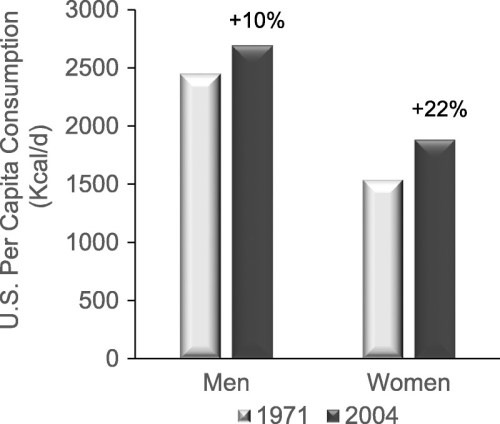
I was reading an article at Nutrition Today and came across this graph of calorie consumption change from 1971 to 2004 (or 2000?):

The verbal summary is from this article cited by the cited by the Nutrition Today authors: During 1971—2000, a statistically significant increase in average energy intake occurred. For men, average energy intake increased from 2,450 kcals to 2,618 kcals, and for women, from 1,542 kcals to 1,877 kcals. So men’s daily calorie intake went up by 168, and women’s by 335.

The original article I read states, alternatively, that men’s daily caloric consumption rose from 2450 to 2693, a gain of 243. I can’t explain the discrepancy between 243 and 168, nor why 2004 is in the graph instead of 2000.

Maybe you don’t think an extra 168 calories a day is much. If you believe in the validity of the Energy Balance Equation, those 168 daily calories will turn into  17.5 pounds of fat in a year unless you “burn them off” somehow. If you weigh 150 lb (68 kg), you can burn those 168 calories by doing a daily 15-minute jog at 5.5 mph (8.9 km/hr). But you ain’t gonna do that, are you?! (I’m not getting into a debate about validity of the equation now; for another perspective, read Lyle McDonald.)

But year 2000 was a long time ago. How much are Americans eating now? According to a 2016 report from Pew Research Center:

Broadly speaking, we eat a lot more than we used to: The average American consumed 2,481 calories a day in 2010, about 23% more than in 1970. That’s more than most adults need to maintain their current weight, according to the Mayo Clinic’s calorie calculator. (A 40-year-old man of average height and weight who’s moderately active, for instance, needs 2,400 calories; a 40-year-old woman with corresponding characteristics needs 1,850 calories.)

Bottom line? We’re eating more than we did in 1970. Which could explain why we’re fat. Unless we’re burning more calories than we did in 1970, which I doubt.

Steve Parker, M.D.

PS: In scientific literature, kcal is what everybody else calls a calorie.

Click pic to buy book at Amazon.com in the U.S.

3 Comments

Filed under Causes of Diabetes, Overweight and Obesity