
You may learn something from this video by a bike repair shop owner.
If he foregoes health insurance, I recommend a Health Savings Account.
Steve Parker, M.D.
PS: Most of my books will help you safely avoid the medical-industrial complex.

You may learn something from this video by a bike repair shop owner.
If he foregoes health insurance, I recommend a Health Savings Account.
Steve Parker, M.D.
PS: Most of my books will help you safely avoid the medical-industrial complex.
Filed under healthcare reform
How can you tell when a politician is lying?
And yet we think politicians can reform U.S. healthcare in a beneficial direction…
Steve Parker, M.D.
Comments Off on When His Lips Are Moving…
Filed under healthcare reform
Don’t watch the video if you’re not ready for a sad, sad, story about a cancer patient. Non-U.S. citizens may not understand this story.
Steve Parker, M.D.
PS: I can neither defend nor criticize the specific cancer treatment discussed in the video. I don’t know enough about the case and, compared with an oncologist, I know very little about cancer treatment.
Comments Off on This Is No Way to Treat People
Filed under healthcare reform
Dr Bernstein passed on to his reward last April. He was a major influence on my own approach to diabetes treatment. We see very few “great men” in our times: He was one.
Dr Bernstein practiced what he preached, which explains how he lived to the age of 90. That is exceedingly rare for a type 1 diabetic.
Thanks to Jan at The Low Carb Diabetic for bringing this to my attention. She published an account of what it was like to be one of Dr Bernstein’s patients.
Steve Parker, M.D.
Filed under Uncategorized

It was around 2009 when I was finally ready to abandon the time-honored diet-heart hypothesis. I remember wondering if I’d be excommunicated from the medical community, i.e., lose my medical license due to heresy. In a nutshell, the diet-heart hypothesis to which I refer was the idea that dietary saturated fat was the clear-cut cause of coronary artery disease and associated heart attacks, angina pectoris (reversible heart pains), and cardiac deaths. (Also strokes and peripheral arterial disease.)
My re-evaluation of the evidence lead me to create the world’s first ketogenic Mediterranean diet, which is included in the 2nd edition of my Advanced Mediterranean diet and Conquer Diabetes and Prediabetes. Search Amazon.com and you’ll find several other subsequent ketogenic Mediterranean diet books; I wonder if any of them cited my work.
Dr. Axel Sigurdsson recently wrote an updated history of the diet-heart hypothesis, focusing on the downfall of the hypothesis and the role of George Mann, whom I’d swear I never heard of. An excerpt:
Ancel Keys changed the world. He was right about many things—that lifestyle matters, that food affects disease, that public health can’t afford to wait forever. But in boiling heart disease down to a single nutrient, he oversimplified a complex truth. His hypothesis became policy before it was fully proven. And once policy hardens, it resists correction.
George Mann was no savior. His critiques were often bombastic, his tone combative. But beneath the fire was a warning science should have heeded: that premature consensus can blind, that evidence must lead—not politics, not personalities, not the noise of institutional momentum.
I recommend the entire article to you. I suspect AI (artificial intelligence) was utilized, mainly judging from the three pictures. Dr. Sigurdsson has been publishing some great articles recently, and I believe credited AI in some of them, which is OK by me.
Steve Parker, M.D.
Comments Off on A Modern History of the Diet-Heart Hypothesis
Filed under coronary heart disease, Heart Disease, Longevity, Stroke
Alleged attorney Jeff Childers reports an alleged link between the covid-19 vaccine(s) and neuropsychiatric disorders. The item starts a third of the way down the web page. I haven’t read the source article and probably won’t. You’ll see mention below of cerebral venous sinus thrombosis. One of the neurologists I work with has started ordering more brain scans looking for that. Coincidence?
All that follows is from Childers. To facilitate readability, I won’t put it in italics like I usually do quotations:
For years, scientists who questioned mRNA safety were told to put up or shut up (“publish or perish”). Well— now they’ve published. And I’ll give you one guess whether or not the conclusions support our long-standing concerns. Today, a new peer-reviewed study published in the International Journal of Innovative Research in Medical Science, blandly titled “View of Association Between COVID-19 Vaccination and Neuropsychiatric Conditions.”
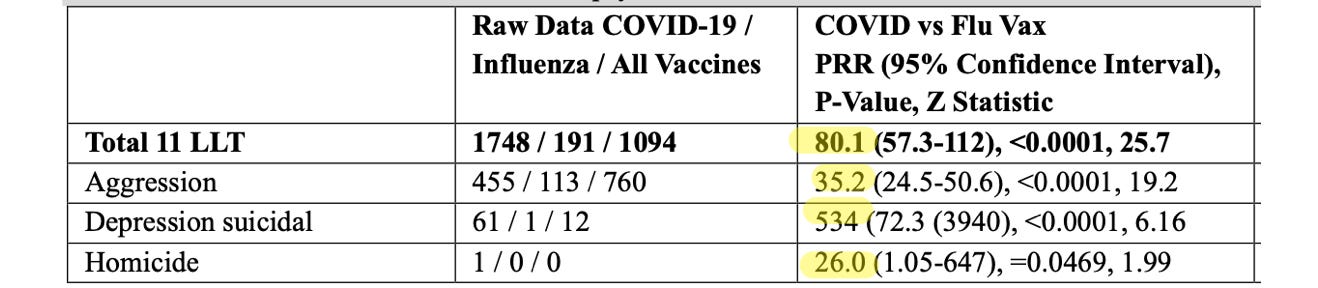
The results, however, were not bland.
In the just-published peer-reviewed study, researchers analyzed over three decades of vaccine injury reports in the U.S. government’s own VAERS database, comparing covid mRNA vaccines to both flu shots and all other vaccines (combined). Using the CDC’s and FDA’s own method for detecting safety problems —called “Proportional Reporting Ratios” or PRRs— they found that reports of serious neuropsychiatric issues like brain fog, psychosis, dementia, and even suicidal behavior were not just higher, but dozens to hundreds of times more frequent after the covid shots.
If you thought people were crazy to take the jab, you might have been onto something.
The safety signal thresholds weren’t just crossed; they were blown out of the water, with some categories showing PRRs over four hundred, far above the FDA’s red-flag threshold of two. The study concluded these signals were sufficiently alarming to warrant immediate attention and further investigation— an understatement as big as the Statue of Liberty.
Among the most alarming findings, the study flagged massive spikes in reports of serious brain-related problems after covid vaccination. Compared to flu shots, reports of brain fog were up over 100-fold, psychosis nearly 80 times higher, and Alzheimer’s-type dementia more than 40 times more frequent. Even more chilling, reports related to suicidal thoughts or behaviors, including suicide attempts and self-harm, showed increases as high as 80-fold. One rare but deadly condition —cerebral venous sinus thrombosis, a type of brain clot— was reported at rates over 400 times higher than with flu vaccines.
These numbers weren’t small deviations— they were sky-high red flags by the FDA’s own data and safety standards.
Steve Parker, M.D.
Comments Off on Shocking Study Reveals mRNA Vaccine Risks: Higher Rates of Brain Disorders
Filed under Coronavirus
When I was doing my Internal Medicine residency in 1981 to 1984, we held scientific medical journals in great esteem. The New England Journal of Medicine, for instance. It was published once weekly, about a hundred pages IIRC. At the end of the year, I sent my 52 copies off to a bindery to be glued into a hard-cover book format, to be cherished and consulted for years. That book was two or three inches thick. I did that for maybe five consecutive years; I’ve no idea where they are now. Probably in a landfill.
The told us on the first day of medical school, “Half of what we teach you will be obsolete in five years.” So continuing medical education is an imperative. One way to keep learning is to read medical journals.
You may be surprised to learn that I no longer read scientific medical journals very often. How do I keep my medical practices up to date? I work in the hospital side-by-side with surgeons and medical subspecialists (e.g., cardiologists, gastroenterologists). In general, I talk to them and watch what they do. If there is a ground-breaking new diagnostic tool or therapy, I’ll hear about it from them. They’re not in an ivory tower, isolated from patients. They’re in the trenches with me facing sick and hurting patients every day. I still read scientific medical journals, but take them with a nugget of salt.
I’m a science journal skeptic, questioning their reliability, objectivity, and relevance. But I’m not the only won. Check out the writings of Dr. Marcia Angell, former editor of New England Journal of Medicine, and Dr. John Ioannidis.
Seemay Chou had this to say about scientific journals:
I’m a scientist. Over the past five years, I’ve experimented with science outside traditional institutes. From this vantage point, one truth has become inescapable. The journal publishing system — the core of how science is currently shared, evaluated, and rewarded — is fundamentally broken.
Vox Day has excerpted a TLDR from Chou’s article:
It might seem like publishing is a detail. Something that happens at the end of the process, after the real work of science is done. But in truth, publishing defines science.
The currency of value in science has become journal articles. It’s how scientists share and evaluate their work. Funding and career advancement depend on it. This has added to science growing less rigorous, innovative, and impactful over time. This is not a side effect, a conspiracy, or a sudden crisis. It’s an insidious structural feature.
For non-scientists, here’s how journal-based publishing works:
After years of research, scientists submit a narrative of their results to a journal, chosen based on field relevance and prestige. Journals are ranked by “impact factor,” and publishing in high-impact journals can significantly boost careers, visibility, and funding prospects.
Journal submission timing is often dictated by when results yield a “publishable unit” — a well-known term for what meets a journal’s threshold for significance and coherence. Linear, progressive narratives are favored, even if that means reordering the actual chronology or omitting results that don’t fit. This isn’t fraud; it’s selective storytelling aimed at readability and clarity.
Once submitted, an editor either rejects the paper or sends it to a few anonymous peer reviewers — two or three scientists tasked with judging novelty, technical soundness, and importance. Not all reviews are high quality, and not all concerns are addressed before editorial acceptance. Reviews are usually kept private. Scientific disagreements — essential to progress — rarely play out in public view.
If rejected, the paper is re-submitted elsewhere. This loop generally takes 6–12 months or more. Journal submissions and associated data can circulate in private for over a year without contributing to public discussion. When articles are finally accepted for release, journals require an article processing fee that’s often even more expensive if the article is open access. These fees are typically paid for by taxpayer-funded grants or universities.
Several structural features make the system hard to reform:
Stack all this together, and the outcome is predictable: a system that delays and warps the scientific process. It was built about a century ago for a different era. As is often the case with legacy systems, each improvement only further entrenches a principally flawed framework.
Steve Parker, M.D.
Comments Off on Why I Rarely Read Medical Journals
Filed under healthcare reform
I’ll believe it when I see it.
Health insurance pre-authorization, for example, is when your eye specialist recommends removal of your cataracts so you can see again, but your insurance company wants some clerk or administrator to review everything and either agree or disagree with your physician. If disagree, no eye surgery for you. Unless you’re willing to pay entirely out-of-pocket. Mind you, the clerk does not have a medical degree and has never examined you or spoken to you. Isn’t this one of the reasons Luigi Mangione executed that healthcare executive?
From American Greatness:
Health and Human Services (HHS) Secretary Robert F. Kennedy Jr. joined other federal health officials on Monday to promote an initiative to end the practice of healthcare insurance pre-authorization.
Kennedy was joined by Centers for Medicare & Medicaid Services Administrator Mehmet Oz as part of a roundtable discussion with insurers to discuss pledges made by the health insurance industry to streamline and reform the prior authorization process for Medicare Advantage, Medicaid Managed Care and Affordable Care Act Health Insurance Marketplace plans which account for most insured Americans.
The HHS Secretary commented on how when he joined the presidential transition team, he was told that the single most important thing he could do to improve the experience of patients across the nation was to “end the scourge of pre-authorization.”
Of course, the unsurers will argue that pre-authorization is necessary because those greedy doctors are recommending that surgery, MRI scan, specialty consultation, or physical therapy merely out of greed.
Steve Parker, M.D.
Comments Off on Breaking News: Health Insurers Abandoning Pre-Authorization
Filed under healthcare reform
From Karl Denninger, an article titled Enough of this Nonsense:
I’m talking about the basic economic question: Supply, demand and what happens when you allow someone to force another person to pay your bill.
I keep hammering on this and will until people stop running tropes whether out of sincere (but false) belief or some other reason.
Let’s take Eliquis. Its a common medication and its expensive. Roughly 3.5 million Americans take this drug and it is one of the most-commonly prescribed for people who have atrial fibrillation. It appears to be reasonably effective in reducing the risk of strokes and heart attacks in people with that condition.
It is also about $8,000 a year in the United States without insurance and “insurance” forces those who do not have that condition to pay for those who do — including Medicare and Medicaid.
###
The common claim is that “if you cut that off those people will die” because they can’t possibly afford the price.
The claim is false.
In Germany the drug costs about $700 a year, so it is ten times as expensive in the United States.
Parker here. I know why Eliquis (apixaban) so much more expensive in the U.S. I wrote all about it in my latest book. Read Denninger for his opinion. (He’s smarter than me but was wrong about his predicted 2024 severe economic contraction. Making predictions is hard, especially when it’s about the future.)
Steve Parker, M.D.
Comments Off on Eliquis Is a Cash Cow, at Least in the U.S.
Filed under healthcare reform
Comments Off on What Happened to the Signers of the Declaration of Independence?
Filed under Uncategorized
Click the pic to purchase at Amazon.com. E-book versions also available at Smashwords.com.
 Bible Verse of the Day
 Diabetic Mediterranean Diet